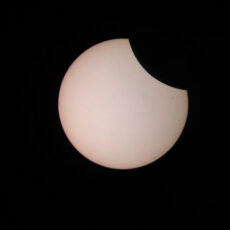
There’s a partial eclipse of the Sun from the UK on Saturday, 29 March 2025 – and it’s at a really convenient time of day, mid-morning, so if skies are clear it offers a great spectacle. The big question is how to view it safely – you shouldn’t use makeshift filters or sunglasses. Many of the suggestions, such as using a pinhole in a cereal packet, aren’t very useful. But we have some great alternatives.
All the planets are in a line in the sky – or so we are told. But what can you expect to see, and how can you find them? Here’s the Society for Popular Astronomy’s realistic and authoritative guide to the planetary parade, written by astronomers in the UK, not hacks!
All the bright planets (apart from Mercury) are in the evening sky during January and February 2025. They make a great sight to observe – but is there any significance to it? Is there any particular date when we should go out and look? Are they triggering off the northern lights? Here’s the answer according to astronomers.
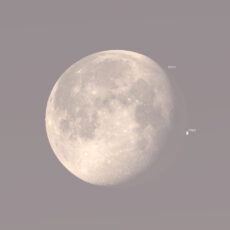
You might think that the Moon would pass in front of planets quite often, but in fact this is quite a rare event, and one which amateur astronomers are keen to watch and photograph. The disappearance of one astronomical body behind another is known as an occultation. Such an event occurs on Wednesday 18 December 2024, as seen from the UK and western Europe.
However, the occultation will take place during daylight in mid-morning, and will be quite low in the north-north west, so this will be a challenging observation. Normally, finding Mars in the daytime sky is extremely difficult. But to make things a bit easier, the nearby Moon will be just three days after full, so it will be quite bright and easier to spot.
Being daytime, Mars will be even harder to see against the bright sky, and it’s unlikely that just ordinary binoculars will show it. But at the moment Mars is close to Earth so it is brighter than usual, and if the sky is very clear it should be visible and photographable using a telescope with a magnification of 50 or more.
The exact timing of the event depends on where you are, but from the UK it begins between 09:15 and 09:30 GMT with Mars disappearing behind the bright limb of the Moon, taking about 15 seconds to do so. It emerges from the dark limb of the Moon some 50 minutes or so later.
Locating the Moon will itself be a challenge. Even typical GoTo telescopes will not be able to find it, as they need to be set up using stars. The easiest means will be to use a sky app on a device with accurate accelerometers that will indicate the correct part of the sky. As a guide, from central England the Moon will be at an azimuth of 290° (west-north-west) and an elevation of 12° at the start of the occultation.
Simulations of the location of Mars around the Moon as seen from the UK are shown below.
The appearance of Mars and the Moon as seen from central England at the start of the event. Mars will be near the prominent dark feature Grimaldi. Simulation from Stellarium software.
The reappearance as seen from the UK will be at the dark limb near Mare Crisium. Simulation from Stellarium software.
The brightest comet for several years is still shining in UK skies during October and November 2024 – bit it’s getting harder to see as it moves away from the Sun and becomes fainter. Here’s how to find it.
Comet 2023 A3 Tsuchinshan-ATLAS is becoming visible in the evening sky in the UK during October 2024. Following its closest approach to the Sun on 27 September the comet will fade as it climbs into the evening sky but should be visible with binoculars or photography if you know where to look. But where exactly should you look?
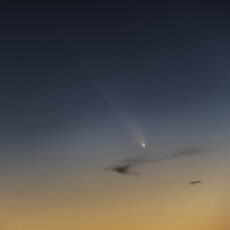
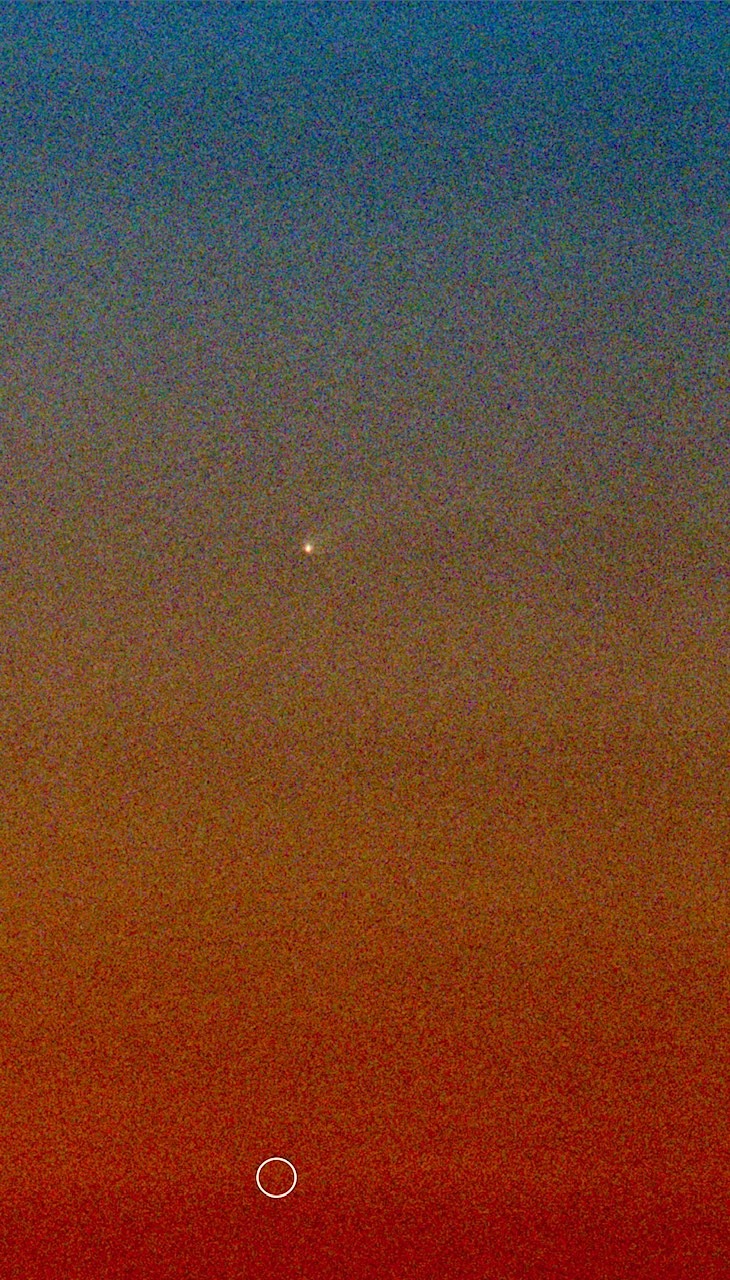
First sightings of the comet from the UK since perihelion the day before.
Comet C/2023 A3 Tsuchinshan-ATLAS peers above the distant tree tops in the murky haze of a Dorset morning.
Comet C/2023 A3 Tsuchinshan-ATLAS has been imaged on Fri 28 September by at least two observers in the UK, including me. This was effectively the first day that the comet was high enough to image and potentially observe and although neither observer was able to see it in binoculars or small telescopes. However, photography has been able to tease out the comet and some of its coma and tail from the murk low on eastern horizon.
With the comet only rising at 06:03 BST from my observing site at Knowlton in Dorset, it was always going to be an early start to the day. The sky had been inky black and crystal clear only an hour earlier, with good transparency all the way to the horizon. However, the breaking dawn revealed a band of murky haze through which the comet would rise in the east, shortly before the Sun itself made an appearance.
Taking my SeeStar S50 with me, I set it up, aligned and focussed it on nearby Regulus well before dawn. Then I waited with my Helios 10 x 70 binoculars to sight the comet as it appeared above the horizon. At the appointed time, the SeeStar duly swung to the comet, but plate-solving and 10-second imaging was clearly not going to be possible in a bright sky at such a low altitude.
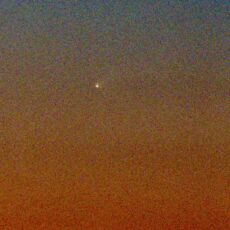
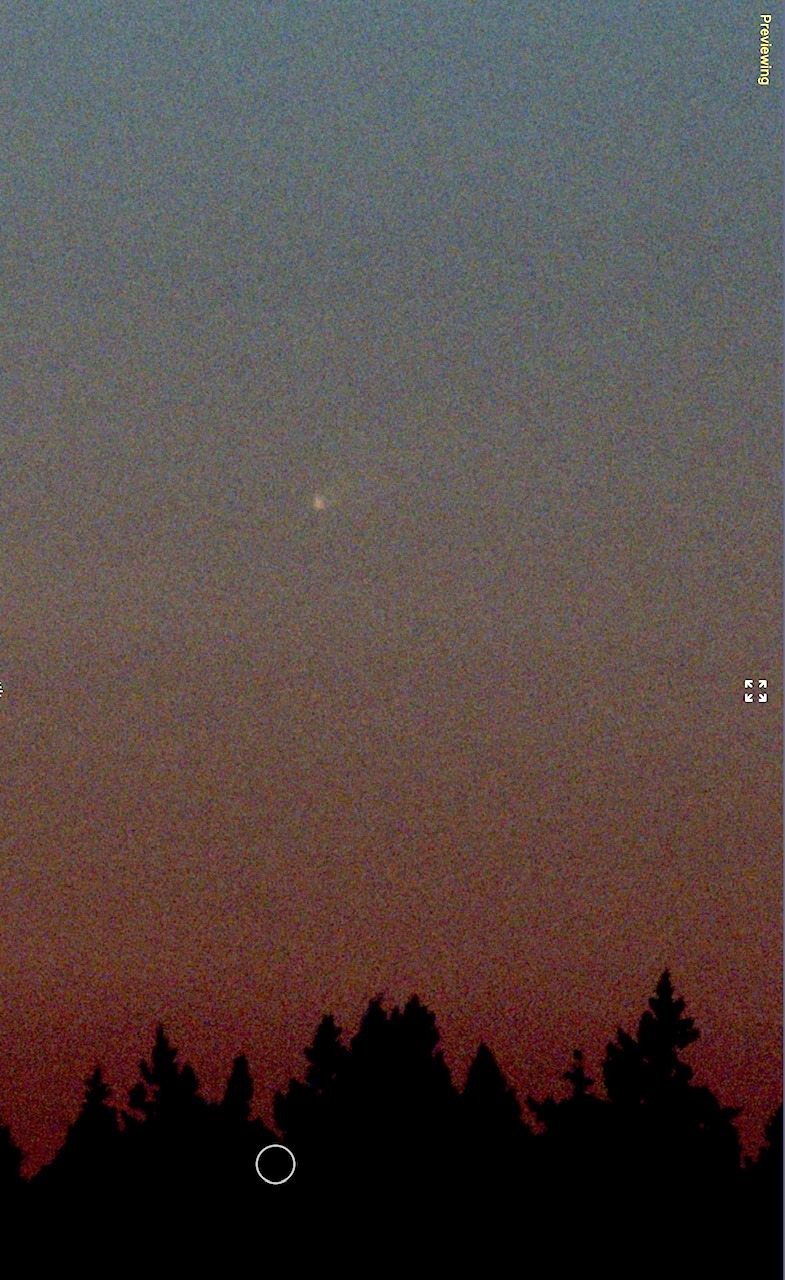
However, peering into my iPad, I was able to see the bright nucleus and a wisp of a tail on the preview screen. These images on this page are simply screenshots of what the SeeStar was seeing in real time. By 06:15 the sky was too bright and the comet quickly disappeared in daylight.
Despite very careful, slow sweeping along the horizon and despite knowing exactly where the comet was, I was unable to spot it with the binoculars. Perhaps the haze was just too much for my sleepy eyes.
The comet about eight minutes after it rose in the east.
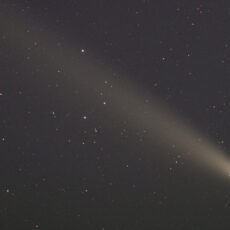
Processed at home later, the comet and its tail are clearly visible in these low resolution images. The white circles are SeeStar artefacts,
Were these the first images of C/2023 A3 Tsuchinshan-ATLAS taken in the UK since the summer? I’d like to think so.
I’d also like to think this is merely the prelude to the big show this comet will produce in the next two or three weeks. Good luck.
After months of speculation, comet C/2023 A3, Tsuchinshan/ATLAS, is about to pop up over the horizon as seen from the UK. Views from the southern hemisphere show that it is already sporting a short tail and is being seen in twilight. So what are the prospects for UK observers?
Saturn, the ringed planet, is returning to the evening sky, but its appearance will be very different from last year. Instead of its famous rings being prominent in a telescope, all that you will see for the next few months is a thin sliver to the left and right of the planet. Read more
On Wednesday 21 August, a rare event happens – the Moon passes in front of Saturn as seen from the UK, offering a unique chance to see two of the most spectacular objects in the Solar System in the same view. But observers will need to be particularly keen, because the event begins at about 4:30 am BST.