UPDATE: Comet C/2023 A3 Tsuchinshan-ATLAS imaged in Dorset

UPDATE: Comet C/2023 A3 Tsuchinshan-ATLAS imaged in Dorset

First sightings of the comet from the UK since perihelion the day before.
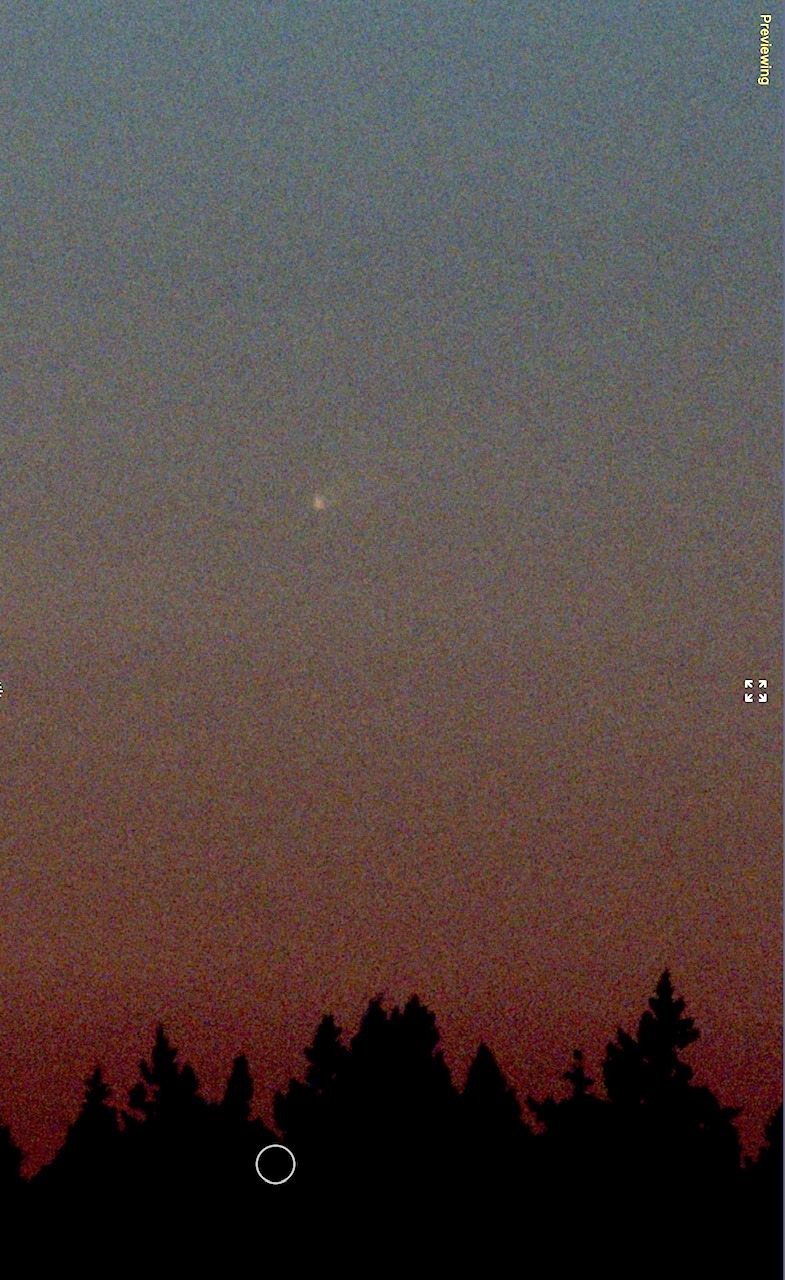
Comet C/2023 A3 Tsushinshan-ATLAS
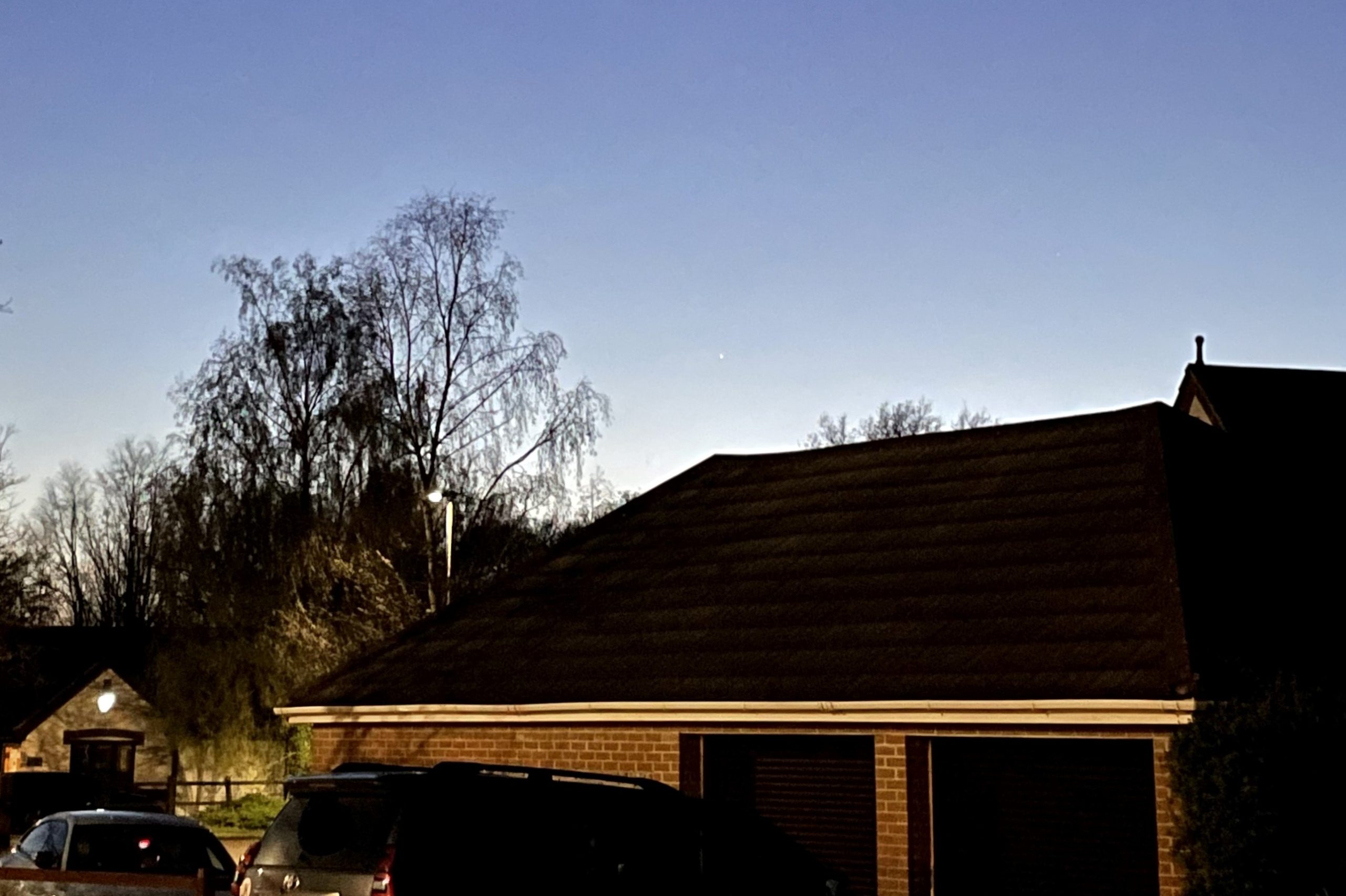
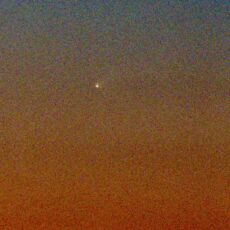
Comet C/2023 A3 Tsuchinshan-ATLAS peers above the distant tree tops in the murky haze of a Dorset morning.

Comet C/2023 A3 Tsuchinshan-ATLAS has been imaged on Fri 28 September by at least two observers in the UK, including me. This was effectively the first day that the comet was high enough to image and potentially observe and although neither observer was able to see it in binoculars or small telescopes. However, photography has been able to tease out the comet and some of its coma and tail from the murk low on eastern horizon.

With the comet only rising at 06:03 BST from my observing site at Knowlton in Dorset, it was always going to be an early start to the day. The sky had been inky black and crystal clear only an hour earlier, with good transparency all the way to the horizon. However, the breaking dawn revealed a band of murky haze through which the comet would rise in the east, shortly before the Sun itself made an appearance.

Taking my SeeStar S50 with me, I set it up, aligned and focussed it on nearby Regulus well before dawn. Then I waited with my Helios 10 x 70 binoculars to sight the comet as it appeared above the horizon. At the appointed time, the SeeStar duly swung to the comet, but plate-solving and 10-second imaging was clearly not going to be possible in a bright sky at such a low altitude.

However, peering into my iPad, I was able to see the bright nucleus and a wisp of a tail on the preview screen. These images on this page are simply screenshots of what the SeeStar was seeing in real time.  By 06:15 the sky was too bright and the comet quickly disappeared in daylight.

Despite very careful, slow sweeping along the horizon and despite knowing exactly where the comet was, I was unable to spot it with the binoculars. Perhaps the haze was just too much for my sleepy eyes.
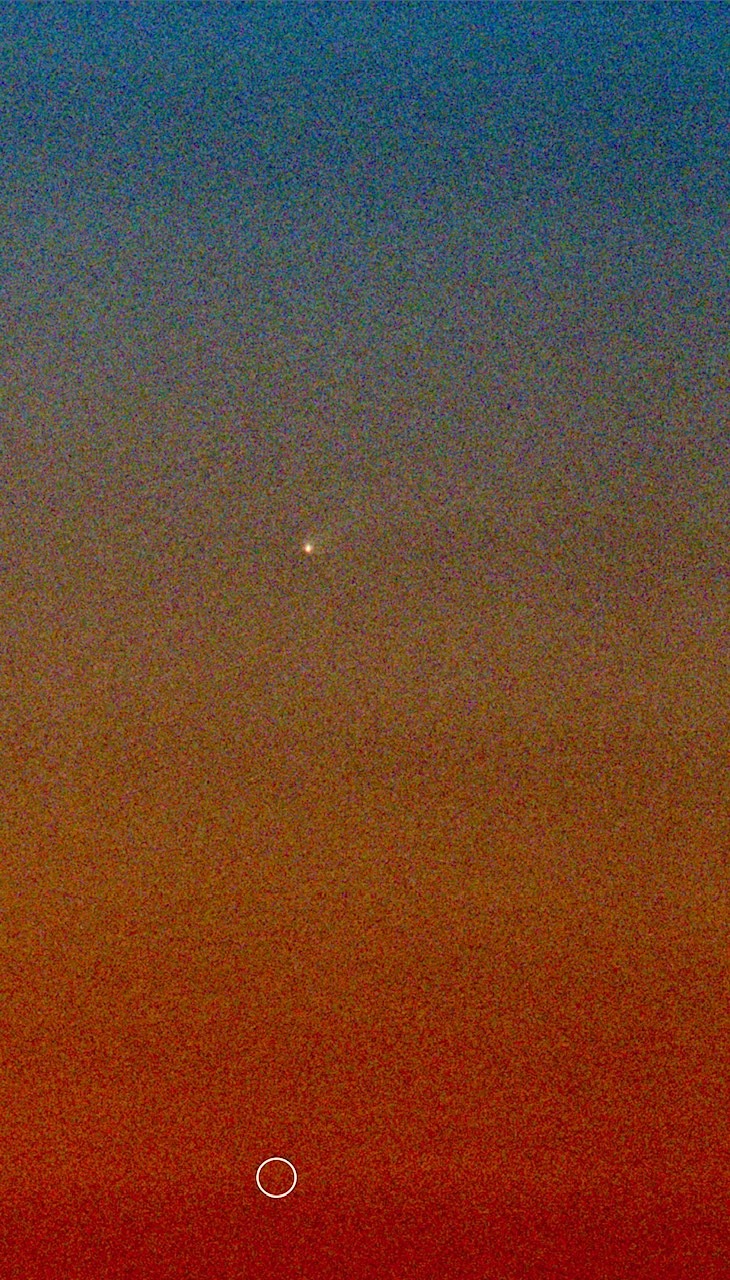
Comet C/2023 A3 Tsushinshan-ATLAS low in the east.
The comet about eight minutes after it rose in the east.

Processed at home later, the comet and its tail are clearly visible in these low resolution images. The white circles are SeeStar artefacts,

Were these the first images of C/2023 A3 Tsuchinshan-ATLAS taken in the UK since the summer? I’d like to think so.

I’d also like to think this is merely the prelude to the big show this comet will produce in the next two or three weeks. Good luck.

 

Try a Messier Challenge this week

Try a Messier Challenge this week

Attempting to view all the 110 Messier objects in one night is fun. It’s best tried during the last week of March or early April, when the Sun is out of the way.

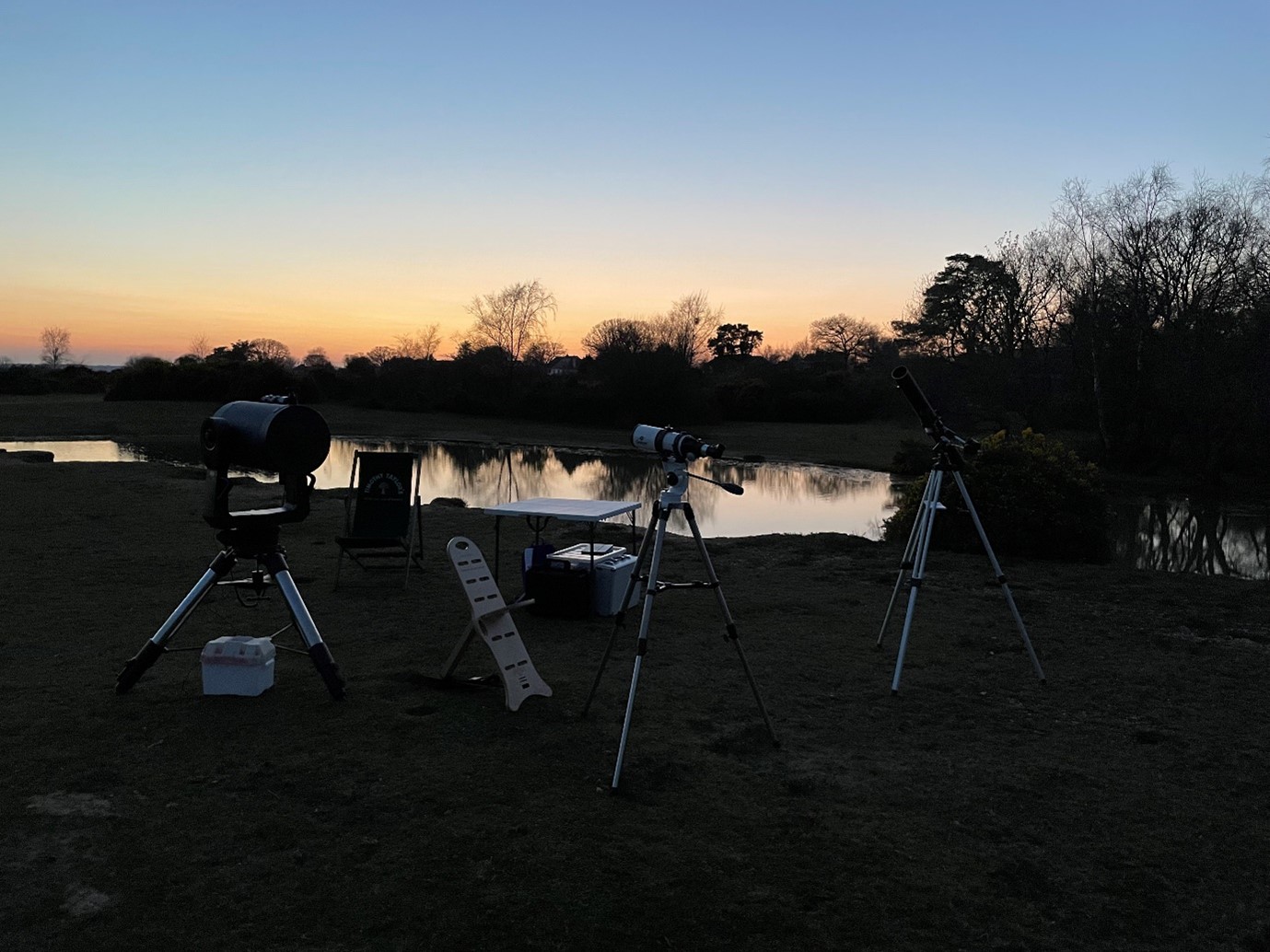
Telescopes Ready and Waiting. A Messier Challenge is about to start. Credit: Mark Hardaker

From the United Kingdom, it is not possible to complete what astronomers call the “Messier Marathon”, an all-night session during which the observer tries to see each of Messier’s 110 nebulous objects.  We are too far north to be able to see M74 in Pisces before it sets in the evening and to see M30 in Capricornus before the sun rises.  However, you can still get tremendous satisfaction from completing a Messier Challenge – trying to find as many as you can – during the night.

M13 Her [xst2ii]

Many astronomical societies gather under dark skies during these days to have a go. The Moon’s phase is critical of course, especially as some of the more tricky Messier objects are located low in Scorpius and Sagittarius – you don’t want the Moon lurking nearby. This year the waning crescent Moon moves out of Sagittarius around Wednesday 3 April, making the weekend after the best time to plan a Challenge.

A successful Challenge can net you around 100 – 105 Messier objects, depending on your location and, particularly, how clear your southern horizon is, but you must plan well. The original Marathon was first attempted by American astronomers in the 1970s. The concept – for a Challenge or a Marathon – is to start observing at dusk and to continue through the night until sunrise.

How to Plan a Messier Challenge Credit: Jim Cornmell and Mark Hardaker

Your observing plan will start with the Messier objects low in the western sky at sunset, trying to catch them before they set. Next, work steadily eastward across the sky through the night, logging your progress as you go. As one who has done it, I can confirm that a Messier Challenge is a test of your observing stamina and willpower, especially if the weather is changeable, and of your own physical fitness. You need to have sufficient hot coffee on hand to last you through the night and some food to sustain you – it gets quite cold in the early morning. Having some shelter available from the wind is a good idea, as well as warm blankets and a deck chair to sit and rest. And don’t forget your dew shields! As the night turns colder, a thin misty layer will cover every surface, including your lens and mirrors, unless you protect them.

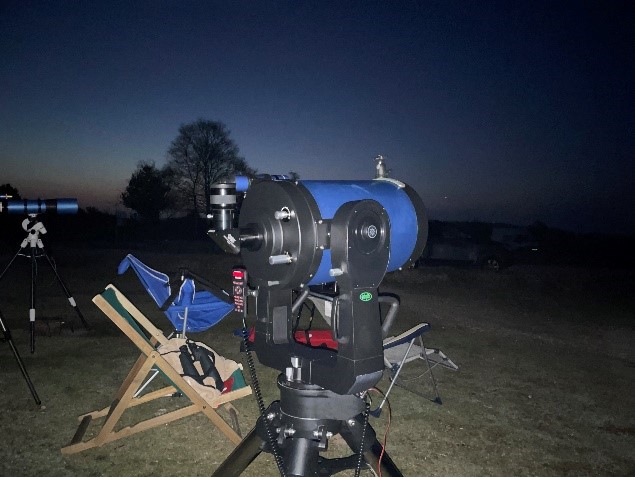
Waiting for the last Messier objects in the morning cold. Credit: Mark Hardaker

Imaging a Messier Challenge in one night may be even more challenging, but worth a try.  The new smaller fully-automated smart telescopes, such as the ZWO SeeStar S50, might prove useful in capturing images quickly then moving on to the next object. Do make sure you have enough battery power to last the night.

After the first rush to catch the lowly galaxies in the north and west and a second to capture the many objects in the “realm of galaxies” in Virgo, there follows a period of relative calm. You can pause a while to enjoy the night sky as it wheels above you and share your experiences with your colleagues. Then, suddenly it seems, the summer constellations of Scorpius and Sagittarius appear on the eastern horizon and the race is on to see the galaxies and clusters there before the first rays of dawn call a halt to the proceedings.

Enjoy your Challenge and keep safe.


Mercury Magic in March

Mercury Magic in March

Mercury is visible low in the western sky during March, but be quick!  It isn’t there for long.

Mercury1

On 20 March, Mercury will shine low in the west as the sky darkens about 30 minutes after sunset. It’s going to be a lean time for planet hunters in the coming few months, as the brighter neighbours in our Solar System move closer to the Sun. Only Jupiter is hanging in there, moving lower in the southwest at dusk.

But March will bring the elusive planet Mercury back into the western sky, low down near the horizon soon after sunset.

Being the closest planet to the Sun, Mercury never strays out of the twilight sky and you have to be in the right place at the right time to catch it. So make the most of its appearance this month, as it won’t be as well placed in the evening sky for another year.

Have a look towards the west, starting about 30 minutes after sunset. Around the time of the spring equinox, due this year on 20 March, sunset is around 6 pm virtually everywhere in the country. Look in the brightest part of the twilight and as the sky gets darker you should be able to see a bright starlike point just a few degrees above the horizon.

Mercury
Mercury, low in the west during its last evening appearance in April 2023. This year’s show should be similar. Credit: Mark Hardaker

You’ll need an unobstructed and clear horizon, and if there are any clouds around you might need to wait till they drift away. Binoculars will help. Mercury will become easier to see as the sky gets darker, but it also sinks lower towards the horizon as well. And please be careful. Do not try looking before sunset; you won’t see Mercury and you could damage your eyesight if you accidentally look at the Sun.

When to Look

You might first spot Mercury very low on the horizon on 12 March, when a thin crescent Moon will help you find the planet.  Draw a line from bright Jupiter in the southwest, down through the Moon, continuing to the horizon. Mercury will be on that imaginary line, just a few degrees high.

Viewing becomes easier a few days later and on the equinox day itself, 20 March, Mercury will shine at magnitude -0.6 and should be easily seen with the naked eye.

As the month progresses, Mercury grows fainter and lower in the sky, until by 1 April it will be tricky to find even with binoculars. Only ten days later, Mercury will depart from the evening skies and pass between the Earth and the Sun.  It will reappear in the morning sky during May but will be virtually impossible to see in the bright morning twilight.

Viewing Tip

Today’s smart phones, with their accurate astronomy apps, can help you to locate the stars and planets in the sky. Apps such as Stellarium, Sky Safari and Sky Guide will line you up towards the west and show you when and where to find Mercury, as well as showing the nearby constellations in the sky. Good luck.


Watch for Algol at its minimum

Watch for Algol at its minimum

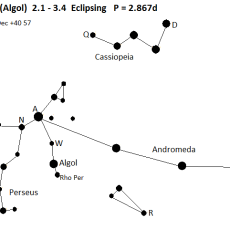
On clear February evenings, the variable star Algol (Beta Persei), in the constellation Perseus, is high overhead from central UK locations. An eclipsing binary, this star “winks” in brightness every 2.87 days, dipping from its normal magnitude 2.1 to a minimum of around 3.4, as its dimmer orange-yellow secondary passes in front of, or eclipses, the brighter bluer primary. Read more

Love Is All Around – and also in the sky.

Love Is All Around – and also in the sky.

February is usually a cold, dreary month, but as we move towards the middle week, we can feel the warmth of spring and summer just around the corner.  And Valentine’s Day on 14 February gives us the chance to share this warmth and love with our partners and companions in life.

In the sky, there are a couple of romance-themed objects on view this month, the best known of which is the Heart Nebula in Cassiopeia, officially known as IC 1805. This delicate emission nebula glows red by the light of hydrogen, ionised by the light of small cluster of stars at the centre of the nebula. Its blue and orange colours come from emissions from ionised sulphur and oxygen, respectively.

The Heart Nebula in Cassiopeia. Credit: Ross Gould. Sky-Watcher Esprit ED 80, ZWO ASI533MC

This lovely object was discovered by the great deep sky astronomer William Herschel on 3 November 1787 and is almost four times the size of the full Moon. You can find the Heart Nebula high in the north-western sky during February, between Cassiopeia and Cepheus, not far from the famous Double Cluster. However, don’t get your hopes of spying a glowing heart in the sky too high – it’s a very faint object. However, it’s a popular target for astrophotographers equipped for long-exposure photography.

Real lovebirds will have to wait until past midnight in February to locate another heart-shaped object low in the south-west, the Antennae Galaxies. When seen at correct right angle, these two galaxies are lovingly wrapped around each other in an enormous heart-shaped collision of stars, dust and gas.  Located low in the constellation of Corvus the Crow, these galaxies are listed as NGC 4038 and NGC 4039 and also in Sir Patrick Moore’s Caldwell catalogue as objects 60 and 61. The main body of the collision is indeed heart-shaped but the galaxies are more popularly known as the Antennae Galaxies because of the two trails of stars emerging from them which look like insects’ antennae.

The heart-shaped Antennae Galaxies – NGC 4038/9 Credit: Star Shadows Remote Observatory and PROMPT/CTIO (Jack Harvey, Steve Mazlin, Rick Gilbert, and Daniel Verschatse)

These galaxies were also discovered by William Herschel in 1785 and are located around 50 million light years from us. At around 11th magnitude, these are not bright objects, and the faint heart-shaped streams are really only seen on photos. To see them on Valentine’s Night you will need at least a 150 mm telescope and a clear sky to the south-west after midnight – and a very understanding partner.

Comet 144P/Kushida hiding in the Hyades

Comet 144P/Kushida hiding in the Hyades

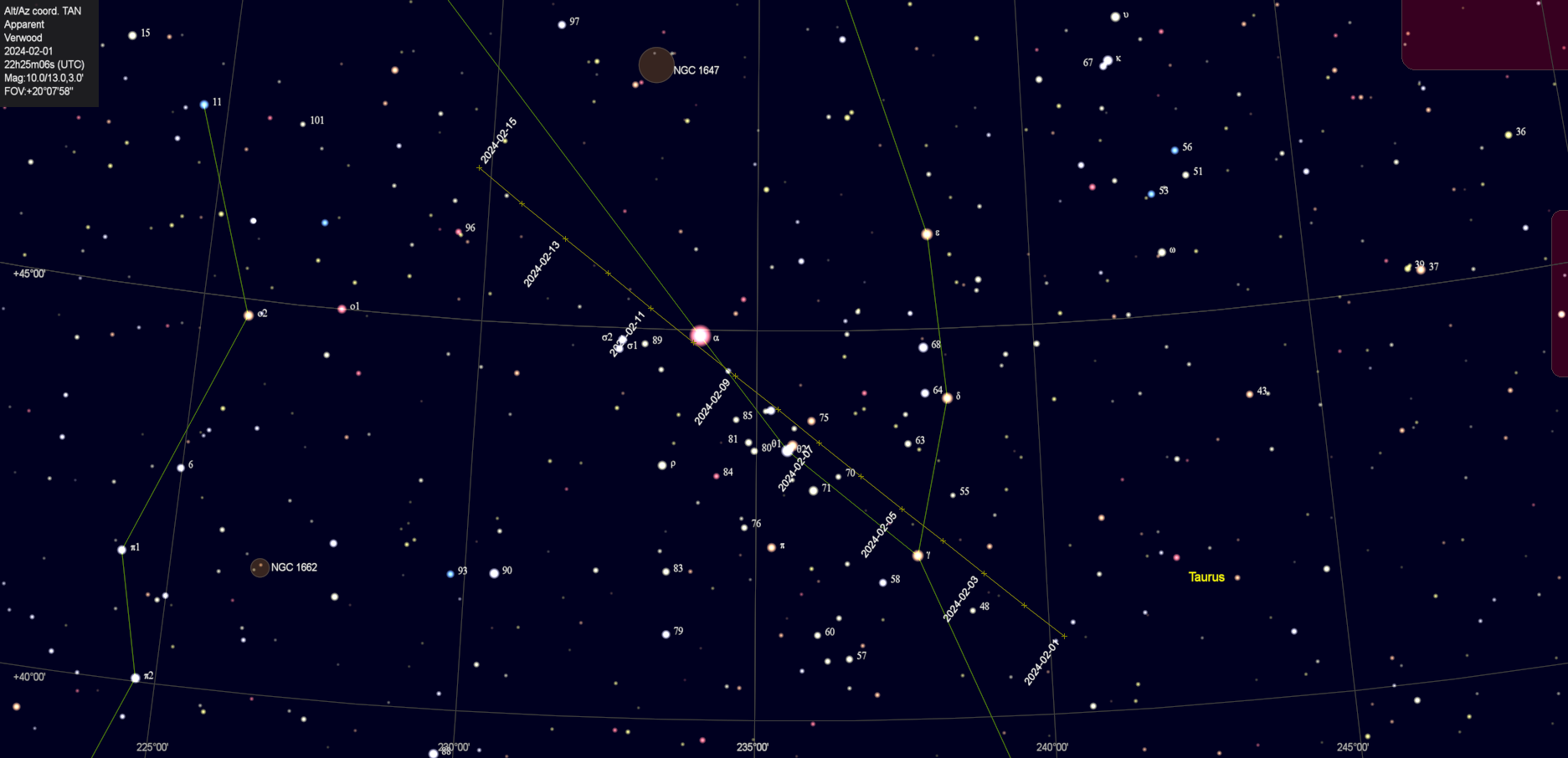
Periodic comet 144P/Kushida moves through the Hyades open cluster in Taurus during the first week of February, making it easy to spot with binoculars or a small telescope.

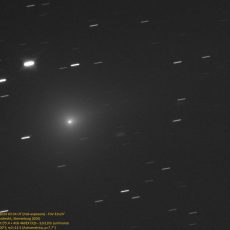
Comet 144P/Kushida
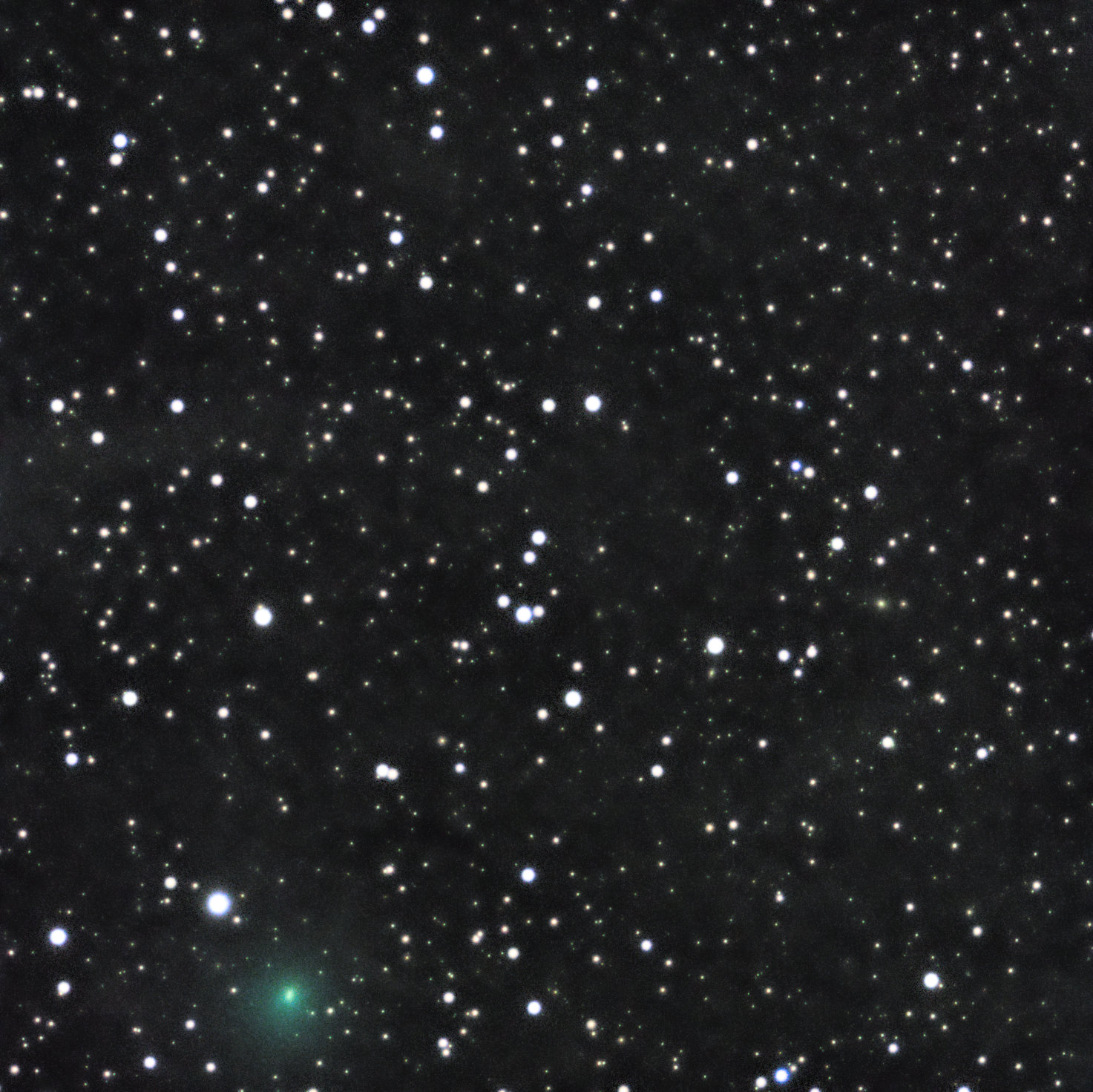
Comet 144P/Kushida was caught on the edge of a frame in early January 2024 Credit: Mark Hardaker

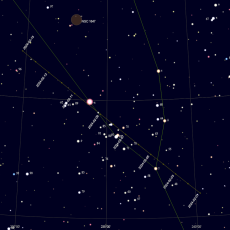
On 4 February, the comet will be visible just north of Gamma Tauri, the tip of the V-shaped face of the celestial bull. During the month it will pass through the cluster, its position changing every night.  On 10 February, it will pass only 7 arcminutes from brilliant Aldebaran, fading slowly as it heads away from us and reaching Orion by the end of March.

Although only magnitude 9 or so, the comet should be visible as a pale grey patch in good binoculars, especially as the Moon will be new on 9 Feb. Larger telescopes will show the comet nicely, while astrophotography will show the distinct greenish glow often associated with comets.  This is caused when diatomic carbon (C2) molecules in the “coma” or nebulous envelope surrounding the nucleus, are excited by the Sun’s ultra-violet light.

Chart 1a
Comet 144P/Kushida moves through the Hyades during February, passing very close to Aldebaran on 10 Feb. Credit: Mark Hardaker

Comet 144P/Kushida was discovered in 1964 by Yoshio Kushida and has an orbital period of 7.366 years. At its most distant, its orbit takes it well past Jupiter, while the comet reaches perihelion no nearer than 1.4 AU from the Sun, outside Earth’s orbit.

Look for comet 62P/Tsuchinshan in January skies

Look for comet 62P/Tsuchinshan in January skies

Comet 62P/Tsuchinshan passed perihelion, the closest point to the Sun in its orbit, on 23 December last year, but is still showing nicely in Virgo in the late evening sky.  It’s not a naked eye object and you will need good binoculars or a small telescope to see it.

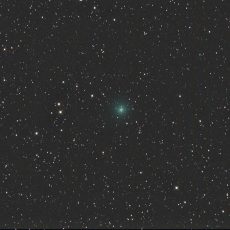
Comet 62P/Tsuchinshan
Comet 62P/Tsuchinshan in Leo on 9 Jan 2024. Credit: Gideon van Buitenen.

The comet has a typical green ‘coma’ surrounding its nucleus, caused by excitation of diatomic carbon (C2) in its thin atmosphere. A faint tail has been seen but is now subsiding as the comet starts to recede from the Earth and Sun. During the next month or so, the comet will pass into the ‘realm of galaxies’, an area in Virgo peppered with faint nebula.  It will be a challenge to distinguish the comet from these galaxies.

62P/Tsuchinshan
62P/Tsuchinshan moves towards Virgo’s “realm of galaxies” this month. Click to enlarge. Credit: Gideon van Buitenen.

62P is also known at Tsuchinshan 1. The comet was discovered on 1 January 1965 at the Purple Mountain Observatory in Nanjing, China.  It orbits the Sun approximately once every 6.2 years, journeying out beyond Jupiter.  At its nearest to the Sun, its orbit brings it no nearer than a point between the Earth and Mars.

The brightness of a comet is very difficult to predict, as it depends on the scattering of sunlight from dust in the comet’s coma and tail. The amount of dust varies as the comet rotates and as its distance from the Sun changes. This often results in sudden increases in the comet’s brightness, known as outbursts, as gases sublime from the from the nucleus, bringing dust with it. Comet 62P/Tsuchinshan will probably be around magnitude 9, fading to 10 in the next few weeks.