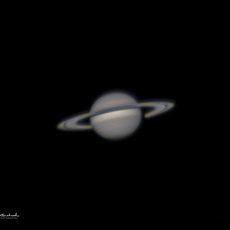
Saturn is the planet with the rings, right? But for the past couple of years, the planet has been a disappointment to those with small telescopes hoping for a spectacular view. The planet has not put on its usual display because the rings have been almost edge-on to Earth. It’s been an unusual sight, but lacking in drama. But now they are back, and the planet is higher in the sky from the UK than it has been since 2010.
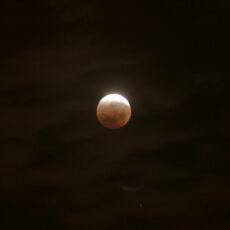
The great partial solar eclipse of 2026 is over! Generally good weather across the UK meant that hundreds of thousands of people got to see the event, with the Sun’s disc being narrowed down to a thin crescent as the Moon moved in front of it. But the eclipse story isn’t over yet! There’s a deep partial lunar eclipse coming up on 28 August, and another good partial solar eclipse in a year’s time – so put the dates in your diary now and don’t get caught out!
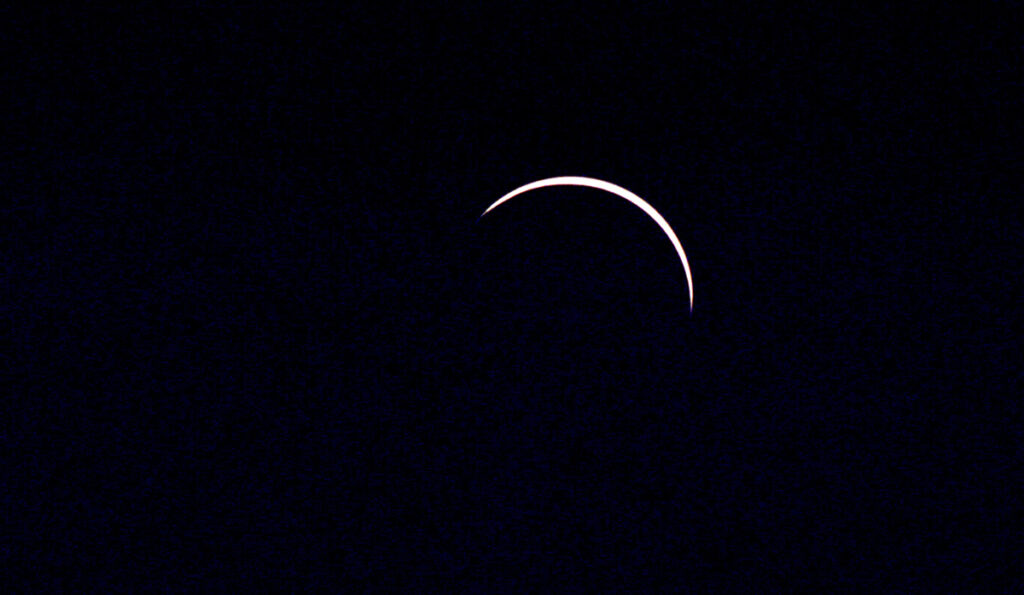
There will be a partial eclipse of the Sun visible from the whole of the UK during the evening of Wednesday, 12 August 2026, with the Sun appearing as just a thin crescent – a unique event. But while it’s easy to view it safely, you need to be prepared in advance, so get your act together now!
During the eclipse the Sun will become just a thin crescent as seen from the UK. But even this thin sliver will be blindingly bright. Credit: Stan Armstrong
What, where and when
A partial eclipse occurs when the Moon is new and happens to pass directly between the Earth and the Sun, so you see it silhouetted against the Sun’s disc. This doesn’t happen every new Moon, and even when it does, you need to be in the right part of the Earth to see it. In this case, only those in western Europe and Canada will see it. And for a lucky few, mostly in Spain, the eclipse will be total, offering a view of one of the rarest natural spectacles that we can predict.
Even the partial eclipse will cover a great deal of the Sun as the track of totality is just 250 miles to the west of the UK. From the mainland UK up to 96% of the Sun will be covered, leaving just a thin sliver of the Sun visible. But looking at even this small amount of the Sun can cause irreparable eye damage, so you really need to be ahead of the game and start preparing now.
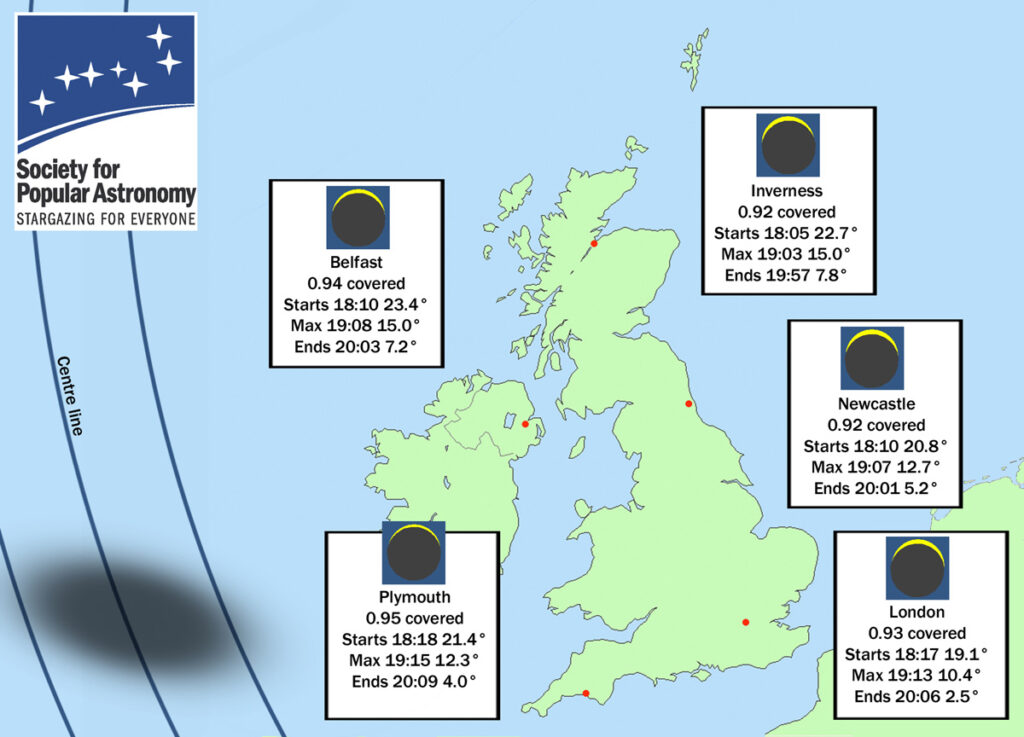
The eclipse will be visible from the whole of the UK, weather permitting of course, The appearance of the Sun at maximum eclipse and the times of the start, middle and end are shown on the map below.
Even though over 90% of the disc of the Sun is covered the sky won’t go dark, although the sunlight will appear weaker than usual. You probably wouldn’t notice anything unless you were aware of it, unless you glimpse the Sun through cloud. Imagine the alarm of people in ancient times who happened to glance up and saw the Sun progressively being eaten!
How the eclipse will look, and timings. For each location we give the amount of the Sun covered at mid-eclipse, the times of the start, beginning and end, and the height of the Sun above the horizon for each time. Image credit Society for Popular Astronomy
How to watch the eclipse
You need to take great care when viewing the Sun at any time. It’s so bright that you need to dim its light by about 100,000 times before you can gaze at it safely. So read our FAQs below to find out what your options are. If you need to buy suitable filters or glasses, don’t leave it so late that you can’t get them delivered – they aren’t available from any regular shops!
We’ve recorded a five-minute video with Prof Lucie Green in which she shows you how to view the eclipse safely using nothing more than a small mirror! There’s also advice on how to buy and use special eclipse filters. Watch it now!
Tip: Because the Sun will be low in the sky during the eclipse, make sure you have a good observing location with no trees or houses in the way at the time of maximum eclipse. The easiest way to find the right spot is to check the Sun’s position a few days beforehand at the same time. But the Sun won’t be exactly the same position on the 12th — it will be a little lower and to the left, so allow for that when you choose your observing spot.
Eclipse FAQs
How can I view it? The Sun is so bright that looking at it directly will blind you. Even at mid eclipse, the remaining bright part of the Sun is far too bright to view. You need to cut its brightness down by about 100,000 times. Ordinary sunglasses are useless, and you should never use household materials such as bin liners, food wrappers or the like (see below). So either use an authorised eclipse viewer, or project the Sun’s image using a small mirror or a telescope or binoculars. A welder’s No 14 glass is also OK for viewing directly.
Where can I get an eclipse viewer or material from? Only specialist astronomy suppliers may have stocks. The most commonly used material for making filters is Baader AstroSolar, available from a number of suppliers, but other materials are available. Just search for ‘solar eclipse viewer’ or ‘Baader Astrosolar’.
I’ve often had to look into a low sun when driving – what’s the problem? Under those circumstances your eye will not fix on the Sun itself but will dart around and a reflex action prevents you from gazing at the actual Sun. But when trying to see the eclipse you may try to force yourself to overcome this reflex, which is dangerous.
Can I view it through thin cloud? Quite often we do see the Sun’s disc through cloud with no problems. The problem is that when viewing an eclipse we tend to stare at it for longer than we would usually do so, which could cause a buildup of heat. This must be your own decision – if the Sun is so much dimmed by cloud that it’s hardly brighter than the cloud itself, it may be OK for you to look at it briefly, but eyesight sensitivity varies from person to person and this is not based on medical advice. Look away the instant that the cloud thins.
What about looking at a reflection in water? This cuts the brightness down to only about a few per cent of the original brightness – not nearly enough for safety, no matter how dirty the water!
Why can’t I look through a photographic negative like I did when I was young? Years ago, most photos were taken on black and white film, and the black areas of the negatives were made of silver particles. A couple of layers of these could cut down all wavelengths of light quite well. But colour negatives use dyes rather than silver, and these don’t absorb all wavelengths of light equally. The worst thing is that even though they cut down the visible light, so the Sun looks dim, they may allow through other wavelengths, such as infrared (heat) which will quietly fry your eyeball without your realising it until it’s too late. The same applies to many other dense materials, such as bin liners, smoked glass, food packaging and CDs. So don’t take the risk!
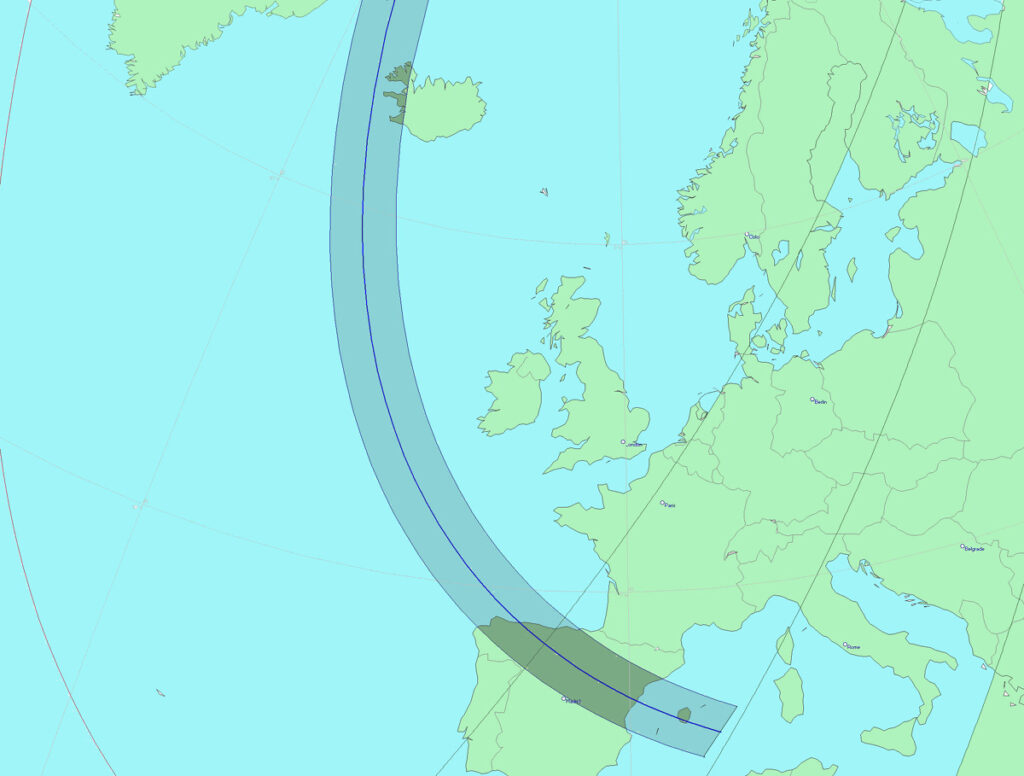
Where will the eclipse be total? The track of the eclipse over the Atlantic and Europe is shown in the diagram below. At the eastern end, over the Mediterranean, the Sun sets during the eclipse.
The track of totality is shown in grey, with the centreline of the event in blue. Outside this area, a partial eclipse will be visible.
Midsummer skies are not ideal for stargazing as it doesn’t get dark until late in the UK. But this is the time of year when spectacular clouds can appear at the edge of space. Normally astronomers hate clouds but these are special.
Two bright planets are attracting attention in the western sky after sunset during June 2026 – Venus and Jupiter. But which is which? Actually, they swap places during the month. And we show you how to catch a glimpse of Mercury in the middle of the month.
It’s May, and the sky doesn’t get truly dark until quite late in the UK, especially in more northerly areas, so you need to stay up late to do your stargazing. But there are still some great sights to be seen without losing sleep. Here’s a quick guide to some of the things that you can find in the May sky.
What’s the best-known constellation? The Plough (or Big Dipper)*? The Southern Cross? Actually, it has to be Orion, because unlike the other two it’s visible the whole world over, it’s very easily recognised and it has more bright stars than any other star pattern.
The International Space Station is making a spectacular series of evening passes over the UK, continuing until the end of January 2026. You can view it from your back garden as long as you have a good view of the sky, so there’s no need to travel anywhere to see it.
Everyone notices the times of sunrises and sunsets in winter in the UK. For months, the Sun has been high in the sky when all but the earliest of risers get up. But in December and January, many people get up and travel to work or school and back in the dark. Here are some facts about winter sunrise and sunset times that you might not know.