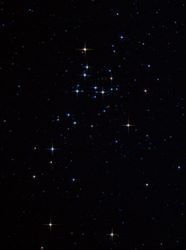
It’s May, and the sky doesn’t get truly dark until quite late in the UK, especially in more northerly areas, so you need to stay up late to do your stargazing. But there are still some great sights to be seen without losing sleep. Here’s a quick guide to some of the things that you can find in the May sky.
It may not be astronomical, but one object that is most easily visible when the Sun is not far below the horizon is the International Space Station (ISS). This is making a series of evening passes over the UK between 7 and 23 May. There’s no mistaking the ISS when it glides silently through our skies. It is often brighter than any celestial object at night other than the Moon, and moves as swiftly as a nearby aircraft, but without any accompanying flashing lights or noise. Yet it’s at least 400 km above your head, and as you watch the station rapidly passes over the rest of Europe, travelling at around 460 km every minute.
A typical pass lasts about 10 minutes, although it is only easily visible for about six minutes. It always moves from the west side of the sky to the east, although its exact track depends on where you are viewing from and the stage of its orbit. It can pass directly over southern England, and even from the north of Scotland you can still view it easily.

Quite often the Station fades as you view it, as it passes into the Earth’s shadow. From the astronauts’ point of view, sunset has arrived, which is repeated every 90 minutes.
This is a great opportunity for photography, and also for showing off your predictive powers to your friends and family. To find out how to get predictions for your own location go to our help page: https://www.popastro.com/predicting-the-iss-and-other-satellites/. This explains how to use the prediction tables and get a map of the sky showing its track against the starry background.
Watch the affair between Jupiter and Venus
The two brightest planets are also in the sky at the moment, Jupiter and Venus. These two were given their names years ago, Jupiter being the chief god to the Romans and Venus being their god of love. and in the May sky you can see Jupiter and Venus approaching each other.
Venus is currently the evening star, and you can see it over in the north-western twilight from about 30 minutes after sunset, before any actual stars are visible. At the start of the month Jupiter is higher up in the west, to the left of Venus, and starts to become visible about an hour after sunset.
As the month continues, Jupiter sinks lower each evening while Venus gets a little higher. By the end of the month they are about a stretched hand’s width apart so you can compare the two easily. Venus is quite a lot brighter than Jupiter, as it’s about five times closer. They are both quite low by about 11 pm in the north-west at this time. Mercury also starts to appear close by, and it will be higher up in early June.
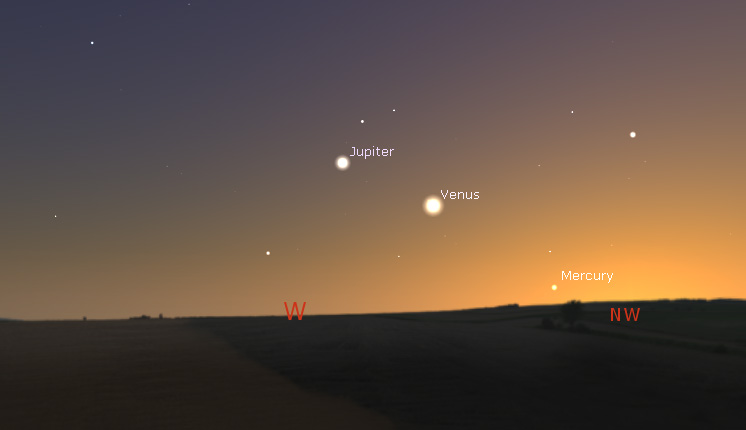
The two stars above Jupiter are Castor and Pollux, the Heavenly Twins, in the constellation of Gemini.
If you look low in the west on the evening of the 17th and you have a good clear sky you could see a thin crescent Moon about 30 minutes after sunset, below and to the right of Venus. Follow the line from Jupiter through Venus down to the horizon, or use a sky map app on your phone to help you find it. A pretty sight, so see if you can get a good photo with some interesting foreground detail and not just a lot of telephone wires which is what usually happens. It will be 26½ hours after new and will only be about 2 per cent illuminated so it will be very delicate — a great photo opportunity.

Continue to follow Jupiter and Venus into June and you’ll see them very close together around 9 June.
The Coma star cluster challenge
If you are ready for a challenge, and have binoculars or a dark country sky, try finding the Coma Berenices star cluster. This isn’t as compact or as bright as the Seven Sisters star cluster (the Pleiades) of winter, but it is quite distinctive and attractive.
First, find the constellation of Leo, which is one of the few that actually looks like what it’s meant to be. Its stars are bright enough to be seen even from a light-polluted sky, once you find the bright star Regulus, which is in the south-western sky at the moment, to the left of Jupiter. Also look for the bright star Arcturus, quite high up in the south.
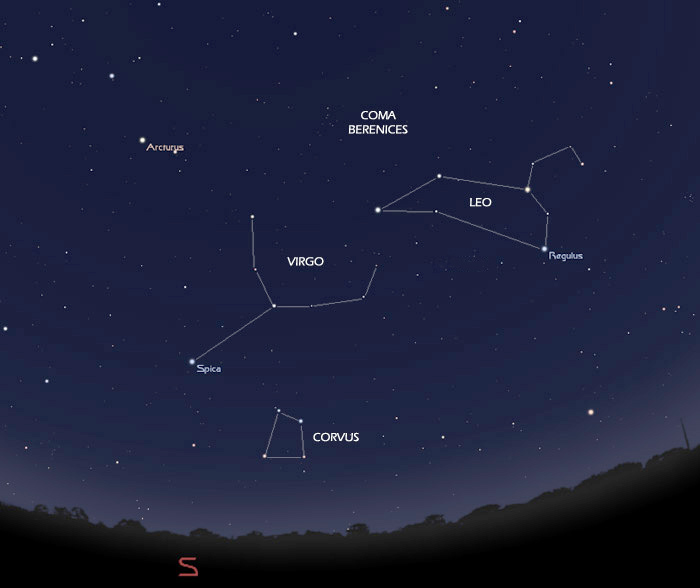
Between Leo and Arcturus you’ll find Coma Berenices. Its main feature is a triangular pattern of faint stars, which give the constellation its name – Berenices’ Hair.
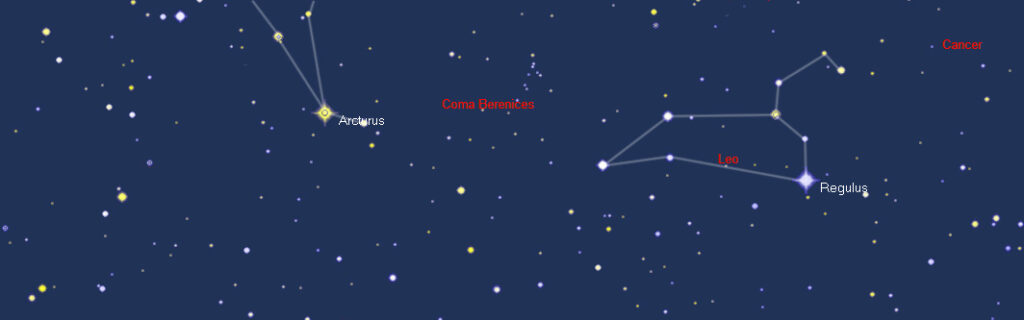
The name comes from a story about Queen Berenice, an actual person rather than a mythical one, who was the beautiful wife of Ptolemy III of Egypt in the third century BCE. She was famous for her long hair which she promised to cut off if her husband returned safely from fighting the Assyrians. He did, and she put her hair on the altar in the temple of the goddess Aphrodite. The next day the hair wasn’t there. To save everyone’s neck, the quick-thinking court astronomer, Conon of Samos, came up with an explanation for the missing hair. He pointed to a cluster of stars in Leo’s tail and said that the gods had been so pleased with the sacrifice that this was where the hair could now be found.