
The great partial solar eclipse of 2026 is over! Generally good weather across the UK meant that hundreds of thousands of people got to see the event, with the Sun’s disc being narrowed down to a thin crescent as the Moon moved in front of it. But the eclipse story isn’t over yet! There’s a deep partial lunar eclipse coming up on 28 August, and another good partial solar eclipse in a year’s time – so put the dates in your diary now and don’t get caught out!
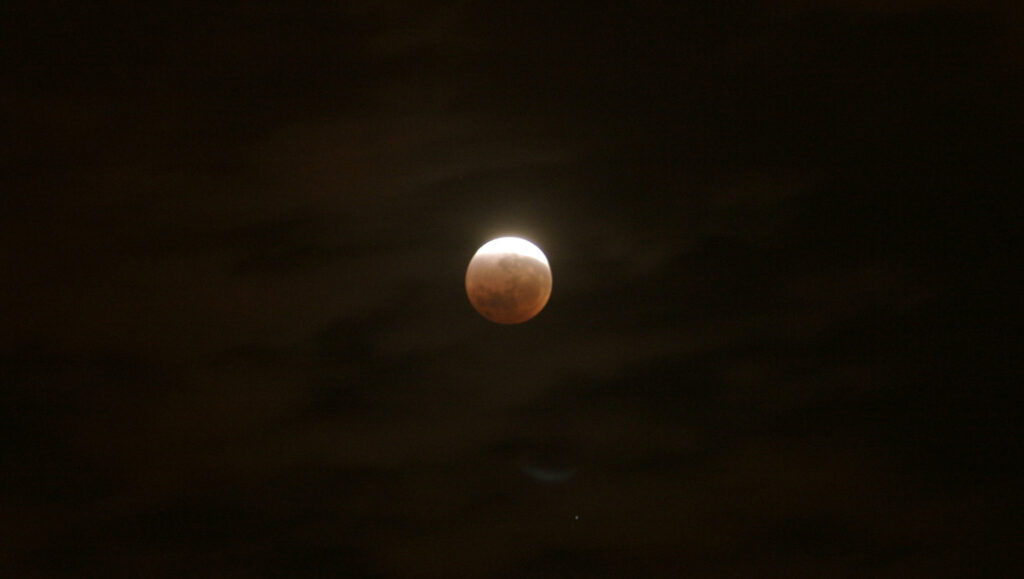
Eclipses, both solar and lunar, come in groups when the orbit of the Moon is in the right place to create them. So on 28 August 2026 there will be a lunar eclipse – which is when the Moon passes through Earth’s shadow. And it will also be a very deep partial, but not a total eclipse, so a thin sliver of the Moon will remain illuminated, as it doesn’t pass directly through the main shadow of the Earth.

Sounds exciting? The only downside is that from the UK the eclipse takes place on the early morning of Friday 28 August – so you need to set the alarm as you go to bed on Thursday 27th!
From the UK, the event starts at 2:21 am BST when the full Moon starts to enter Earth’s outer shadow, called the penumbra. Within a few minutes you’ll see the Moon getting slightly darker on its left side. By about 3:30 am it’s fully in the penumbra, then a few minutes later the left edge starts to go into the full shadow, the umbra, and the Moon has a bite taken out of its disc.
By 4:15 am it starts to look like a half Moon, except that the shadow across it is curved, not straight. Maximum eclipse occurs at 5:12 am, when just a thin part of its disc is illuminated and the rest of it is in shadow, probably appearing reddish. By this time the Moon is getting quite low in the sky over to the south-west, so if you wake then and look outside expecting to see it, you might not spot it at all as it could easily be behind a house or a tree. It’s also starting to get light, as dawn is breaking, so you need to look to the opposite direction of sunrise, which occurs just after 6 am in central UK.
The times of the eclipse are the same across the whole of the UK, but the Moon will be higher in the sky towards the north and west, and will set earlier to the south and east.
From then on the Moon starts to recover its original appearance, but it sets before it leaves the Earth’s shadow. The later stages could provide great photo-opportunities, if you have a very clear sky and a low horizon to the west-south-west (an azimuth of about 250°). Use a skymapping app on your phone to help you, if you have one!
The next solar eclipse
In the UK we’ll get the next solar partial eclipse on the morning of Monday 2 August. The Sun will be about 50% covered by the Moon at about 10 am. So put your eclipse glasses somewhere safe (and make sure they don’t get bent, which is likely to affect their safety), so you can enjoy that event as well!