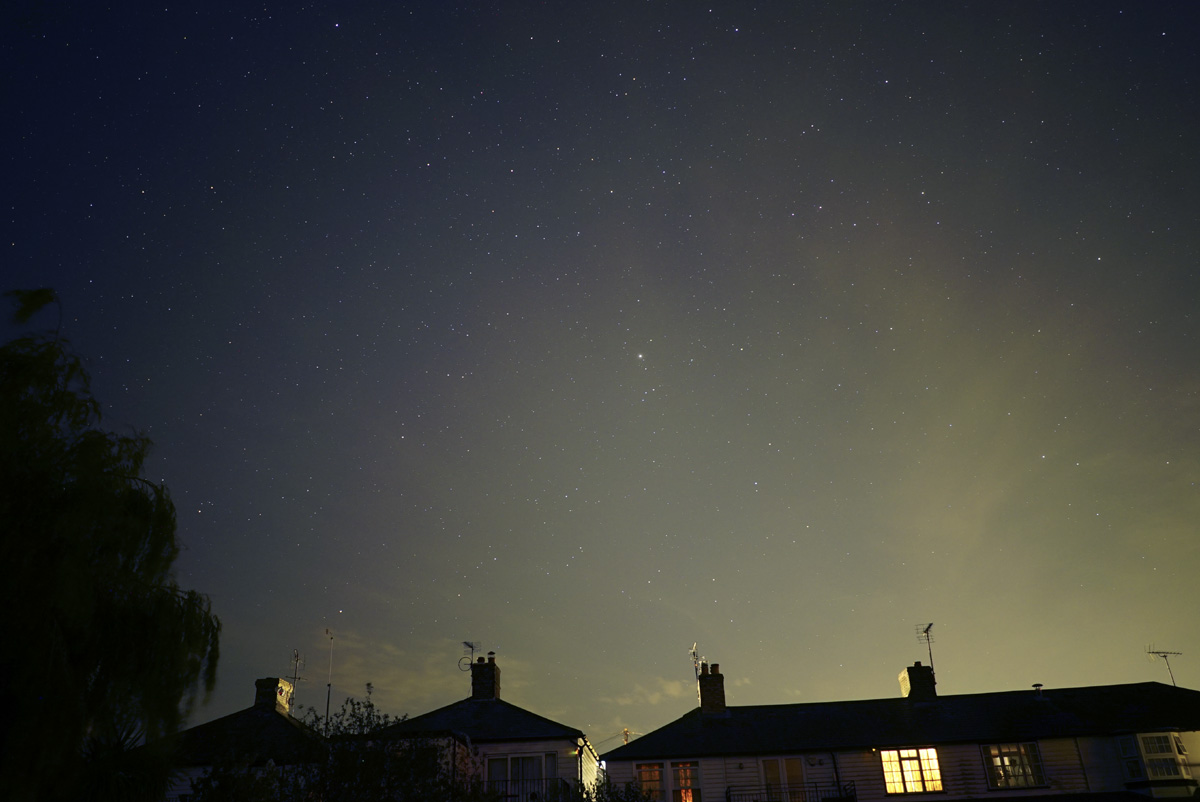
Saturn, the ringed planet, is returning to the evening sky, but its appearance will be very different from last year. Instead of its famous rings being prominent in a telescope, all that you will see for the next few months is a thin sliver to the left and right of the planet.

The reason for this is that as Saturn moves around its orbit, its rings appear to widen and then close, as seen from the Earth. Just like the Earth, Saturn’s equator has a tilt. Whereas the Earth is tilted at 23.5 degrees, Saturn’s is more pronounced, at 26.7 degrees. This means that as Saturn moves around its 29.4-year orbit, the rings appear to wobble up and down, making them appear to open up and then close twice per orbit.
Because the rings are very thin – probably only a dozen metres thick in parts – they seem to disappear when seen edge-on from our viewpoint. This will not occur until March 2025, when the Earth pass through the ring plane, but during July and August of this year, the rings are only open around two degrees, making them visible only as the thinnest slivers in small telescopes.
As the rings open and close, so the planet’s overall brightness, or magnitude, changes. When Saturn’s rings are fully open, as they were in 2017, the planet appears as bright as -0.55 whereas for the next year or so, it will barely reach magnitude +1.1. You can see why the ring tilt makes so much difference in this pair of photos, each made with similar sized telescopes.

When the rings are edge on, we will also start to see transits and shadow transits of Saturn’s moons across the disk, in particular Titan. This phenomenon starts in spring 2025. More information will be published on our website nearer the time.
The last time the rings were edge on was in 2009 and the next time will be 2038, so enjoy the view this time around.
Where to look
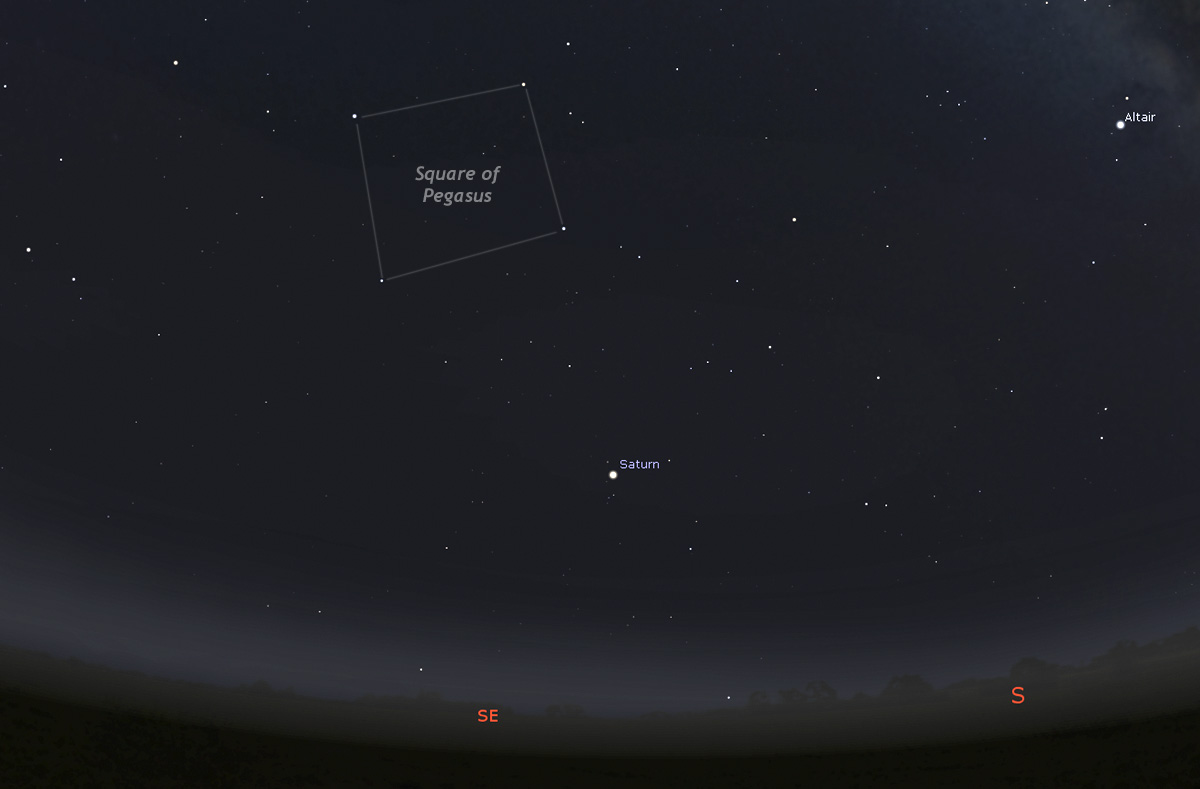
Saturn actually rises soon after sunset over in the east but it isn’t high enough to be seen properly until about 10 pm BST. By 11 pm it’s quite high up over to the south-east. It’s a fairly bright starlike object, and you can use the Square of Pegasus, in mid sky, as a guide to it, as shown below.
Saturn reaches its highest point at about 2 am, and is in the constellation of Aquarius. This is the best time to observe it through a telescope, as when it is lower in the sky its image is affected by the turbulence in our atmosphere.