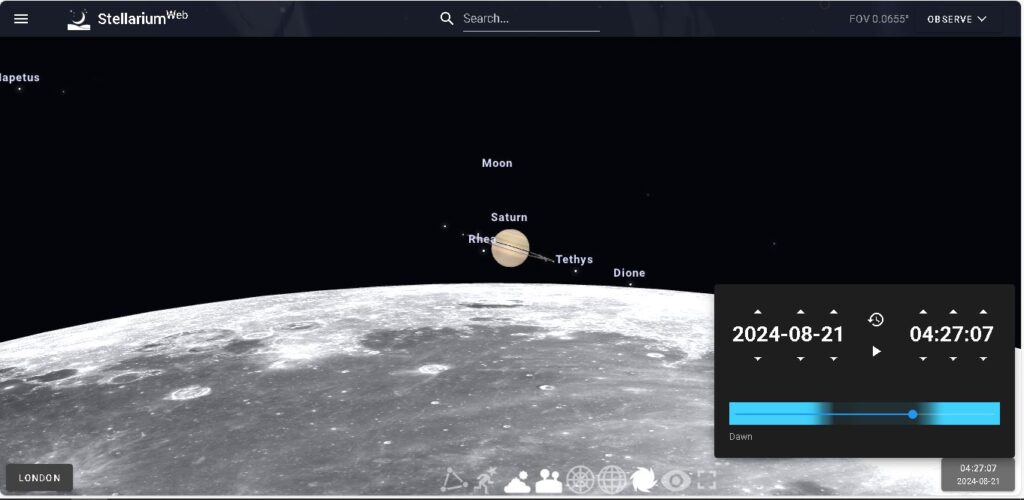
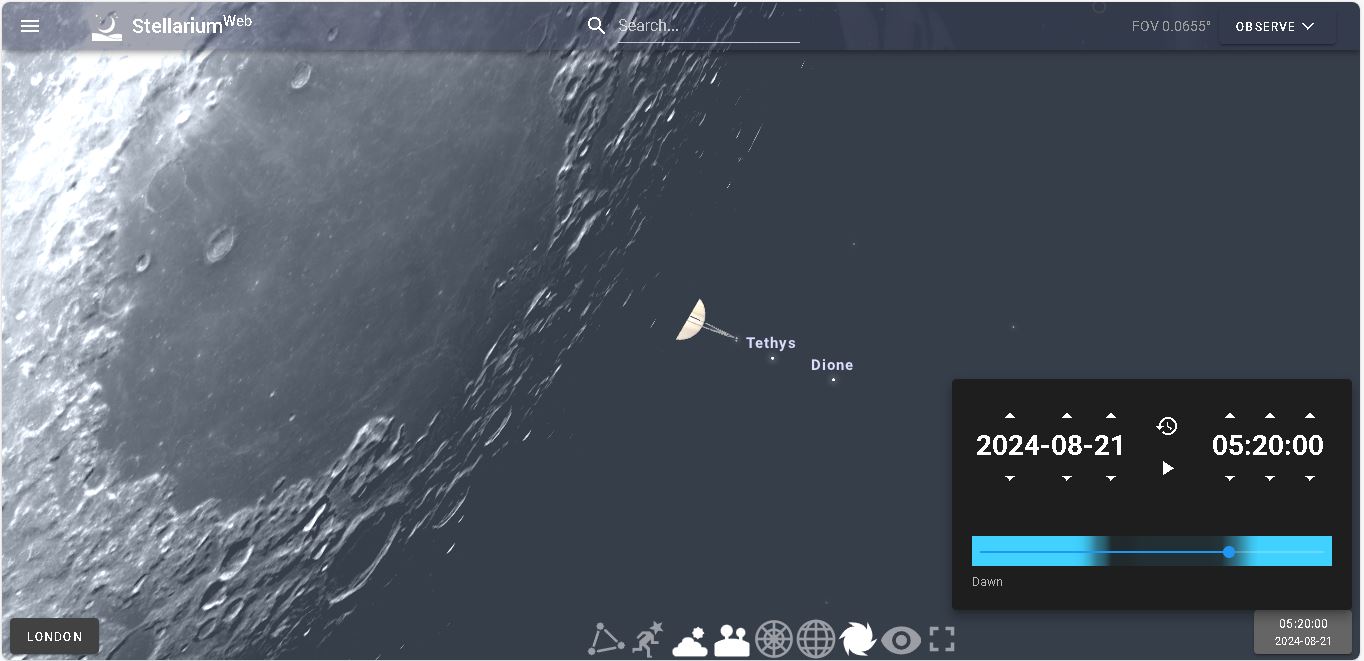
On Wednesday 21 August, a rare event happens – the Moon passes in front of Saturn as seen from the UK, offering a unique chance to see two of the most spectacular objects in the Solar System in the same view. But observers will need to be particularly keen, because the event begins at about 4:30 am BST.
Update 21 August:
High-level haze from forest fires in North America and clouds spoiled the view for some in the UK. Here are two photos of the event showing the moment when Saturn passed behind the Moon.

The disappearance takes place at the bright limb (edge) of the nearly full Moon, about 25° above the horizon in the south-south-west. Saturn should be plainly visible through a telescope, despite the brightness of the Moon. It reappears some 52 minutes later from the dark limb, although with the Moon 97% illuminated the lunar features will be visible not far away. The disappearance and reappearance will be taking place during and shortly after astronomical twilight respectively, so the sky will not be completely dark.
Looking more closely at the event, as seen through a large amateur telescope Saturn’s moons Titan, Dione and Tethys will disappear first. The angle of disappearance is such that the edge of the Saturnian disk will just make contact with the bright lunar limb before the ring system does. For the reappearance, Titan, Dione and Tethys will reappear in sequence, but this time Saturn’s ring system will emerge first, followed by the main disc. Such events, where one planetary body hides another, are known as occultations.
The amount of magnification you are able to use will determine the amount of detail you will be able to see. However, even at relatively low power this will be a fascinating event. Planetary occultations such as this do not occur very often, and so we would encourage anyone with an interest to brave the early hours and attempt to observe this spectacular sight.
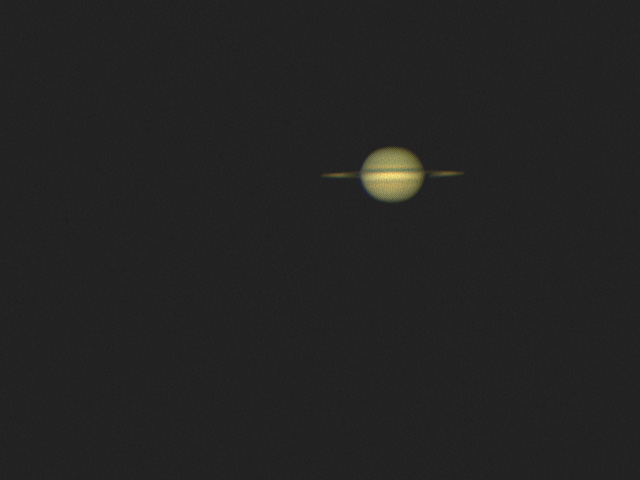
Notice that Saturn doesn’t look as it usually does, as this year and next we view it with the rings almost edge-on. Here’s a recent photo taken by SPA member Chris Campbell:
Interestingly, this event takes place when the Moon is near perigee – at its closest this month. What’s that you say? You thought it was on the 19th, when the media went mad for a ‘blue supermoon’? Sorry, no. The definition of a so-called supermoon was devised by an astrologer, and the full Moon only has to be within 90% of its closest to qualify as a supermoon! The actual moment of perigee is on 21 August at 05:33 UT, which is 6:33 BST. So if you missed it on the 19th, take a look on the 21st and it will be even more super!
The link to the details for this and other lunar occultation events can be found on the SPA website: Lunar Occultations- July to August 2024 – Occultation Section (popastro.com).