
All the bright planets (apart from Mercury) are in the evening sky during January and February 2025. They make a great sight to observe – but is there any significance to it? Is there any particular date when we should go out and look? Are they triggering off the northern lights? Here’s the answer according to astronomers.
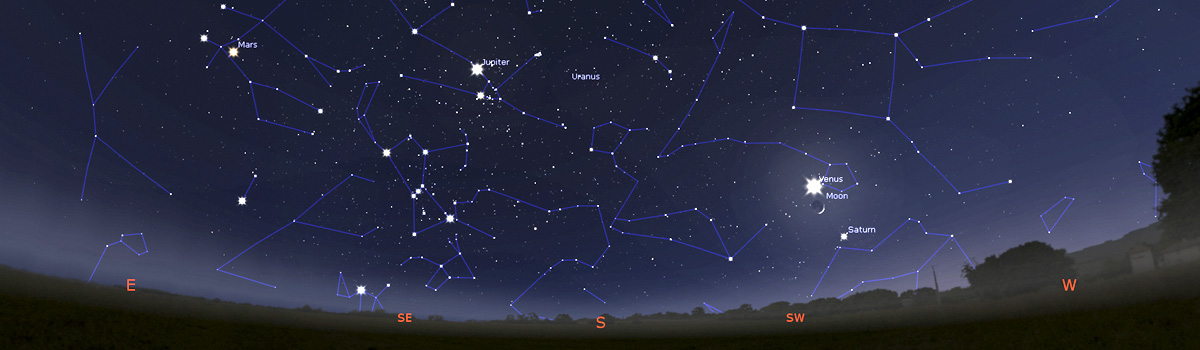
Right now we have brilliant Venus in the western sky, Jupiter very high up and Mars, the Red Planet, glaring down at us high in the east in the evening sky as seen from pretty well everywhere in the world. And Saturn’s there as well, although not as bright as usual this year because its famous rings are more or less edge-on to us, reducing the amount of sunlight it reflects. They’ve been in the evening sky since November 2024 and they’ll be there until the spring, although Saturn starts to sink into the western twilight as from mid-February onwards.
The last time all the planets were in the evening sky at once was in 2018, when Mercury was also visible. It also happened in 2004, without Mercury, and in 2000. For much of last year there were no bright planets at all in the evening sky. So from the astronomical point of view it’s just a chance alignment, and a time when there’s plenty to see through our telescopes.
Is there one particular evening when things are especially good? Not really, although there are times when the Moon is close to a planet, or one planet passes another. On 13 January, for example, the full Moon will be quite close to Mars (and it gets very close in the early hours of 14 January). And on 18 January Venus passes a couple of degrees from Saturn. But because Saturn is particularly faint, and Venus so bright, it won’t be anything other than a pretty sight if you look carefully. The map at the top of this page is shown for 1 February, by which time Saturn and Venus have swapped positions compared with early January.
Mars is at its closest to Earth for the year on 16 January, which is why it’s looking bright and clearly reddish. This year it isn’t especially close as Mars approaches go, however, but amateur astronomers can get a good view of it through their telescopes. It won’t be as close again until 2031, as the close approaches of 2027 and 2029 will be even more distant than this one
The best time, of course, is when you get a clear night wherever you are! Even if you’re in the middle of a city you can pick out the bright planets. And if you can find a darker spot and get your eyes adapted to the dark you’ll be surprised how many stars you can actually see. Here’s a photo showing the constellation of Orion over the Houses of Parliament in central London.

But for astronomers in the UK, the big time will be the first week in February, which had been designated National Astronomy Week. This will be marked by public observing sessions and other events across the UK, and runs from Saturday 1 February to Sunday 9 February. During the Week, the Moon will be waxing from a crescent to fairly full, and will pass each planet in turn, giving great photo opportunies. For those unable to make it to one of the public observing sessions to see things directly through telescopes there will be livestreaming of the views of the planets and even galaxies each evening of the week on YouTube, plus popular talks on some nights. Find out more by going to astronomyweek.org.uk.
Northern lights?
Can we expect any repeat of the spectacular northern lights (the aurora borealis) that amazed people across the UK during 2024? The answer is – quite possibly, but there’s no way to predict them more than a couple of days in advance.
The Sun is very active at the moment, as part of its regular 11-year cycle of activity. That means that solar eruptions, which fling out the charged particles that cause the northern lights, are more likely than they were a few years ago. There’s no link between the positions of the planets in the evening sky and the Sun’s activity, but the chances are better now than they have been for a few years. If you want to get alerts to when the northern lights are likely to happen, go to aurorawatch.lancs.ac.uk and sign up for their Facebook alerts. Bear in mind that not every event is spectacular – most are only visible from dark sites and the farther north you are the better. And alerts can be triggered off even during daylight, when you won’t see anything.
I’ve heard there’s a comet coming!
Yes, it’s true – but from the UK it’s unlikely that anyone will see anything! Comet 2024 G3 is indeed in the sky – but it’s too close to the Sun to be seen, and isn’t so bright that it will be visible. Don’t under any circumstances start gazing at the Sun just in case – there’s a good chance that you’ll ruin your eyesight for life.
It has been seen from the southern hemisphere, but it will be too low in UK skies to be spectacular. The news stories talking about it dazzling observers are mostly written for US readers – and we know how the media love to hype things up! Let’s hope for something better from the UK during 2025!