
All the planets are in a line in the sky – or so we are told. But what can you expect to see, and how can you find them? Here’s the Society for Popular Astronomy’s realistic and authoritative guide to the planetary parade, written by astronomers in the UK, not hacks!
Although all the planets are up there, forget Saturn! It really it too close to the Sun to be seen. To make it more difficult, Saturn is especially faint at the moment because its rings are edge-on to us. In a very clear sky and low horizon you might just see a tiny spark, especially with binoculars or a telescope, but from the UK it is virtually impossible. The web stories that say you can see it originate in the States where it is just a bit higher after sunset.
If you are determined to try, the best time might be 28 February, when the very thin new Moon will be very close to it. This is a difficult observation in its own right, as the Moon will be only 17 hours after new.

The easiest to spot is Venus, as it’s currently appearing as what’s often called the Evening Star (even though it’s a planet). It’s a lovely sight, and easy to photograph. Mercury is below Venus, but much closer to the horizon, so if you don’t get a clear view in that direction you won’t see it. Mercury rises in the sky toward Venus, and it’ll be at its easiest to see between 6 and 10 March.
During this time, Venus is getting lower in the sky every evening, while Mercury gets higher. On 14 March they are both the same height above the horizon, so Venus will be a good guide to spotting Mercury. But you have to be quick – they both get too low to be easily seen by about 7.15 pm.
There’ll be a great photo-opportunity on 2 March, when the crescent Moon will be just above Venus and to its left.
For the other bright planets, Jupiter and Mars, look much higher in the sky. They are the brightest things up there, other than planes of course, until the Moon joins them. Jupiter is above a reddish star, Aldebaran, and near the Pleiades or Seven Sisters. The half Moon will be near Jupiter on 5 and 6 March.
If you have binoculars, do take a look at the Moon. You’ll see its craters really clearly. And while you’re at it, look at Jupiter. You’ll notice that it is accompanied by up to four of its bright moons. These change position night by night, as they orbit Jupiter.
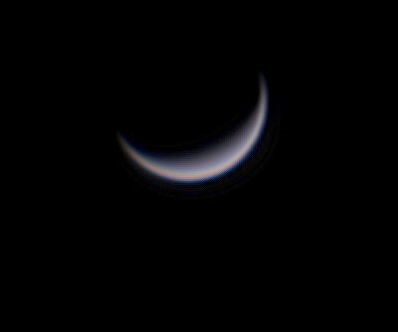
And try looking at Venus as well. With good binoculars you can actually see that it is a tiny crescent, like a crescent Moon. But the best time to look is early in twilight as soon as it becomes visible in a blue sky, otherwise its brightness is too dazzling to see the crescent.
High up in the south-east is Mars. It has a noticeable orange tint to it, which stands out against the other planets. The two stars to its left are Castor and Pollux, also known as Gemini, the Heavenly Twins. Mars is just a tiny dot, and you need a telescope to see its disc.
We’ve created a short video showing you what the planets look like in the real sky, recorded on 27 February:
Now, about the planets being in a line. The map covers a large extent of sky, but the planets always lie along a line around the sky known as the ecliptic, along with the Sun and Moon. So they are always along a line, not just now. But they aren’t close together, so if you were expecting to get a single photograph with them all in, you can’t.
But there are three stars in a line – in the constellation of Orion, over in the south at twilight. You might be able to photograph Orion, Jupiter and Mars all together.
So what about the other two planets, Uranus and Neptune? Uranus is actually quite easy to spot using binoculars. There’s an online guide to finding it, produced for National Astronomy Week at the start of February but which still works, along with a video that shows you an actual view of the sky as seen through binoculars. The link is https://astronomyweek.org.uk/finding-uranus-and-neptune-during-national-astronomy-week/. However, by now, although Neptune is in the same position in the sky as shown on that link Venus has moved on and is no longer a guide. The only feasible way of finding Neptune is using a telescope equipped with an electronic finding system, with a very clear sky and a low western horizon. It is very faint and will scarcely be visible against the twilight sky.
After 12 March the International Space Station starts to put in an appearance, although mostly low in the sky. For a guide finding it, go to our page on finding the ISS.