
The Aurigids (AUR) peak on 1st September. The radiant doesn’t rise till midnight, but there is no moonlight to interfere this year. The September eta-Perseids (SPE) peak around the 9th September, but a nearly Full Moon will rise at 3am. Both showers have rates of around 5 per hour though the Aurigids have been known to outburst up to 50.
In October, the Orionids (ORI) on the 21/22nd will fare better with a New Moon. A nearly Full Moon will wash out the Draconids (DRA) on the 8th, and the Southern Taurids (STA) on the 10th, though the latter are active from throughout October. The Northern Taurids (NTA) overlap the Southern branch, and are active from mid October through into November. All these showers have rates around ten per hour.
Meteor news
Meteor Notes July and August 2022
The Perseids (PER) this year will be blighted by a Full Moon on the morning of the 12th. However, as seasoned observers know, rates can be as high as 100 per hour and the Perseids can produce some bright meteors, so let’s hope for clear skies. The best direction to look will be North, away from the Moon.
The southern Delta-Aquariids (SDA) peak on 30th July with an hourly rate of around 25 but most of the shower will be below the horizon for UK observers. The radiant is highest just before dawn.
The alpha-Capricornids (CAP) peak at much the same time. The radiant is close to the Delta-Aquariids but Capricornids can be distinguished by a lower velocity.
Meteorite Hunting with Drones
Scientists from Curtin University in Australia have successfully used drones to recover a 70g meteorite that fell over Western Australia in April 2021.
The fireball on 1st April 2021 was observed by cameras from the Desert Fireball Network (DFN). Using this footage, a ‘strewn field’ was calculated, that is to say, the area where any potential meteorites might be found.
However, rather than the traditional field-walking fingertip search, scientists decided to use drones and machine learning to help.
One drone surveyed the fall zone with a high resolution camera. The data were then loaded into a machine learning algorithm which hunted for meteorite candidates in the images. To train the algorithm, the scientists placed a few real meteorites in known locations.
Once candidate rocks had been identified, a second drone was sent to take a closer look, flying low over each potential meteorite and sending back high quality images. This allowed the search team to check out the rocks without having to walk to the site.
After the second drone’s work was done the team had identified five likely candidates. They then went in on foot to check each out and to their delight, one of the five turned out to be a 70g recently fallen meteorite! Furthermore, the recovery was very close to the predicted fall line, which demonstrates the effectiveness of the technique.
Although not applicable in every situation this new approach could allow searches to be carried out more quickly and safely, especially in remote or dangerous locations. For example a recent meteorite fall in Croatia remains unrecovered, because the strewn field is also an uncleared minefield.However, this method could be used even in such locations, perhaps even allowing scientists to use drones to safely recover the fall.
So, expect to see more robotic rock recovery in the future!
Full details are available from the ArXiv server https://doi.org/10.48550/arXiv.2203.01466
Meteor Notes May and June 2022
Spring is the season of day-time showers. If you’re operating a radio detector, look out for the many Arietid showers which peak in May and June and can have a combined rate of around 30: the eta Arietids (DEA) at 09:00UT on 9th May, the May Arietids (DMA) at 10:00UT on 16th May, the Daytime Arietids (ARI) at 10:00UT on 7th June plus the zeta Perseids (ZPE) at 12:00UT on the 9th of June.
The only major shower in May or June is the eta Aquariids (ETA) which peak early in the morning of 6th of May. The radiant rises just before dawn so it is best to observe in the early hours. A Visual rate of ten per hour is possible. There’s more about this shower here.
The June Bootids (JBO) have not been active for several years but if you see any enhanced activity between 23rd and 27th June, please let me know.
Possible Tau Herculid Outburst at Dawn on 31st May
In 2022 there’s a possibility of a brief but intense meteor shower around 05:00UT on 31st May.
On the night of 30th/31st May, the Earth is scheduled to pass through the debris trail left behind by comet 73P/Schwassman-Wachmann. This is considered the source of a weak meteor shower, the Tau Herculids. Although it is named the Tau Herculids, the shower’s radiant is now in Bootes, between Arcturus and M3. This drift is due to the influence of Jupiter on the orbit of the dust.
In 1995 comet 73P was observed growing in brightness by seven magnitudes. Closer examination revealed it had broken up into a number of small fragments and by 2006 it was seen to have broken into at least 68 pieces. Breakups of this nature release a lot of dust, and if the Earth passes through the right part of the debris field, there’s a possibility of significantly enhanced shower activity.
Sadly for UK observers, the predicted time of the outburst is between 04:55UTC and 05:17UTC, by which time dawn will be breaking and the radiant will be extremely low in the West. However, if you’re in North or South America, the outburst will be better placed. if you have suitable conditions, look out for slow moving fairly dim meteors.
Meteor Sky Notes March and April 2022
The least said about March the better. All we can hope for is a sporadic fireball leading to a Winchcombe type find!
Luckily April is better. The April Lyrids (LYR) peak on the afternoon of 22nd April. Hourly rates of up to 90 are often quoted but realistically 18-20 is more likely. The radiant rises around 21:00 but the waning gibbous Moon will rise about midnight so the best time to observe will be between these hours.
Later in the month we have the η-Aquariids (ETA), best seen before dawn. The peak is around the 6th of May but meteors may be seen anytime from mid April to mid May so look on any clear morning. The hourly rate is quoted at 40, and with the Moon just past new, moonlight should not interfere too much but a rate of ten is more likely.
14th December Fireball
David Stuart reports that on 14th December, his great niece was watching the Geminids from her South Oxfordshire garden when she was lucky enough to witness – and video – an amazing fireball. Eleanor had popped out into the garden with her mother and sisters having been alerted to the meteor shower by an app on her phone.
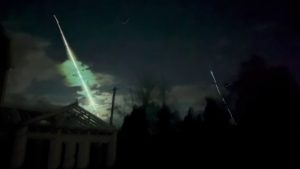
Eleanor recorded the meteor on 14th December 2021 at 22.54 using an Apple iPhone 13. The direction was just south of East from her location near Didcot. The way the meteor lights up the clouds is particularly striking, as David said in his email.
Note also the lens flare to the right, running parallel to the meteor. In the video you will see that this goes upwards.
Here’s the video, which is well worth a watch!
Meteor outlook for January to March 2022
The Quadrantids (QUA) begin in late December and peak on the night of 3rd/4th January. This year there will be no Moon to interfere so rates of 40-50 are possible. If the skies are clear this shower is well worth getting outside for – but wrap up warm!
Meanwhile the December Leonis Minorids (DLM) will be rumbling along in the background till February. Rates are low. Other showers in January and February are either very weak or impacted by moonlight.
As frequent readers will remember, the Anthelion Source is active during this period. The anthelion is the name for a large number of weak, badly defined sources covering a huge patch on the opposite side of the sky to the Sun. You will pick up meteors from this any time between December and September but you are more likely to pick these up on a radio detector.
Meteor outlook for November and December 2021
The Northern Taurids (NTA) will be fading away in early November. The Leonids (LEO) peak on 17 November, but will be blighted by a nearly full Moon. Expect 2-3 meteors per hour in the conditions. The minor showers of late November (Nov. Orionids and Phoenecids) are also impacted by moonlight.
The Geminids (GEM) peak on 13-14 December. The Moon will be just past first-quarter and will set around 2am UK time when the radiant will be high in the southeast at midnight and rates of 40 per hour are realistic. The Monocerotids (MON) peaks at the same time. Later in the month, the Ursids (URS) peak on 22nd December. Rates should be around five per hour, with the Moon not interfering.
Finally the Quadrantids (QUA) begin in late December. This year there will be no Moon to interfere so rates of 40-50 are possible.
Slovenian Meteorite Recovered via Dashcam Footage
After eighteen months of painstaking analysis, researchers have been able to track down and collect fragments of a daytime fireball that burned up over Slovenia in February 2020. So far, 720g has been recovered, with an estimated 2kg still to be found.
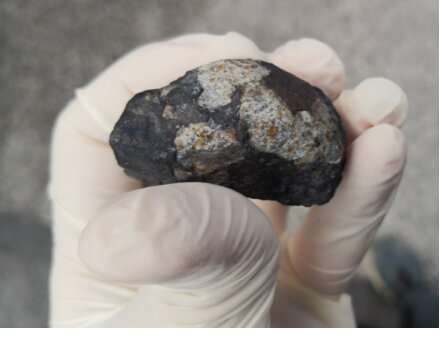
The team, led by Dr Denis Vida of UWO, collected dashcam and securitycam footage, and even cyclist’s helmet cam view, to work out the object’s trajectory and eventual fall zone.
Normally this can only be done if there are stars in the field of view to ‘calibrate’ the meteor’s movement, but as this was a daytime event no stars were visible. Furthermore, most meteor cameras are stationary, but dascams are often moving at up to 70km/h! This presented a difficulty for the team.
However many images contained identifiable buildings or landmarks such as lamp posts. So in lieu of stars, the team asked local photographers to image the same landmarks from known nearby locations at night. After much painstaking, detailed analysis this allowed the team to accurately determine the pointing direction and GPS coordinates from which each frame of each dashcam video had been taken to within a few centimetres, and then to calibrate it against the starfield that would have been visible, had it been dark.
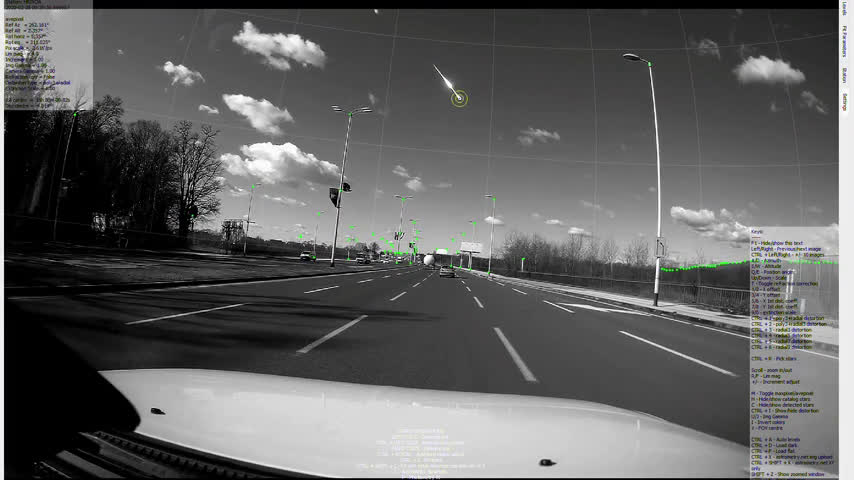
Meanwhile, knowing the precise brightness of the fireball was also important, as this can be used to work out the object’s mass. Its important to know this as larger objects are more likely to survive and leave meteorites behind. Again this calculation is normally done by comparing to stars in the field of view but instead the team bought an identical dashcam, which they then calibrated against a known light source.
Finally, using the opensource RMS software, they were then able to determine the trajectory of the meteor. This analysis suggested that although it fragmented into at least seventeen pieces, the meteor disappeared from view at an altitude of under 20km, meaning that fragments were very likely to have reached the ground.
The analysis also allowed the team to calculate the ‘fall zone’ to within fifty metres. Much of it was over farmland, and its likely that in the intervening 18 months, some material has been lost to ploughing and other agricultural activity. Nonetheless, over 700g of material was recovered from this zone, demonstrating the usefulness of this technique. Expect to see more work and hopefully more recoveries using this approach!
A short presentation given by Dr Vida at the Europlanet Science Congress (EPSC) 2021, can be found here.