
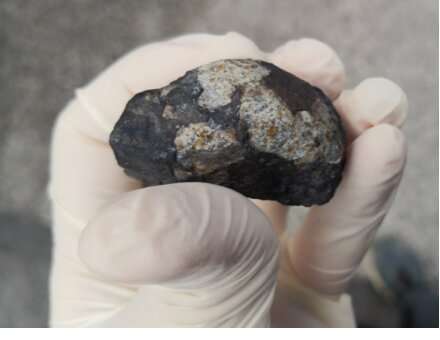
After eighteen months of painstaking analysis, researchers have been able to track down and collect fragments of a daytime fireball that burned up over Slovenia in February 2020. So far, 720g has been recovered, with an estimated 2kg still to be found.
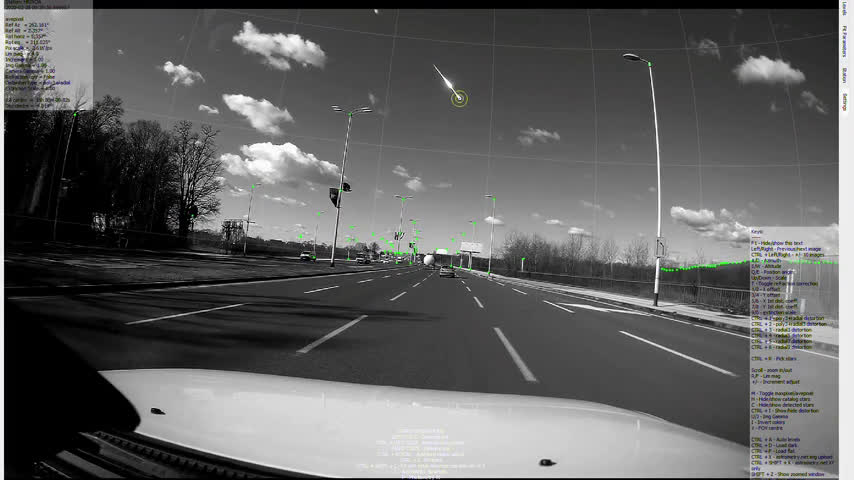
The team, led by Dr Denis Vida of UWO, collected dashcam and securitycam footage, and even cyclist’s helmet cam view, to work out the object’s trajectory and eventual fall zone.
Normally this can only be done if there are stars in the field of view to ‘calibrate’ the meteor’s movement, but as this was a daytime event no stars were visible. Furthermore, most meteor cameras are stationary, but dascams are often moving at up to 70km/h! This presented a difficulty for the team.
However many images contained identifiable buildings or landmarks such as lamp posts. So in lieu of stars, the team asked local photographers to image the same landmarks from known nearby locations at night. After much painstaking, detailed analysis this allowed the team to accurately determine the pointing direction and GPS coordinates from which each frame of each dashcam video had been taken to within a few centimetres, and then to calibrate it against the starfield that would have been visible, had it been dark.
Meanwhile, knowing the precise brightness of the fireball was also important, as this can be used to work out the object’s mass. Its important to know this as larger objects are more likely to survive and leave meteorites behind. Again this calculation is normally done by comparing to stars in the field of view but instead the team bought an identical dashcam, which they then calibrated against a known light source.
Finally, using the opensource RMS software, they were then able to determine the trajectory of the meteor. This analysis suggested that although it fragmented into at least seventeen pieces, the meteor disappeared from view at an altitude of under 20km, meaning that fragments were very likely to have reached the ground.
The analysis also allowed the team to calculate the ‘fall zone’ to within fifty metres. Much of it was over farmland, and its likely that in the intervening 18 months, some material has been lost to ploughing and other agricultural activity. Nonetheless, over 700g of material was recovered from this zone, demonstrating the usefulness of this technique. Expect to see more work and hopefully more recoveries using this approach!
A short presentation given by Dr Vida at the Europlanet Science Congress (EPSC) 2021, can be found here.