
January

The first shower of the year is the Quadrantids. In 2023, the Quadrantids were less dramatic than previously, with cloud interfering for many observers. UKMON only picked up 459 confirmed Quadrantid meteors compared to 738 of the lesser Comae Berenicids shower a week earlier. By contrast, Phil’s radio picked up as many as 100 Quadantids per hour at one point.
Fireballs
We had two reports of a fireball at 01:00 UT on the 9th, from Dave S and John Clinch. Louise Sullivan reported another at 06:58 on the 19th, and Carla Foster reported another almost exactly two days later at 06:67 on the 21st.
Dawn meteors seem to be the thing, because Tony Care spotted another fireball on the 24th, this time at 06:53 UT. This one was detected by the video networks including my own camera (see picture) and proved to be a magnitude -7 event.
Click the image for a more detailed report.

The final reported fireball of the period was an evening event on 28th, at 21:25 UT and was reported by Pieter Jackson. There was a magnitude -10 fireball on the 31st – but unfortunately the UK was clouded out and so all we got on camera was brightly lit cloud! Let’s hope for clearer skies next time.
February and March
Meteor Section Report: February and March 2023
January to mid April are the ‘dry season’ for meteors, with no night-time showers and very little sporadic activity. So, there’s not much to report this time round.
Fireball CX1

We do often get fireballs though and the main event of note for this period is of course the asteroid 2023 CX1 that fell over Western France on the 13th of February at 02:59 UT. This was seen by many UK observers, including Amy Fell who saw it from southern England and sent in a report via the Fireball page on the website. The flash was seen as far away as Glasgow and North Wales, even through cloud!
The asteroid’s descent was also captured by three cameras in the UK Meteor network. The data from these cameras contributed to identification of the fall zone, and to the subsequent recovery of meteorites from the ground. Multiple fragments were recovered, much to the delight of all concerned.
There’s more on this story in the Meteor Section News on the website – click the image to read the story.
April and May
It has been a very quiet couple of months for meteor hunters. The April Lyrids this year were pretty quiet, with even the video networks only detecting a few. The Eta Aquariids in May were also very quiet. The UK Meteor Network’s video cameras picked up about 300 confirmed meteors in each shower – but that was across the whole of the UK!
There were also no notable fireballs over the UK in April, and only one in May, just East of Scotland. The attached picture was taken at Kielder dark sky site, over 100 km from the meteor, and shows how far away you can see them. Sadly, the meteor was over the sea and any meteorites will be ‘sleeping with the fishes’…
May and June also host some daytime showers. Phil Hayward used his radio meteor detector to record a couple of these, the Epsilon and May Arietids whose radiant is in Aries. The first in particular show a strong “diurnal” effect, with a peak in the early morning. The May Arietids showed very little activity overall.


June and July
June and July are normally quiet for meteor hunters. This year however, there have been worldwide reports of high numbers fireballs associated the Alpha Capricornid meteor shower. The American Meteor Society reported SEVEN fireballs on the night of 25th and morning of 26th July (see here https://tinyurl.com/2jfafc26).
Similar reports were made from other countries around the world, and indeed the UK Meteor Network picked up two very bright events on the same evening (see pictures). The science behind this is still being worked out, but it is believed to be a “resonant swarm” caused by an interaction between the meteoroid stream and the gravity wells of the gas giants Jupiter and Saturn, which can act like a lens and focus the debris stream into a narrower beam.
That’s it for June and July. As I write, we’re seeing the Perseids ramp up and next month I hope to have a report of more fireballs!
August and September
Perseids
Conditions were good for the Perseids this year. My own meteor cameras picked up nearly 1000 meteors on the night of the peak and across the UK, the camera networks detected 64,000 Perseid meteors overall, matching 70% of them up to give 6100 confirmed multi-camera events, while cameras contributing to the Global Meteor Network confirmed 21,363 Perseids. The global network now has more than 1000 cameras, 200 of them in the UK, and the number is growing every week. There were also three reports of fireballs made via the website, on the 7th, 11th and 14th of August..

Closer to home, Tom Banks reports three Perseids on the night of 8/9th August, and 15 on the night of 11/12th. He also photographed several on the night of 12th/13th, including the one seen in the picture of Fiddler’s Ferry below. This photo is a great example of how you can combine star trails, meteors and landscape photography to create something special
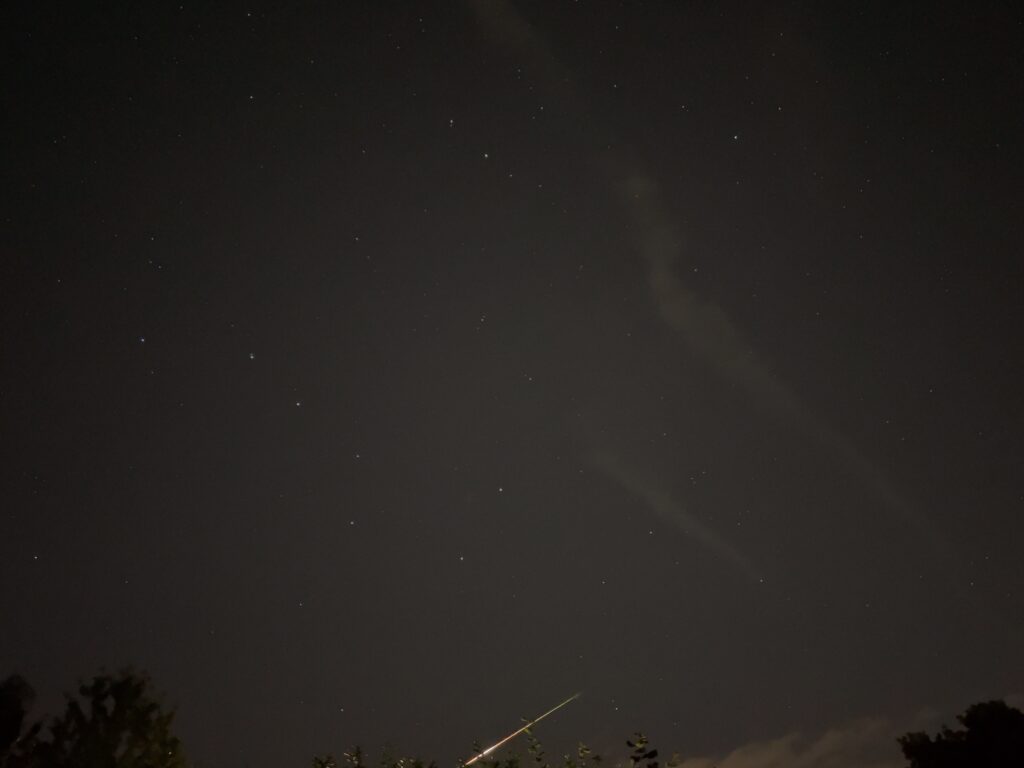
On the subject of photographs, Andrew Hampton sent in this iPhone picture of a Perseid. Phone technology has come along in leaps and bounds since I first took a grainy photo of the Moon a decade ago, and with that in mind I’m intending to write an article for the website focusing on phone photography. Thank you, Andrew for the suggestion!
Other Showers – Kappa Cygnids & Aurigids
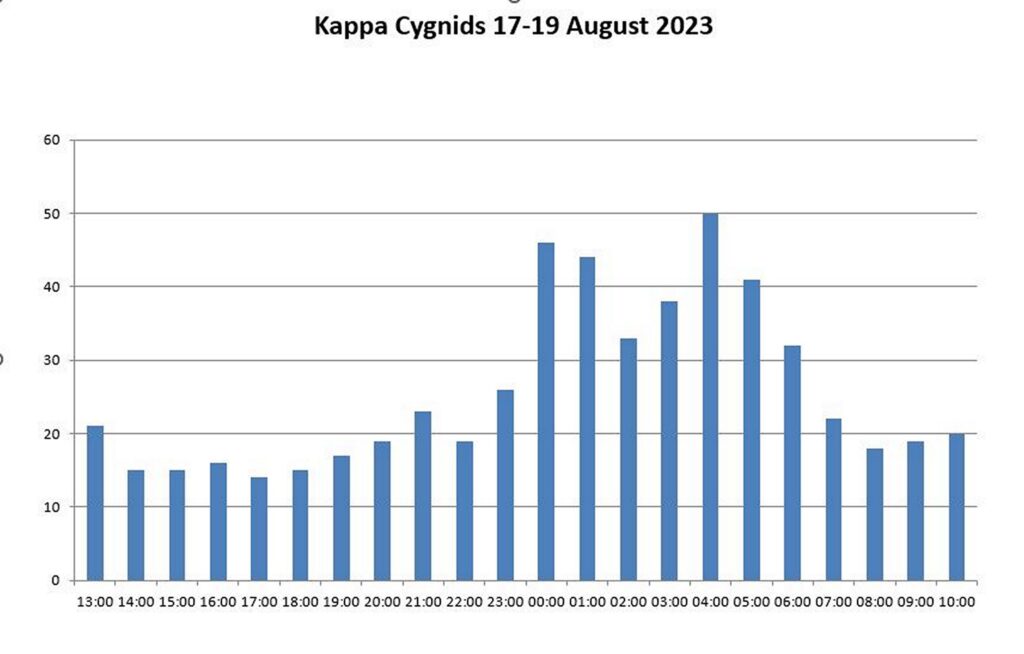
Visually, both these showers were pretty quiet this year with even the Global Meteor network only reporting around fifty of each worldwide. However, using a radio detector, Phil Hayward was able to identify a strong Kappa Cygnid peak over the background of around 30 per hour at 4am on the 18th, and a weaker Aurigids peak around midnight on the 1st of September. My own radio detector was unfortunately offline during the Perseids, but shows similar peaks to Phil’s for the Aurigids. Note that radio data usually shows higher counts than visual because it is able to detect fainter meteors, and works irrespective of the weather or time of day.
Fireballs
As well as the three Perseid fireballs mentioned earlier, fireballs were reported via the website at the following times:
09 Aug 2200 Bob Weedon, southern England
14 Aug 2145 Jonny Carr, Southern England
05 Sep. 2023 Stephen Booth, Waltham
09 Sep, 1930 Patricial Simpson, Chacewater
24 Sep, 2026 Noel Stewart, Desertmartin NI
The UK Meteor Network also reported fireballs, some of which were a long way away!
07 Aug 2326, Mag -4.5 sporadic at 2326, over Norway
20 Aug 0001 mag -7 sporadic 100 miles south of Ireland
21 Sep 2204, mag -4.3 sporadic over the Yorkshire Dales
24 Sep 0132, mag -7 sporadic over Wales
24 Sep 0400 mag -6.5 sporadic over the South Downs
None of these were considered to have dropped meteorites, but we continue to hope!
October and November
Regular Showers
Once again, the October Draconids were a non-event, with only one confirmed orbit being detected by the UK meteor video network. The Orionids on the 23rd of October were more interesting, with over 2000 confirmed orbits, and the Northern and Southern Taurids yielded around 1100 confirmed orbits between them while over 600 Leonids were confirmed.
The video network now has very good coverage over all of the UK south of the Highland boundary line, and many minor showers were also detected. There are details on their new website (link below).
Radio Detections
Phil Hayward sent in reports for radio detections of the Draconids, Orionids and Leonids. Phil reports a radio peak for the Draconids, while he reports a weak peak for the Orionids and a peak for the Leonids on the morning of the 18th. My own radio detector picked up similar patterns which is interesting considering the lack of visual reports for the Draconids and the large number reported for the other showers.
This shows why it’s important to use different techniques to take measurements. Radio detectors are only able to pick up events that occur between the transmitter and detector but will detect during daytime and through cloud, while video cameras can only pick up events at night and only if it is clear, and then only down to about magnitude +6. So, the two methods detect different sorts of event and complement each other.
Fireballs
- UK video networks picked up an astonishing fifteen fireballs in October and November, many of which were also reported through the SPA website.
- Lisa Glazebrook reported a fireball on 17th October at 21:15 which was later confirmed to be a magnitude -4 Sporadic meteor over the North Sea.
- Linda Graham reported fireball on the 29th at 22:10, which can be matched to many other visual reports made to the IMO.
- Pete Graham reported a fireball on the 30th which can be linked to many other visual reports, and to video detections over the Channel Islands.
- Chris P reported a fireball at 20:45 on the 3rd of November, which can be matched to a mag -6 sporadic meteor over Essex and detected by many video cameras.
- Finally, Rachel More reported a bright fireball on the 30th of November which can be linked to a very bright mag -7 sporadic detected over Northern Scotland.
More details of these, and the other fireballs detected during October and November, can be found on the UK Meteor video network’s new website https://archive.ukmeteors.co.uk
December
Regular Showers
The year ends, and the next begins, with two major showers, the Geminids which peak on the night of the 13th of December and the Quadrantids on the night of the 2nd of January. Four minor showers also take place in December.
Geminds

There were few visual reports of the Geminids, probably due to the weather. However, Mark Hardaker spent an hour around midnight on the night of the peak. He recorded eleven Geminids and sent in a chart showing their locations on the sky. This is a really interesting way to look at the data, and clearly shows the location of the radiant.
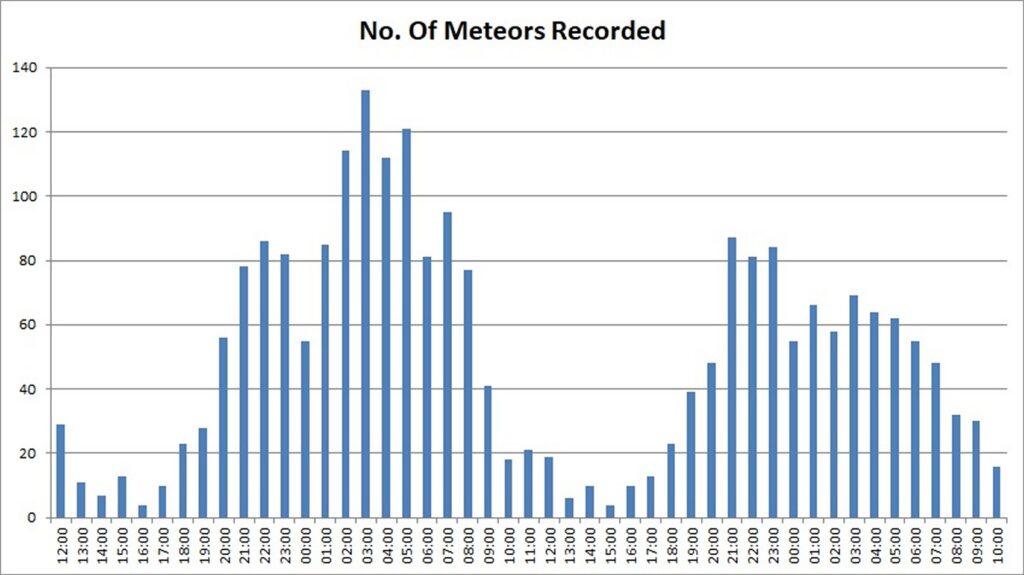
Phil Hayward’s radio detector was also running and at the peak detected 130 meteors an hour. There was a probable second peak the following evening of about 80.
The UK Meteor Network’s cameras picked up around 50,000 single-station detections from 202 cameras which were matched up into 5012 confirmed Geminids. The brightest was magnitude -8.3. The video data showed a strong peak on the night of the 13th/14th as expected.

Minor Showers
December hosts many minor showers including the Hydrids, Ursids and Coma Berenicids. Visually, these showers are not spectacular, but the video networks picked up 458 Hydrids and 380 Coma Berenicids.
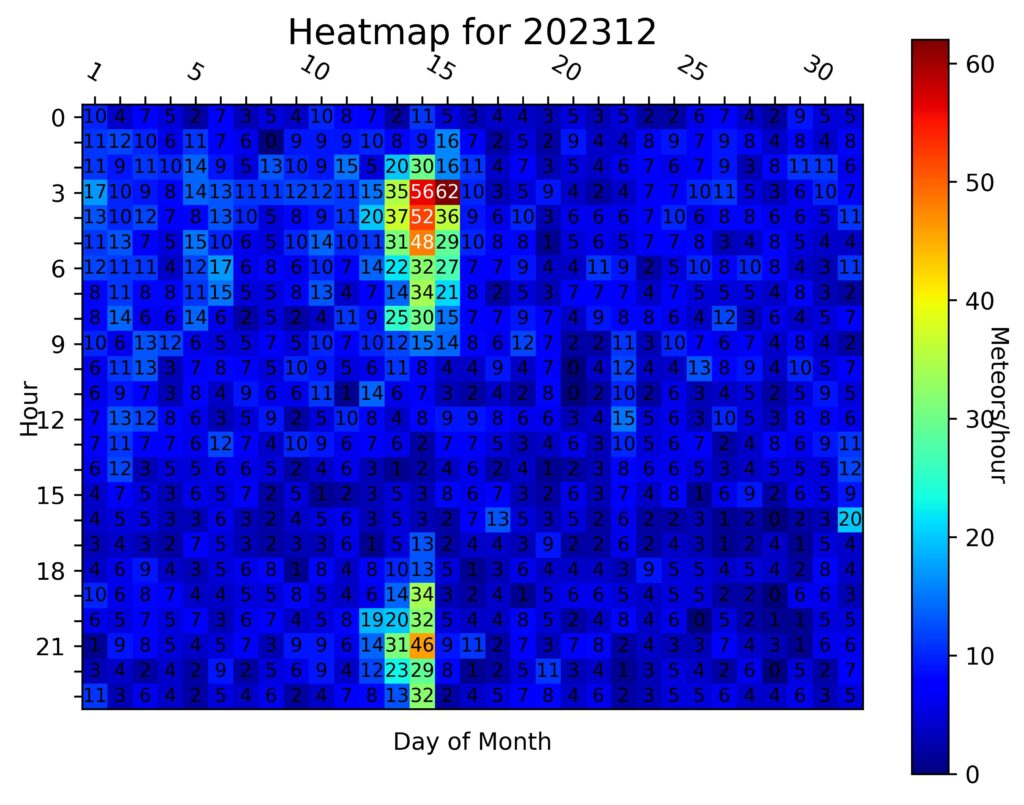
The Ursids peak on the night of 22nd of December, but very few were detected by the camera network or by the section director’s radio detector. There may be some slight increase in rates around the Ursids peak but you need a lot of imagination to find it! The Geminids on the other hand are very clear.
Fireball reports
Four fireballs were recorded by the UK Meteor Network in December. The brightest was 30th Dec at 0207 over the coast just south of Dartmoor which may have dropped a few grammes of meteorites on the moor.
