
December 2022
Regular Showers
The two main showers of the Winter are the Geminids in December and the Quadrantids in January.

The skies were clear over much of the for the Geminids, and Tom Banks reported 66 from the 13th December and 39 on the 14th, including a magnitude -5 fireball at 21:26 UT on the 13th and a magnitude 06 fireball at 01:56 UT on the 14th. Both exhibited a bluish colour.
Across the country, the UK Meteor Network picked up about 6700 confirmed Geminids, a record for this shower in the UK. On the other hand, Phil Hayward detected no Geminids with his radio which is unusual. My own detector picked up a good few.
October and November 2022
Regular Showers
There were no reports of any October Draconids this year, and the UK Meteor Network’s cameras also didn’t detect any. However this shower coincided with a full Moon. The Orionids fared better with over 2000 matches reported by UKMON though no fireballs. The Northern and Southern Taurids were also well represented in video data, with 650 and 360 matches respectively.
2022 was also a “Taurid Swarm” year, when there’s a higher concentration of meteoroids in resonant orbits similar to the Taurids. The Taurids and other Taurid-related meteors are linked to Comet 2P/Encke which we believe broke off a larger body long ago, leading to a lot of debris in a resonant orbit between the Sun and Jupiter. When the resonances are just right, the stream is denser leading to more activity not just in the two main Taurid branches, but also in several lesser streams.
The Taurid Swarm tends to lead to more fireballs, and this year was no exception with fourteen being report between the 9th of October and the 24th of November! Three were potential meteorite droppers too, though two were over the sea (one between Ireland and Scotland, the other between England and Belgium).
By an amazing coincidence, the other was over the Cotswolds – and the potential fall zone was less than 10km from Winchcombe. A ground search was carried out by teams from the Natural History Museum, UKMON and several UK universities, but to no avail. At the time of the fall, the wind speed and direction were quite variable, and so we think it is likely that any rocks would have been pushed randomly away from the calculated fall line, leaving an area too large to search thoroughly. Furthermore, the ‘fall zone’ was a mixture of sheep fields and rabbit warrens – and so there were plenty of little black objects to confuse the searchers! A picture of this meteor as seen from Oxfordshire is shown here.
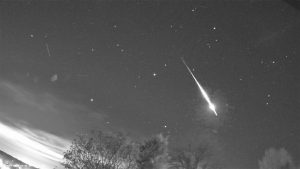 Finally we come to the Leonids, which this year were fairly quiet. The UK Meteor Network reported only 130 matches, none bright enough to be a fireball, though the brightest event would have been spectacular to anyone on a fishing boat about fifty miles west of Scotland. The picture below was taken from near Glasgow.
August and September
Perseids
For once, the skies were clear for the Perseids – though a Full Moon didn’t help.
Nonetheless, Pam Foster reports that she was able to observe for five nights in a row, with the number of Perseids steadily increasing each night. She reported six Perseids on the 9th/10th, nine on the 10th/11th, 11 on the 12th/13th, 13 on the 13th/14th and 11 on the 14th/15th as well as a few sporadics. 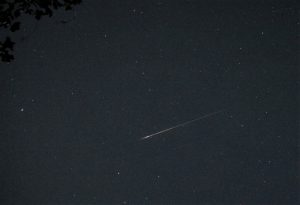
Tom Banks also observed on three consecutive nights, reporting 10 Perseids on the 10th/11th, four on the 11th/12th and 29 on the 12th/13th including a couple of magnitude -4 events. One of Tom’s photographs is shown here.
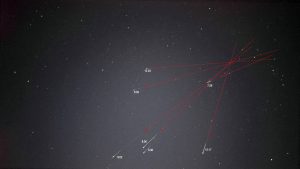
Robin Scagell made video recordings using a Sony A7S on the night of the 12th, recording 66 meteors in two and a half hours, including 15 sporadics. Robin also stacked several detections and traced their paths back to identify a radiant – see picture below. Robin’s camera was fitted with a 28mm f/2 lens and he was shooting at ISO 80,000.
 Paul Brierley also picked up a nice Perseid meteor with his Canon 1000D using an f/2.8 29mm lens.
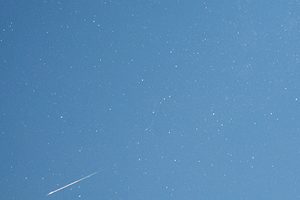
Mary and I also sat out on the night of the peak, recording about twenty between us, though we found it quite hazy with a limiting visual magnitude of about 3.
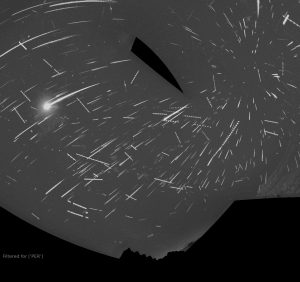
Our meteor cameras were also very active: from 9th to 14th August, we detected 1889 Perseids! That sounds a lot, but our four cameras can see almost the whole sky, bar a small patch at the zenith, and are more sensitive than the human eye. The picture here shows all the meteors detected on just the night of 12th. The location of the radiant is obvious!
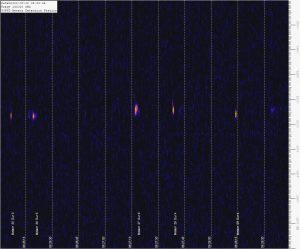
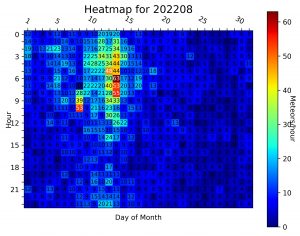
Radio activity was also high. Phil Hayward sent in a report showing a strong peak around 5h UT on the 13th, and some of his radio detections can be seen below. My own radio detector also showed the shower very clearly, with up to 60 meteors per hour at around 6h UT, as shown in the heatmap.
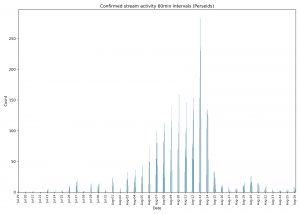
Finally, the UK Meteor Network had one of its most impressive Perseid showers ever, with 130 cameras over the whole UK capturing over 60,000 individual detections. This resulted in 7,300 confirmed Perseids whose orbits were calculated. Several fireballs were reported but sadly, there were no meteorite droppers. The UKMON Perseid report can be found on their website archive.ukmeteornetwork.org
Other Showers – Kappa Cygnids & Aurigids
There were no members’ reports of Kappa Cygnids or Aurigids, both of which seem to have been quiet this year. Even the UK Meteor Network reported only 130 Kappa Cygnids and 485 Aurigids. Perhaps everyone was worn out after Perseid hunting!
Fireballs
The big news was the fireball on 14th Sept at 21h UT seen over Northern Ireland and Western Scotland by over 1000 observers, including one person who heard it while camping on the island of Mull. Analysis suggests this was a relatively slow-moving chunk of asteroid that burned up over the sea, just south of Islay. The UK Meteor Network’s analysis of this event is available here https://tinyurl.com/3evv92bw. The International Meteor Organization (IMO) have a collection of reports and videos here https://tinyurl.com/ww4cye52 .
There were also reports of several other fireballs.
Nigel Willoughby reports a fireball on 14th August at 21:00 UT. This was probably over France. Joe O’Neill saw a fireball over Northern Ireland on 12th Aug at 21:40 UT and Amber Mullins reported a bright fireball on 17th Sept at 03:52 UT over Wales, reported to the IMO by many observers.
Sasha & Gareth Jackaman-Jones reported a fireball over southern Ireland on 24th Sept at 22:24 UT. This event was reported to the IMO by many other observers, while Roger Parker in South Wales saw a different bright event on 24th Sept, this one at 01:20 UT.
June and July
There are very few night-time showers in early Summer, with only the alpha-Capricornids in late July (and even they are best seen just before dawn). Consequently, there’s very little to report from night time observers.
There are however plenty of day-time showers detectable using radio, and Phil Hayward sent in a report on several of these. Phil reports that the Daytime Arietids peaked a few hours earlier than expected on the 7th of June and the Zeta Perseids showed a strong peak around 6am, though the diurnal effect might be partly to blame (for various reasons, more meteors are normally seen between midnight and dawn, causing a diurnal variation in meteor counts from radio detectors).
Finally for daytime showers, we have the elusive June Bootids, whose very existence is now uncertain as although there was a surprise shower in 1998, it has not been regularly recorded. This year, Phil’s radio detector picked up some activity, but my own did not so the question is still open!
It has also been a quiet period for fireballs and only one was reported to us via the website. Ernie Armstrong in West London reported a bright fireball at 00:37 BST on the 27th of June. There were several other visual reports made of this event, and it was also captured by an allsky camera near Ipswich. The UK Meteor Network also picked up a magnitude -4 fireball that passed over the Bristol Channel and broke up over the Mendips with no chance of any meteorites.
April and May
There are only two showers of note during April and May, the Lyrids and eta Aquariids. This year’s Lyrids were a quiet affair with no reports of any particularly bright events. The brightest event reported was a magnitude -2.5 meteor seen over Derbyshire and picked up on a dozen UK Meteor Network cameras. The eta Aquariids which peak around the 6th of May but rumble on for six weeks from mid-April, were even quieter with nothing brighter than -1.4 reported.
On the other hand, we had plenty of fireballs, and even a couple of likely falls!
April
It started on the 1st of April with a bright fireball seen over Southern England and reported to the International Meteor Observation network by Stan Armstrong amongst others. Stan saw it ‘head on’ and so only has a picture of a bright flash.
Then on the 9th of May there was a spectacular magnitude -6 fireball off the South Coast. Analysis suggests that this meteor dropped rocks into the sea just south of the Isle of Wight near Blackgang Chine though for a while we thought this might have made landfall. If you’re out walking in the area, please do keep an eye out though!
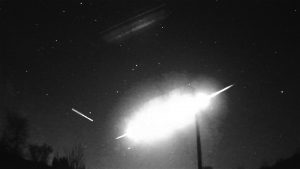
[Right, Fireball 9th April, picture courtesy of UK Meteor Network/Richard Fleet]
Four days later, there was another massive fireball, this time at least magnitude -8. This one was over North Wales, and calculations show that it dropped meteorites onto an area near Shrewsbury. The UK Fireball Alliance organized a search but unfortunately no rocks were recovered despite an extensive hunt. We remain hopeful that the public will find something though. This event was reported via the website by Jim Partridge, Debs Hancock, Stephen Macaulay, Ian Parker and Kate Hurcombe amongst others.
[left below, Fireball 13th April, picture courtesy UK Meteor Network/Gareth Oakey]
April wasn’t quite done with us though, delivering another bright fireball on the 20th which 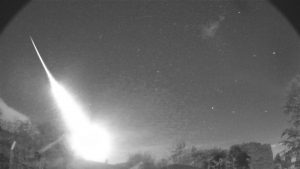 was seen over south Yorkshire. No meteorites this time though – it exploded too high in the atmosphere for anything to survive.
May
On to May next, and with it, more fireballs and bright meteors.
First up, a probable Earth-grazer on the 8th of May. Earth-grazers are meteors that skim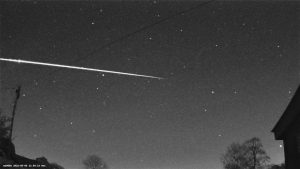 across our atmosphere and shoot off into space. They typically leave long trails as shown in the photo.
[Earth-grazer 8th May picture courtesy UK Meteor Network/Patrick Poitevin]
Then on the 11th there was another magnitude -8 fireball, this time over southwestern England and South Wales. Again, the UK Fireball Alliance reckon this dropped meteorites, 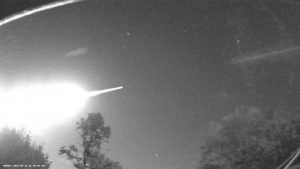 but due to the shallow angle of approach the fall zone was huge – from Bridgend to Treorchy – and nothing was found. Again, we’ve appealed to members of the public for help.
[Fireball 11th may picture courtesy UK Meteor Network/Rob Agar]
And finally, another fireball was observed in the early morning of the 29th of May, this time 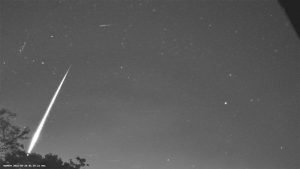 over Suffolk. Unfortunately, it burned up too high to drop meteorites, but it still looked pretty spectacular!
[fireball 28th May c/o UK Meteor Network/Andrew Cooper]
February and March
Early Spring is often known to meteor hunters as Fireball Season as we seem to see more fireballs at this time of year. There’s no scientific reason for it, and statistically fireballs are no more common than at other times. It’s probably just that a lack of big meteor showers between January and April probably makes any bright meteors stand out more.
Reasons notwithstanding, this year has not disappointed.
SPA member Neil Waby reported a fireball on 25th February at 21:50. He estimated it at magnitude -5 and says it had a yellowish colour. It was to the North West of him in Lincolnshire, and probably corresponds to an event picked up by the UK Meteor Network on video cameras (see https://tinyurl.com/4rfdd8tj ). The event was also reported via the website by Steve Toms.
The UK Meteor network also reported a very bright event on the 14th of February at 05:41. This was picked up by eight cameras, travelling North West over Devon (https://tinyurl.com/ef4wtu4p ). Visually this was pretty spectacular, with a big terminal explosion.
Heather Lings reported another fireball on 17th March at 19:55. Using the form on the website, Heather reported that the event lasted about 3.5s. The International Meteor Organization have several other reports of this event, which seems to have been over the North Sea, travelling eastwards.
Finally, via the website, Alex Sayers reported a bright event at 23:09 on 22nd March. This event, which was also reported to the IMO by 40 other observers, was travelling north-eastward over the South Downs. Alex reports that it had a persistent train and an orangeish colour. The UK Meteor Network also picked this one up (https://tinyurl.com/53az4puj).
January
The Quadrantids peaked on 3rd January this year. Unfortunately for many of us it was cloudy, but Pam Foster managed to spot five Quadrantids and three sporadic meteors during three windows in the cloud. Four were short and fast, but the last was brighter with a longer train. The UK Meteor Network reported 673 confirmed video detections matched by more than one camera. Interestingly, the busiest night was 5th but this is more likely to be due to the weather than any unexpected behaviour of the shower. Phil Hayward again monitored with his radio detector and interestingly saw a peak around 11:00 UT on the 3rd then a second around 01:00-03:00 UT on the 4th, which matches my own radio detector.
Fireballs
As well as the spectacular fireball mentioned earlier, Neil Waby reported a fireball at 21:30 on the 7th of January. The UK Meteor Network also caught this event and report that it was a mag -4.3 Northern chi Orionid. There’s more on this event here https://tinyurl.com/32v4d9r6.
There were also reports via the website from Simon Jessup who saw a bright event at 18:30 on the 14th of January and from Ernie Armstrong who reports a fireball seen from Loudwater on the 19th January at 17:51.
Finally, there were reports from Simon Downs and Emily Morton who both saw the 18:48 fireball that was detected over much the North East on the 29th of January. This last was also detected by the UK Meteor Network who were able to determine that it was a magnitude -5.1 sporadic fragment from the outer main Asteroid Belt. More information is available here https://tinyurl.com/bdhx8f96