
January
Quadrantids
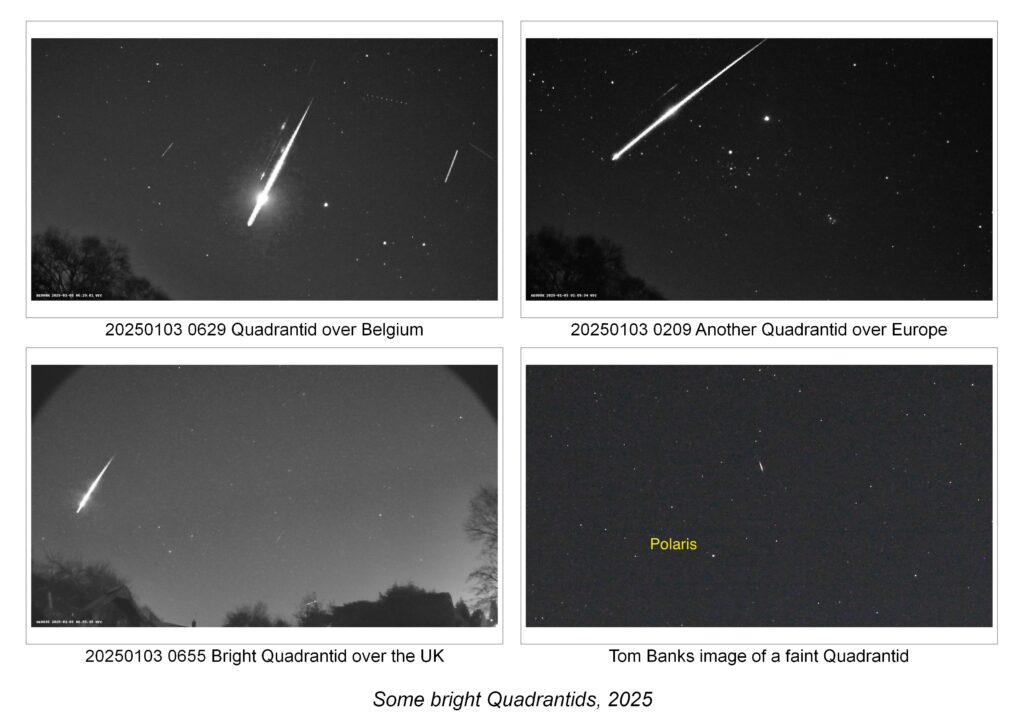
Tom Banks braved the predawn weather on the morning of the 3rd and picked up 21 Quadrantids and a few sporadics between 05.00 UT and 07:23 UT, though cloud frequently interrupted viewing. The video networks picked up around 2500 confirmed Quadrantids, almost entirely on the night of 2nd/3rd January. This is normal for the Quadrantids, which have a sharp but strong peak.
Fireball reports
SPA members reported four fireballs to the International Meteor Network in December, and four in January. One of those reported by SPA members via the IMO was on the evening of the 1st of December over the border between Scotland and England. This event reached magnitude -6.
In addition, I received reports of two other fireballs, on the 12th of December with a visual magnitude of at least -6 off the east coast of Scotland and over South Wales on the 26th, reaching visual magnitude -5.7.

February and March
There are no major showers in February or March, and no members reports of any radio activity. There were however a few nice fireballs seen during this period.
Over 300 people across Europe, including 20 in the UK, reported a fireball on 19th February at around 03:44 UT. The event was over northern Germany but was still about magnitude -1 even in the UK. The IMO report on this event and more images can be read here https://spa.imo.net/members/imo_view/event/2025/1019
Fireball over Germany on 2025-02-19 at 03:45 as seen from the UK
Another bright event was reported by 136 people over Southern England on the 26th of February at around 16:35 – see https://spa.imo.net/members/imo_view/event/2025/1191 for more information.
There was also a fireball seen over Northern Scotland on the 4th of February at about 22:15. A short video of this event is available here https://spa.imo.net/members/imo_view/event/2025/763
Finally, a fireball was seen off the coast of North Western England on the 18th of March at around 22:37. The IMO report of this can be found here https://spa.imo.net/members/imo_view/event/2025/1646
The UK Meteor network picked this event up on 20 cameras, and photos and details of the meteoroid’s orbit are here https://archive.ukmeteors.co.uk/reports/2025/orbits/202503/20250318/20250318_223302.406_UK/index.html
Fireball seen over NW England on 18th of March 2025.
April and May
The April Lyrids peaked on the 23rd of the month. No unusual activity was noted although there was one bright fireball detected at 01:38 on the 23rd over North-Eastern Scotland. The UK Meteor network has more information about this in the Lyrids report https://tinyurl.com/mr2zeppy.
The May Eta Aquariids peaked on the 6th and were very quiet this year with no unexpected activity around the peak. However, on the 14th of May there was an interesting Eta Aquariid that came in at a very shallow angle of 10 degrees and travelled for over 100km over Kent, Surrey and London. The ground track and some pictures of are on the UK Meteor Network’s site here https://tinyurl.com/ms4ycmrp
There were also a few other fireballs of note.
On the 10th of April there was a very bright magnitude -6 fireball over Northeastern Scotland. This was a sporadic that was picked up by the UK Meteor Network.
68 people also reported a bright event over Scotland on the 16th of May at 20:38, though it as it wasn’t dark yet there are no photos of it. A day later on the 17th, 58 people reported another fireball over Derbyshire, this time at 21:30. More can be found out about these events on the IMO website https://tinyurl.com/pfzp6za8
Finally, and excitingly, on the 23rd of April and in addition to the Lyrid detected over Scotland, a second fireball was detected over Southern England. We believe this one probably dropped a few meteorites near Bury St Edmunds, though nothing has been found yet. There’s a news article about this in the meteor section of our website here https://tinyurl.com/3puttvst

June and July
The main event of June and July this year was a meteorite-dropping fireball over Scotland on the 2nd of July.
This event, widely reported in the papers, travelled east over Ben Nevis and probably dropped meteorites a few miles to the south of Spean Bridge (see map below). The meteor shone as brightly as magnitude -12, as bright as the Full Moon!
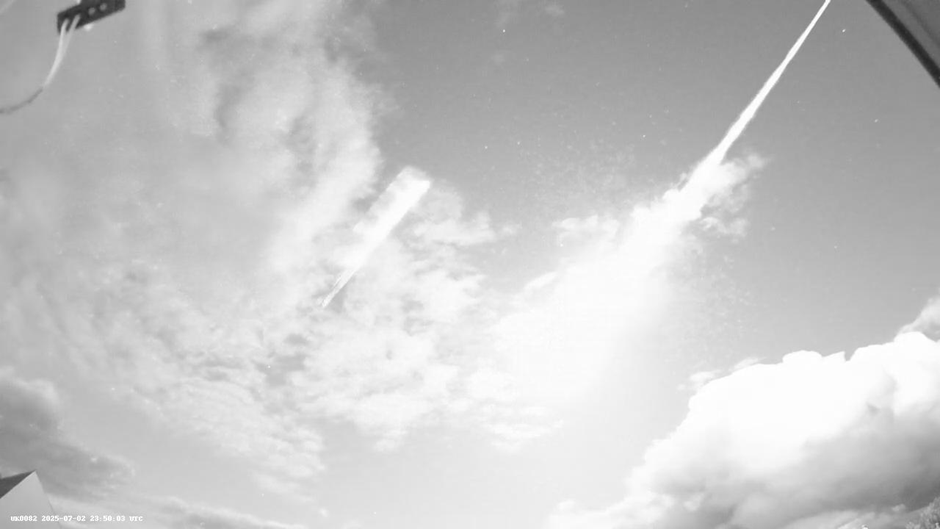
The meteor was tracked by the UK Meteor Network’s cameras and seen by dozens of members of the public who reported it via the IMO and to the press. The terrain is very wild and remote so no search has been organized but UKMON have urged anyone who lives or is walking in the area to keep an eye out for small black rocks.
There’s more on the BBC news website here https://www.bbc.co.uk/news/articles/cq8ze2vnz38o
and a full technical report with photos and video is available on UKMON’s website. https://archive.ukmeteors.co.uk/reports/2025/orbits/202507/20250702/20250702_235005.149_UK/index.html
The fireball as seen from one of the UKMON cameras in Central Scotland.
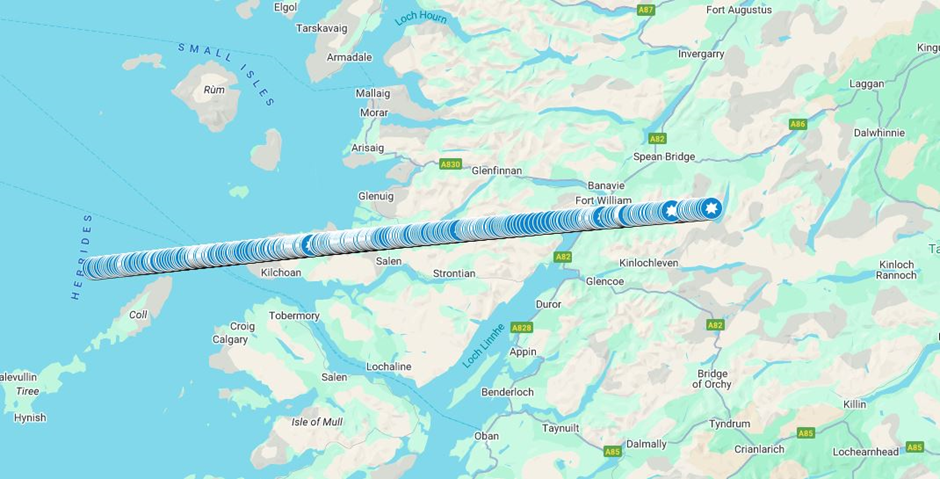
The track of the meteorite, as calculated by our Meteor Section director from video data
Members’ Visual Reports
Aside from the fireball, visual reports were made of three other bright events. On the 2nd of June at 22:27, twenty five observers over the UK saw a bright fireball over Mid-Wales. This fireball was heading north and probably broke up over Shrewsbury. Meanwhile on 28th June at 00:02, two observers in Eastern England spotted a fireball over Belgium which was also seen by fifteen other meteor spotters in Europe. Finally, on the 26th of July around 22:35 several observers in Eastern England saw a fireball over the Netherlands. This was also seen by observers in Belgium and the Netherlands. Only the one over Mid Wales was picked up on the UK camera networks.
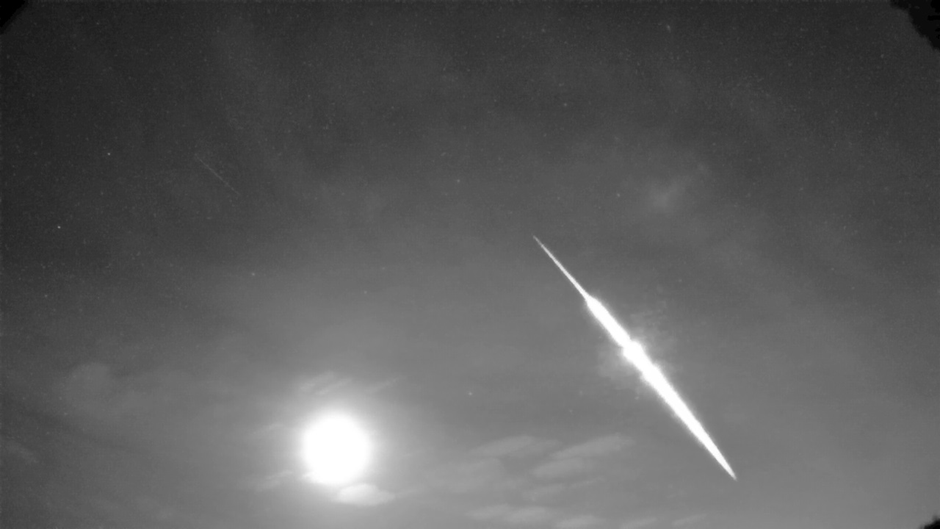
Fireball on 2025-06-02 as seen by a UKMON camera in central England.
August and September
Perseids
Despite a nearly full Moon and some cloudy weather, several SPA members sent in their Perseid reports.
Robin Scagell only managed about 40 minutes observing over two nights but nonetheless was able to spot six Perseids visually, including one at about 02:00 with visual magnitude about -5. He also had a camera running for about two hours and captured several more. He’s made a video of three of them which you can see here https://youtu.be/I9enQOBpXuw
Tom Banks was out between 21:00 on the 12th and around 03:00 on the 13th, Despite periods of cloud and poor seeing he spotted 34 Perseids, and three sporadic. Tom’s haul includes the 02:00 fireball seen by Robin, which for Tom was a little fainter. Tom also had a camera running and sent in the below photograph of this fireball seen here against a cloudy and moonlit sky.
Mary and I were also out doing some visual observing (looking in opposite directions!) Between 21:00 and 03:00 Mary picked up 55 Perseids, one Kappa Cygnid and one Sporadic. My own record was similar. Mary also had her camera running and picked up 12 meteors including another view of the 02:00 fireball as well as some other bright meteors. Its great when we get multiple reports of the same event as it allows us to compare brightness and direction, and so to triangulate the meteor’s true location.
My own radio detector is broken right now, but Sandy Allan had his running. Sandy’s heatmap, shown below, indicates a strong peak around 03:00 on the morning of the 13th which is consistent with the peak seen in other data, and the times at which our visual observers noticed the most meteors.
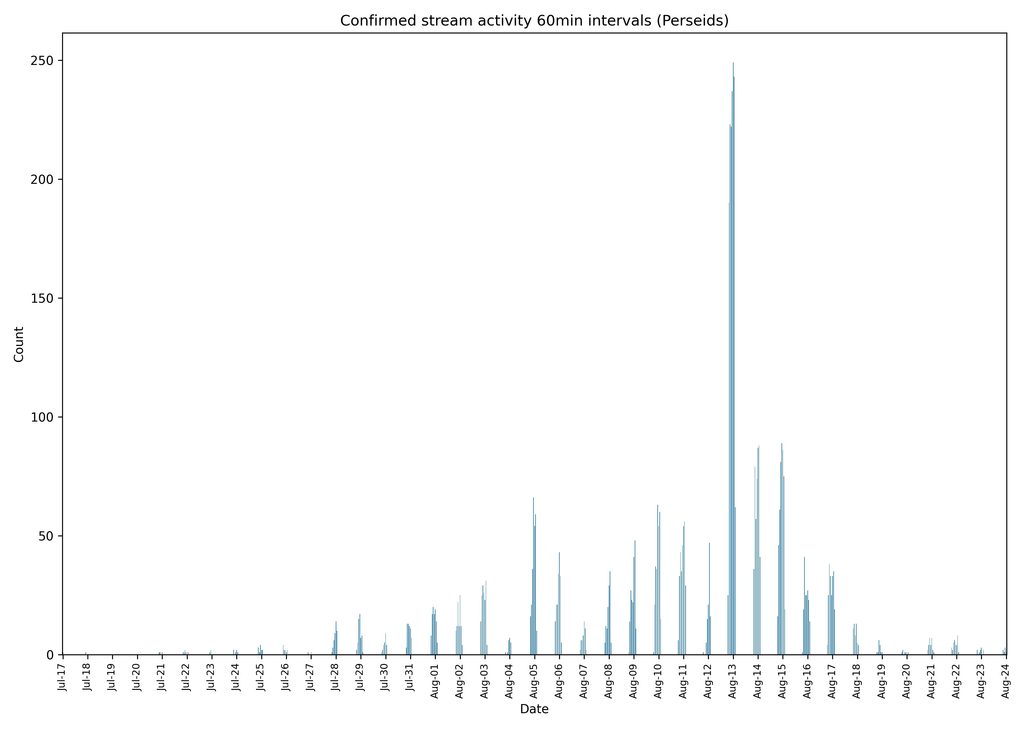
For example, the UK Meteor Network also reported video detections at around 250 per hour at around 2-3am on the 13th, which is an amazing rate – but then they do now have over 200 cameras from Sark to Shetland, and their camera can see two magnitudes fainter than humans! Overall their cameras saw around 5000 Perseids across the country, confirmed by views from two or more video cameras. The brightest of these was about magnitude -5.



October and November
Regular Showers
The main major showers were well represented, with the video networks reporting over 2000 Taurids from half a dozen Taurid showers including the best known Northern and Southern branches, while the around 1700 Orionids and 600 Leonids were confirmed by video data.
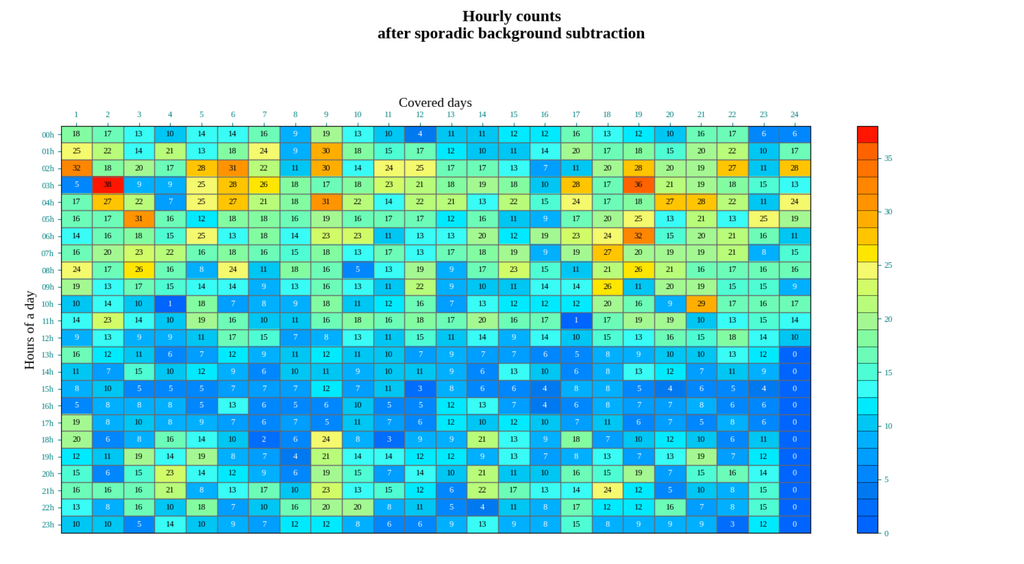
The Draconids were a no-show on the 8th of October. This shower is extremely variable and dominated by very small particles which tend to show up better on radar. Indeed, this is backed up by Sandy Allan’s radio detection results, shown below. The first graph shows daily rates in October, adjusted for sporadics – a nice peak can be seen around the 8th corresponding to the Draconids. A typical radio detection is shown in the 2nd image.
Peaks later in the month are likely to be from overlapping Taurid showers, and these continue through November as shown in third image which is a heat-map. In this we can see multiple “hot spots” notably around the 2nd, 6th, 9th, 17th, 19th, 21st and 24th. Apart from the peak on 17th, which is likely to be the Leonids, the others are close to the expected peaks of various parts of the Taurid swarm.


Fireballs
Four confirmed fireballs were reported via the website in November, and two in October that were on the same night but nine minutes apart. One was over Scotland, the other over the Channel Islands. Five further bright events were reported that didn’t quite meet the brightness requirement, but which were reported via the website.
All of these events can be matched with video data from the UK meteor network and appear in their list of bright events here https://archive.ukmeteors.co.uk/reports/2025/fireballs/index.html.
Photos of the four brightest events are shown below. The best of these was an S-Taurid of magnitude -6.5 over northern France but was bright enough to be seen from across the whole of England. The last of the four was over the Black Isle in northern Scotland and may have dropped meteorites.
Website reports can be seen via the IMO website here – make sure you select country United Kingdom. The IMO includes visual reports that we can’t match with video data and so you will see more reports here than I’ve mentioned above. https://fireballs.imo.net/members/imo_view/browse_events
December
Regular Showers
Geminds
This year’s Geminids were blessed by clear skies and little Moonlight and consequently were pretty spectacular. The video networks picked up nearly 12,000 confirmed Geminids over the two-day short but strong peak. The image below shows the tracks of Geminids as seen the author’s four cameras from the night of the 13th/14th. It reminds me of the famous woodcut of the 1833 Leonids!
Visually, the shower was reported as “prolific but unspectacular” by Tom Banks, who recorded sixty meteors over four hours on the night of 12th/13th under decent sky conditions and a limiting magnitude of about +5. Bob Steele was on holiday in Fuerteventura but despite light pollution and an inconvenient hotel balcony still managed to report seven in an hour on the night of 13th/14th, three the following night and two the night after.
Sandy Allan was running a radio detector and picked up a peak of about 100 per hour on the night of 13th/14th. Sandy’s bar chart is shown below, and as well as the Geminid peaks you can clearly see the diurnal variation due to the rotation of the Earth. Radio detectors are generally more sensitive than even the video networks so these numbers are higher than visual rates.

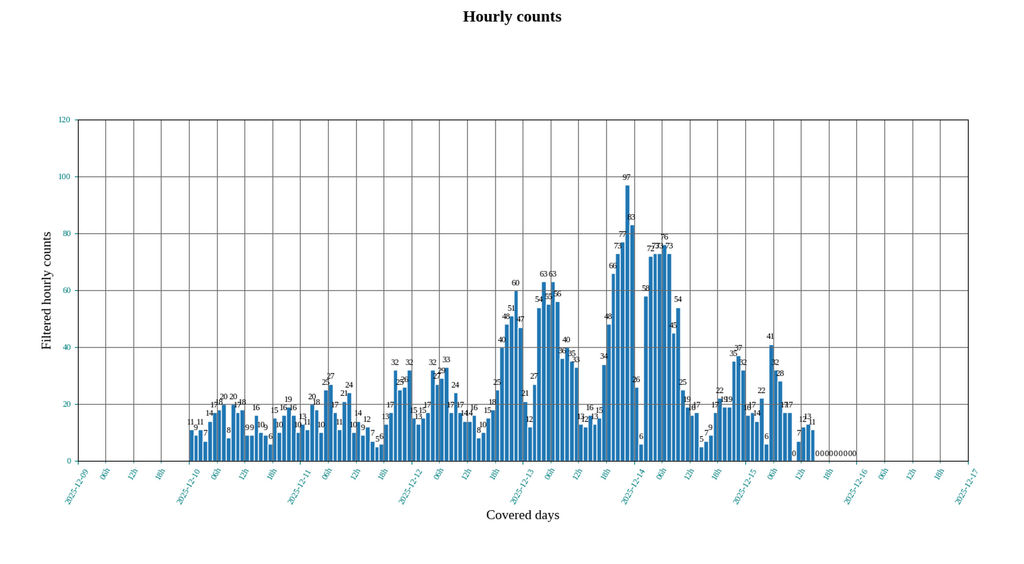
1 A night of Geminids – Mark McIntyre 2Geminids – Radio data from Sandy Allan
Minor Showers
There were no members’ reports of the minor showers, not surprising considering the weather. The video networks also reported fairly low numbers with the Comae Berenicids being the most active with about 750 confirmed meteors. The Ursids and Monocerotids were clouded out.
Interestingly, quite high activity was reported from the Signa Hydrids. This shower is somewhat undefined and is thought to peak around the 18th of December but in fact the UK Meteor Network detected a peak nearer to the 13th. This could be due to weather though.
Fireball reports
There were eleven fireball reports in December and two in January made via the website. Some of these can be linked to video observations, the best of which is a confirmed fireball on 20th December at 00:13 (picture below). There was also a report of a bright Geminid at around 00:55 on the 14th which turns out to have been over Northern France, and another at 03:16 on the 27th which was over Cumbria. Two of the fireballs are shown below.

