Click on an image to see a larger version.
Robin Scagell


Subsequent frame showing train which persisted faintly
Mary McIntyre


Click on an image to see a larger version.
Robin Scagell
Mary McIntyre
Earthgrazer
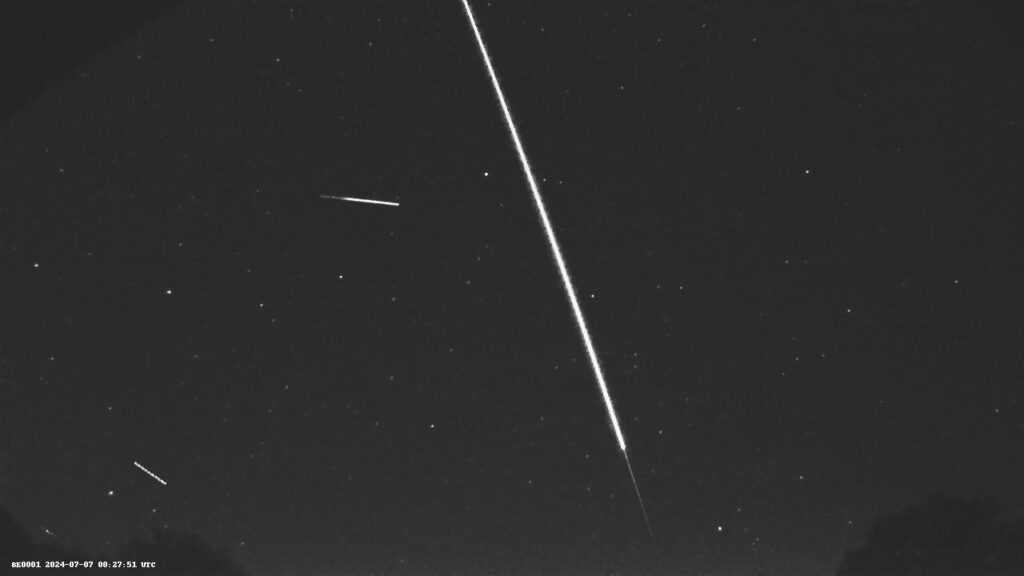
The most interesting event of the last period was an extraordinary Earthgazer meteor that travelled from Austria to England, in only thirteen seconds. This event on the 7th of July was picked up by over 30 cameras spread across Europe. There’s more about it on our website here https://tinyurl.com/mu2sum9y
Visual Reports
Several visual reports were made via the fireball reporting page on our website.
Stephen Celt, Katy Ross, Peter Tribe, Tim Powell, Terry Wood, Julian Heming, Delyth Roberts, Brian Evans, Antonia Mottola and Alasdair Taylor reported a fireball on the 18th of July which was seen by 352 observers in France and the UK, and which was probably over Brittany, and Holly Graves reported seeing a fireball on the 25th of July which was also seen from the Isles of Scilly.
Video Network Reports
The UK Meteor Network reported 750 Delta Aquariids and 444 Capricornids including three fireballs, plus decent rates of 100-200 from the minor showers Phi Piscids, June Aquilids, c Andromedids and zeta Cassiopids. These showers are all in July. There’s a lot more detail, including pictures and video, on their data website https://archive.ukmeteors.co.uk
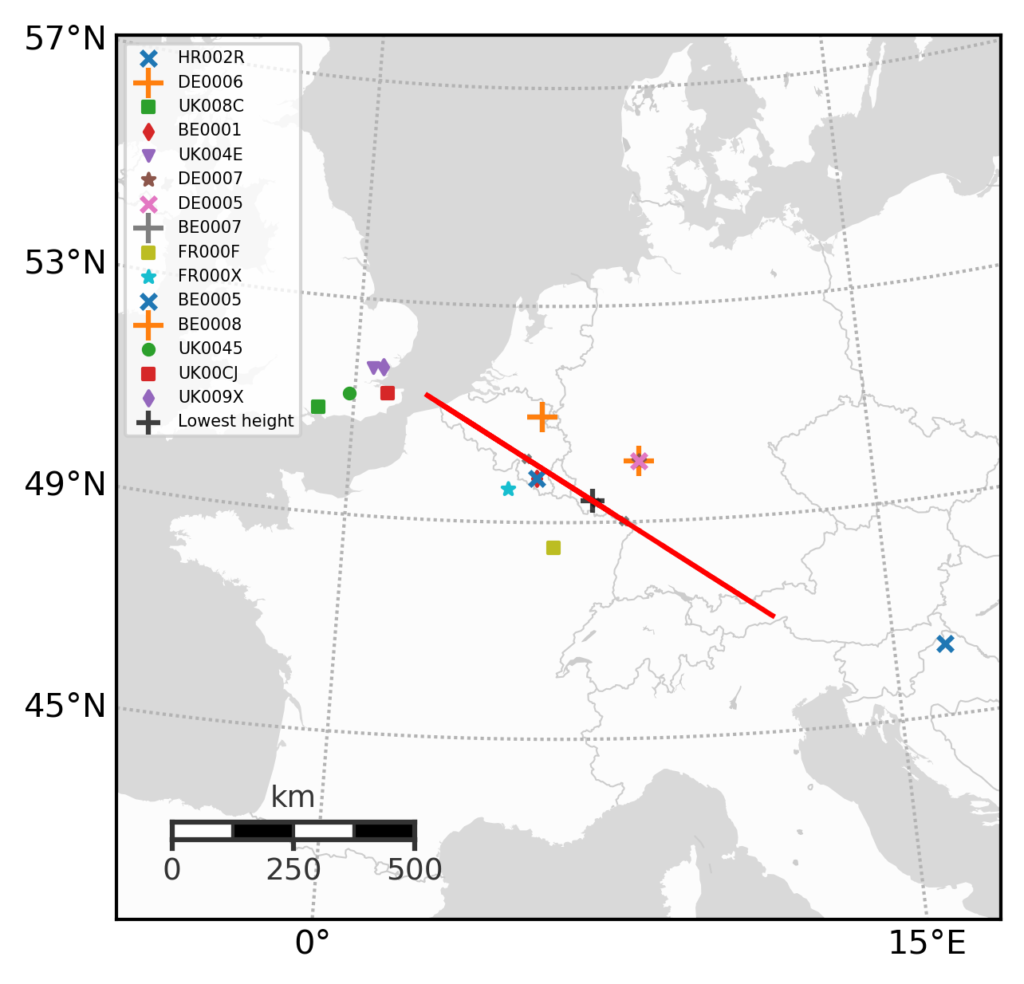
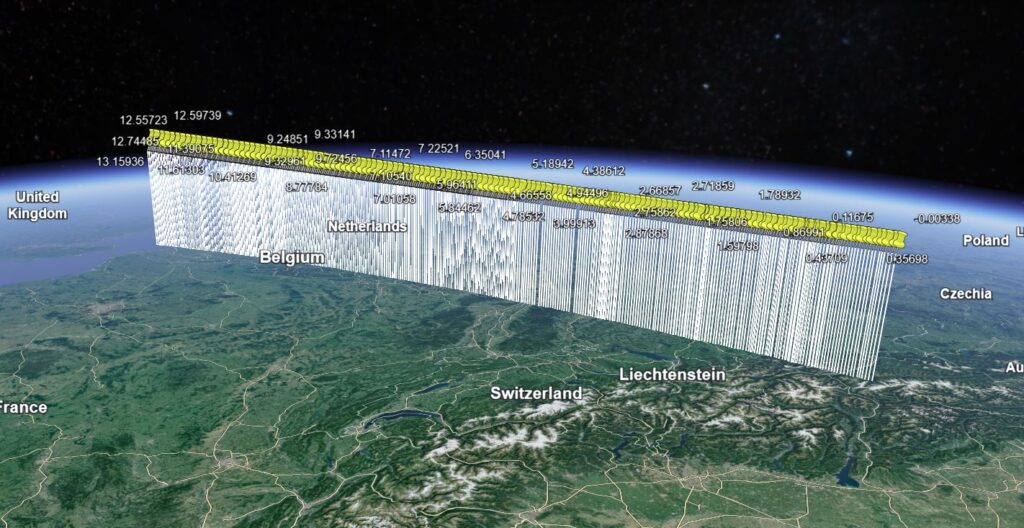
At 00:27:46 UT on the 7th of July 2024, an earth-grazer meteor was observed travelling from near Innsbruck in Austria to a point 30km north of Gravelines on the French coast. The meteor, travelling at 64km/s, traversed a distance of 841 km in 13.3 seconds at an altitude of between 114 and 102 km, crossing over Germany, Luxembourg, Belgium and France before returning to space.
The event was detected by 35 cameras from the Global Meteor Network. A number of possible visual sightings were also reported to the IMO[1]. Its also interesting to note that although relative to the Earth’s surface, its track curves down from 117 to 102 km before rising back up to 114km, it is in fact a straight line and the apparent curvature is due to the Earth’s curvature.
Analysis indicates that the meteoroid originated in the Kuiper belt and likely last visited the inner solar system in 1536, the year in which Buenos Aires was founded and Anne Boleyn rose to and fell from power. Full details of the event can be found on the UK Meteor Network’s website[2].
[1] https://ukmon.imo.net/members/imo_view/event/2024/3306
[2] https://archive.ukmeteors.co.uk/reports/2024/orbits/202407/20240707/20240707_002746.047_UK/index.html

Writing in eMeteorNews, Denis Vida and Damir Segon announce the discovery of a new meteor shower in Hercules. The authors say that 32 meteors were observed on 27th April 2024 in a time range of 20:00 to 23:40 UT.
The discovery was made possible with data from eleven countries across Europe, including fifteen in the UK which are contributing to UKMON.
Commenting on the Global Meteor Network’s groups.io channel, Damir notes that there were as many as 20 meteors in a tight 26 minute window, a rate of one meteor every 78 seconds! Damir added “There will for sure be more analysis about this event in the future, we will certainly be looking forward next year and see what will happen”.
More information, including technical details, are covered in eMeteorNews

On the evening of 20th January 2024, Asteroid SAR2736 was detected shortly before it entered the atmosphere 50km west of Berlin at around 0032 on the 21st. Also known as 2024 BX1, it was first discovered by Krisztián Sárneczky at Piszkéstető Station in Hungary. Here’s a link to the discovery video.
An alert went out globally, and multiple observatories in Europe contributed over 180 observations of this asteroid which is believed to have been around a metre in diameter. There may be meteorites on the ground!
Here’s a short video providing an update on asteroid 2023 CX1, aka SAR2667, and and the hunt for meteorites in France
On 13th February at 02:59, a small asteroid, SAR2667, also known as 2023 CX1, entered the Earth’s atmosphere over the English Channel heading towards France. The spectacular fireball was captured on many cameras (example below) allowing trajectory analysis to be performed.

Now, a search team from FRIPON/Vigie Ciel have found a meteorite on the ground! The discovery was reported on 15th February. About 100 grammes of material has so far been recovered.
This is the first known fall in France since the Draveil fall in 2011, and represents a really important scientific opportunity. Lets hope more material is recovered soon!
The trajectory and orbit of the asteroid can be seen here on the UK Meteor Network’s website, along with more video and images:

The Quadrantids (QUA) begin in late December and peak on the night of 3rd/4th January. The best time to view will be after 5am when the nearly full Moon sets and the radiant will be high in the East. After moonset, rates of up to 20 an hour are possible.
There are no other significant showers till April, but the IMO reports that there’s a possibility of an outburst of the minor shower k-Cancrids on the 10th of January at 04h UT. If you pick this up, please let us know as more data are required. Meteors will be relatively fast moving and the radiant is below the waning crescent Moon.
For southern hemisphere observers there’s also the possibility of a meteor shower due to an encounter with debris from minor planet 2016BA14, on 23rd March between 00h and 04h UT. The radiant, in Pictor, is well below the horizon for northern hemisphere viewers but there’s no Moon at this time, so do watch out for slow-moving meteors appearing to move upwards from the horizon.
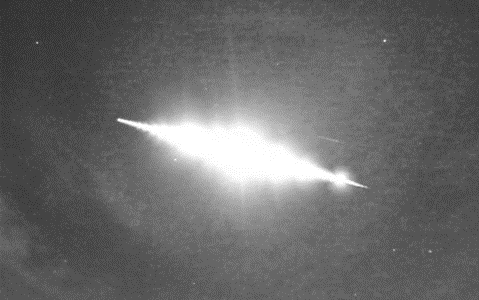
A spectacular fireball on 23rd October may have dropped meteorites over the Cotswolds.
The fireball was picked up on more than a dozen cameras from the UK Meteor Network (UKMON) and was composed of a small chunk of asteroid. Analysis indicated that a few hundred grammes may have made it to ground level somewhere to the north-east of Cirencester – by an amazing coincidence, less than ten kilometres from where the Winchcombe Meteorite fell not so long ago.
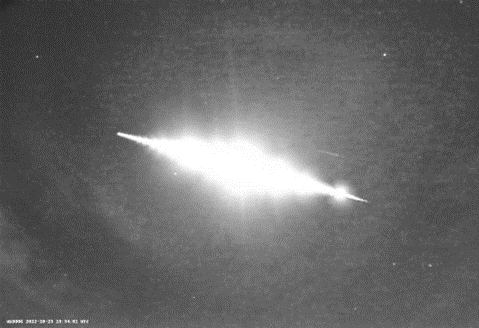
Scientists from across the UK, working with the UK Fireball Alliance and UKMON, conducted a search of the area in the following two weeks but so far, no material has been found. The team remain hopeful though the recent rainy weather is likely to have damaged any fragments.
Dr Ashley King of the Planetary Materials Group at the Natural History Museum offered the following advice for anyone living in the area who thinks they may have something:
“If possible, please don’t pick it up with your bare hands as that will contaminate the stone. It’s probably a glossy, black or brown colour, maybe with the dark fusion crust broken off in places. Meteorites are never spongy or bubbly, so if it looks like a rusty bath sponge or it has bubbly melted bits then it is definitely not a meteorite! It may be in a place where rocks aren’t usually found, like on a lawn or footpath. Don’t take any risks looking for it, and don’t go into areas where you shouldn’t. But if you have found something out-of-place, we’ll certainly be interested to check it out.”
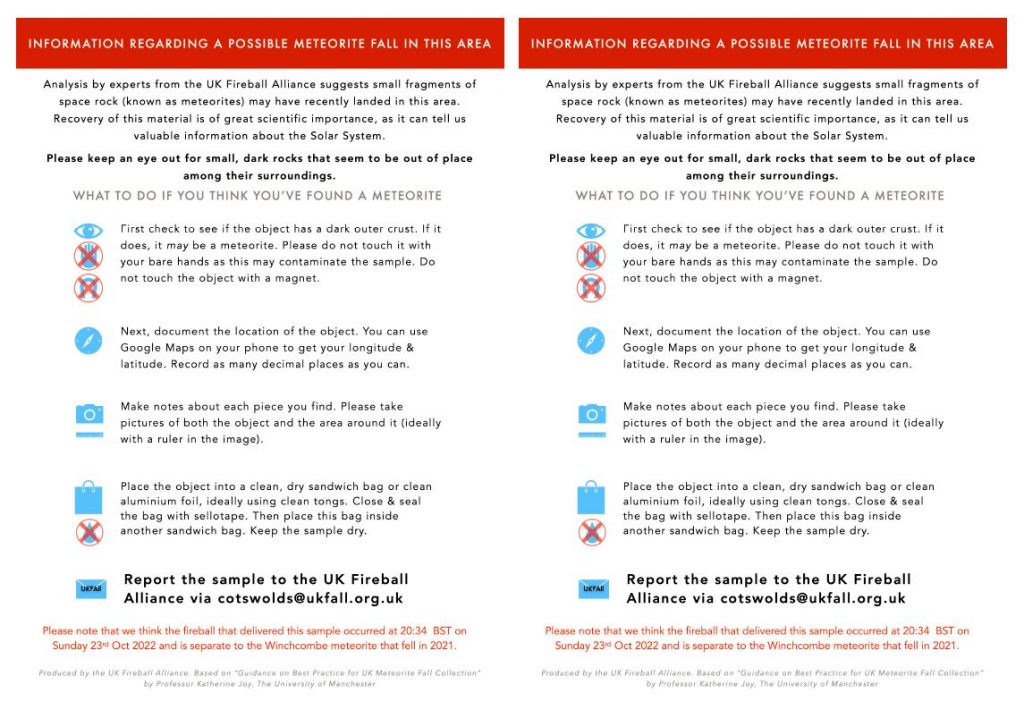
Will Gater has also provided the below infographic, explaining what to do if you find something.
This is the fifth potential meteorite dropping fireball of 2022. Previously, there were fireballs off the Isle of Wight and West Coast of Scotland that probably dropped rocks into the sea, a likely fall over South Wales that may have dropped meteorites in the Valleys, and one over Shropshire that was also the subject of a ground search.
If you think you’ve found a piece of the 23rd October meteorite fall, then please send a photo and coordinates of the location to cotswolds@ukfall.org.uk
Details of the orbit and trajectory can be seen on the UKMON’s website here
The second-best shower of the year, the Geminids (GEM), peaks on 13-14 December. The waning gibbous 20-day old Moon will rise around 9pm though and will interfere. When the radiant is high in the southeast around midnight, rates of 20 per hour are realistic.
Turning back to November, the Northern Taurids (NTA) will be fading away. The Leonids (LEO) peak on 17 November, and with a waning crescent Moon, expect up to ten per hour. Moving into December again, the Ursids (URS) peak on 22nd December and benefit from a new Moon so 10 per hour is again possible. Finally, the Quadrantids (QUA) begin in late December though the peak isn’t till January.