Report on 2025 Lyrids

The April Lyrids (LYR) peaked this year on the morning of the 22nd.

There were few visual reports, but the UK Meteor Network’s cameras detected around 5000 single-station detections leading to 436 confirmed Lyrids. 193 cameras made detections from Sark to Shetland, and one meteor was detected by twenty nine cameras.

The brightest detection had a visual magnitude of -4.1 and several other very bright events were detected. The charts below shows the number of confirmed Lyrids per hour over the period from 19th to 24th April, and the distribution of magnitudes observed.

The Lyrids are caused by dust from Comet C/1861 G1 Thatcher, which has an orbital period of around 461 years and is currently over 100 AU from Earth.

All charts and pictures courtesy of the UK Meteor Network. Fuller report available here.

October and November 2024

A bright meteor caught by UKMON cameras on the 20th of November

Regular Showers

There were no member reports for the Draconids, Orionids, Leonids or Taurids this year. Even the video networks had a quiet time with only 1800 Orionids and 520 Leonids being recorded by the UK Meteor Network over the entire country. The peaks of both showers were not blessed with good weather though. The Northern and Southern Taurids were also relatively quiet with only 800 or so meteors detected by the camera network.

Fireballs

A number of non-members reported a fireball at 19:58 on the 26th of November.  Observers in the North West saw it to their south with at least seven reports made via the fireball reporting form, though the IMO reports incorrectly place it about 100 miles further north than the video evidence! This highlights an issue with visual observations. The IMO report is here https://tinyurl.com/2z7ny6mb and the video data are here https://tinyurl.com/mv34n645

Another bright event was reported over East Anglia on the 15th of November, at about 18:11. This was reported by 58 people, two of them SPA members. Unfortunately, no photographic matches have been found due to inclement weather. The lowest point was over the sea east of Aldeburgh. The IMO report is available here https://ukmon.imo.net/imo_view/event/2024/6948

Another bright meteor, this one from the 18th of October

Members’ Perseid photos from 2024

Members’ Perseid photos from 2024

Click on an image to see a larger version.

Robin Scagell

Mary McIntyre

Earthgrazer Meteor 22nd September 2020

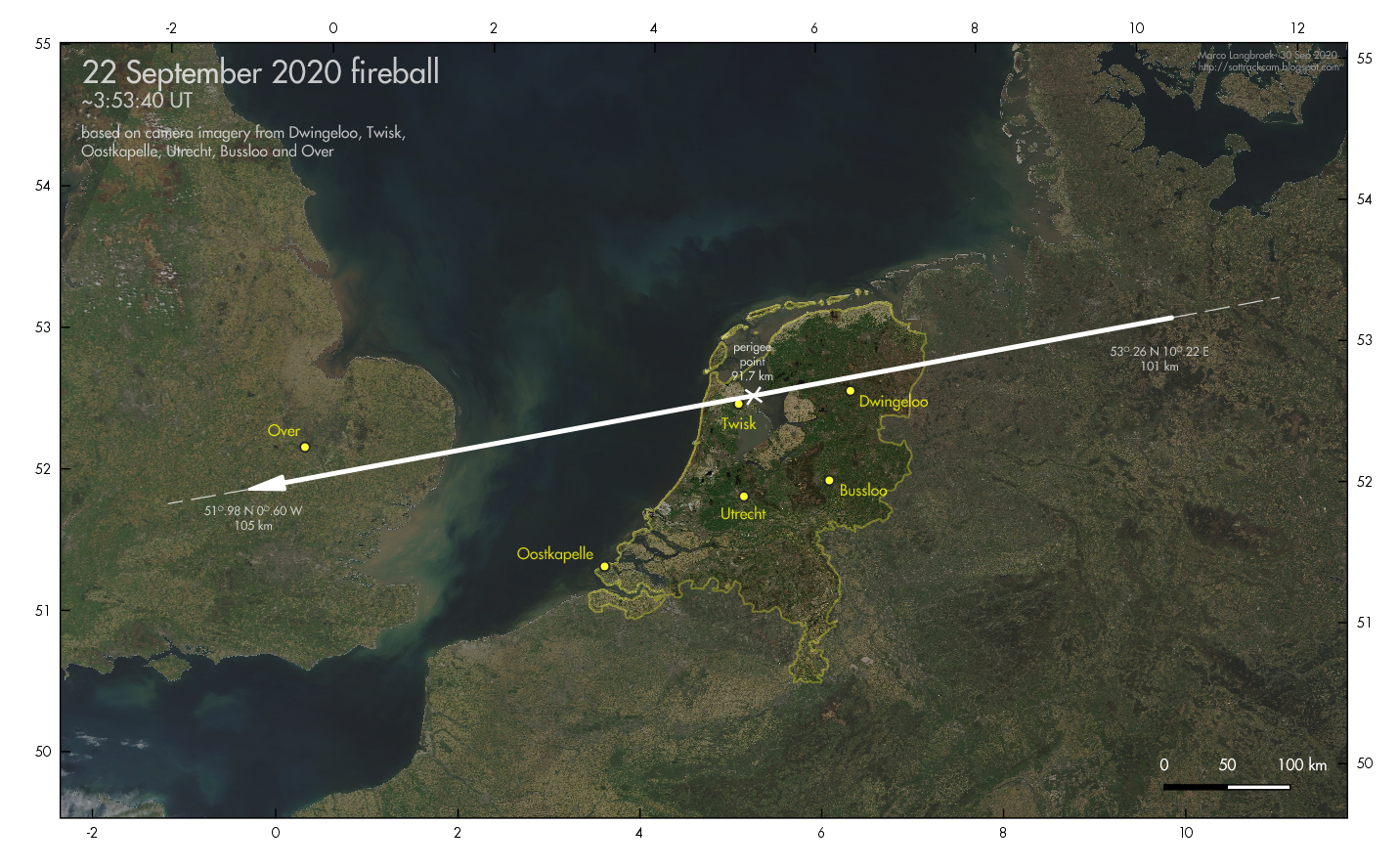
On 22nd September at 03h54m UT, multiple stations across Europe detected an earth-grazing meteor. Earth-grazers are meteors that hit the atmosphere at a shallow angle, and so instead of burning up, they pass through and return to space a little lighter and in a different orbit.

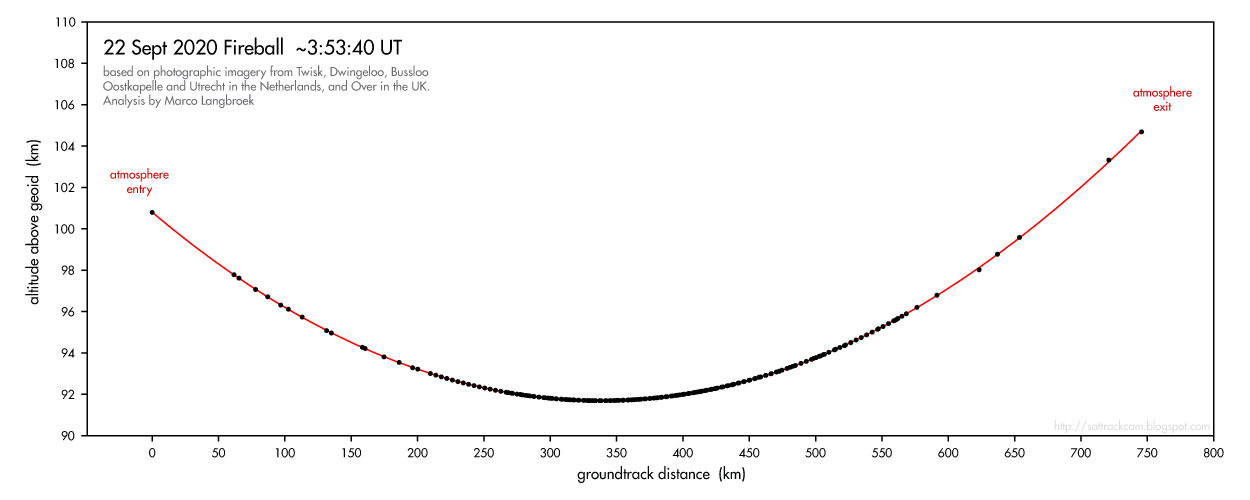
This particular meteor entered the atmosphere over Germany, travelled over the North Sea and left the atmosphere again over central UK. Marco Langbroek of the Dutch Meteor Society estimated that it entered at about 100km, and at its lowest was 90km high before it passed out of the atmosphere again at around 100km. It had a velocity of around 30-35 km/s.
Trajectkaart_22sep2020_035340UT Groundtrackdistance_vs_alt

Interestingly, although its altitude varied, its path was probably a straight line! This is because of course the Earth is a sphere. Marco has written an excellent explanation  here.


Further analysis has since been carried out by members of the Global Meteor Network and Denis Vida from GMN kindly provided the below analysis, based on multiple stations across Europe.

The meteor was first detected at a height of 101.2 km and travelling at 33.94 km/s. At its lowest point it was at 90.2 km, and was last seen at an altitude of 107.4 km over the central UK (coincidentally almost directly above my house!). Its velocity hardly changed during this time, averaging 33.68 km/s.

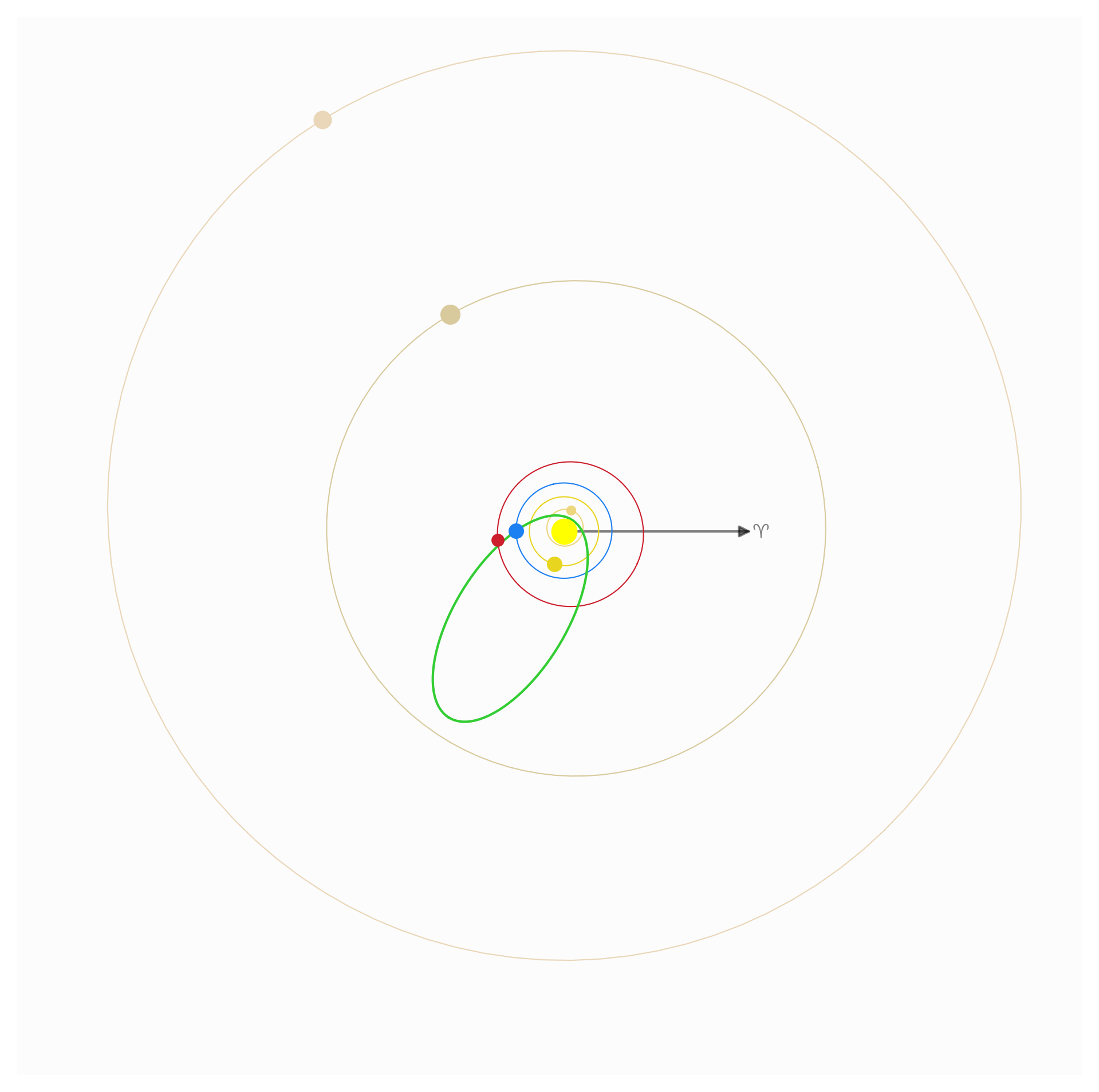
The orbit had a semi-major axis of 2.44 AU, an eccentricity of 0.87 and an inclination of 3.14 degrees which puts it pretty much in the plane of the ecliptic and (to me at least) suggests an asteroidal origin. Perihelion was inside the orbit of Mercury while at its furthest from the Sun, the meteor would have been somewhere beyond the Asteroid belt. The image below shows the orbit as seen from above the Sun’s north pole. The blue and red dots are Earth and Mars respectively.

20200922_035332_orbit_top


Is it a plane? Is it aliens? No, its a meteor, as caught by SCAMP and FRIPON

From an original article By Jim Rowe
With updates by Mark McIntyre

At 5:51 on the morning of Sunday 8th September a very bright, slow meteor was spotted from southern England and France.

Or a plane crash, as it was initially reported – it caused quite a stir in both the press and on social media. It was caught on camera by SCAMP in Honiton (part of the FRIPON network) and by several UKMON and BOAM cameras in England and France respectively.

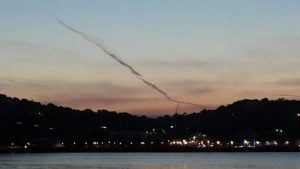
This image was taken from Hampshire by Steve Bosley of UKMON.


Most newspaper websites picked the story up promptly, with the notable exception of the Daily Star, which therefore missed an opportunity to use the words “UFO” and “Alien” in a meteor report.  Full marks go to “The Sun” for its infographic which is pretty close to being right. Less full marks to the BBC for their lead image below, which seems to be a contrail left by the plane that the meteor wasn’t. Oops. Thanks also go to Richard Kacerek of UKMON who helped the press get the story right.


As mentioned earlier, the meteor was initially misreported by the public as a potential plane crash, leading to police helicopters being scrambled to search for survivors. Fortunately this misunderstanding was soon cleared up.

So what actually happened?

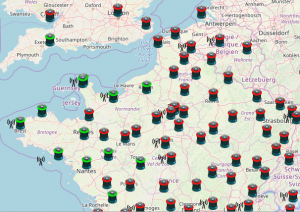
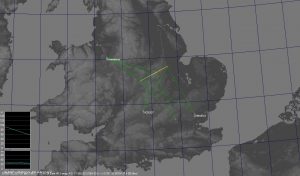
A meteor entered our atmosphere with a very shallow trajectory and left a long trail. It took as much as 30 seconds to cross the sky – meteors normally burn up much more quickly because they come in more steeply.  The meteor was caught by twelve FRIPON cameras in France and the SCAMP camera in Honiton, Devon. These are shown in shown in green on the map to the left.


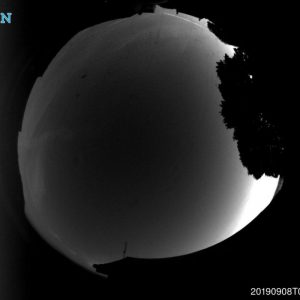
From the UK it appeared very low in the south but was seen by many members of the public. Here’s a composite image of the meteor from the Honiton SCAMP camera. It’s the white streak at the top right of the image – very distant, and so very low on the horizon.


Science!

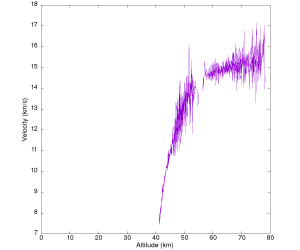
Firstly FRIPON was able to calculate the meteor’s velocity curve. When first visible the object was almost 80km up and travelling around 15-16 km/s. About 28 seconds later it was 40km up and had slowed to about 7-8 km/s, but in that time had travelled around 380km across the Noth Sea, France and the Atlantic. It seems to have been on a very shallow trajectory, but too slow to escape Earth’s gravity and escape back into space.


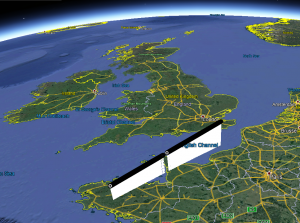
FRIPON also calculated the trajectory, shown here as the black line. The ground track (the imaginary line on the ground exactly below the meteor) is the line at the bottom of the wedge. The Sun picked up a version of this image but then reported that the meteor crossed England’s south coast, which is incorrect.  In fact if it didn’t burn up entirely, then the meteor landed somewhere in the Atlantic.

Other data from UKMON suggests that the meteor was at least magnitude -4 and was a sporadic, meaning that it wasn’t part of any known meteor shower.

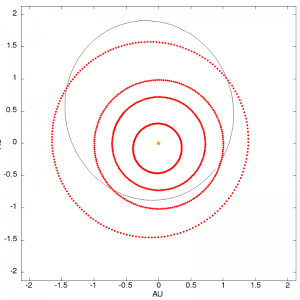
And finally here’s where FRIPON think it came from. The orbits of Mercury, Venus, Earth and Mars are shown as red rings (Mars is the dotted one) and the object’s orbit is the black ellipse. It seems to have been a chunk of asteroid that orbited mainly between Earth’s orbit and that of Mars, but crossed the orbits of both. This time, it didn’t make it past the Earth.


Of course, this is just the sort of rock that we’d love to recover for the Natural History Museum. But sadly this one, like the last few, is somewhere at the bottom of the Atlantic – safe in Davy Jones’s locker!

Hopefully next time we’ll have one land on land…

About SCAMP

SCAMP (the System for Capture of Asteroid and Meteorite Paths) is a network of all-sky cameras based in the UK.  SCAMP detects and records bright fireballs so that the location of any resulting meteorite fall can be estimated.  Any meteorites recovered using SCAMP will be donated to UK museums or universities, along with all images and data recorded.

For more information on SCAMP see www.scamp.org.uk.  To receive alerts from SCAMP you can sign up here.

SCAMP is fully integrated with the French FRIPON network of about 100 cameras.  For more information on FRIPON see www.fripon.org. For a daily e-mail summary of all FRIPON multi-station fireball captures (including SCAMP captures), click here to subscribe or send an email to newsletter-request@fripon.org with “Subscribe” as the subject.

Bright Fireball over the UK!

At 03.52 on the 30th of March 2019 a very bright fireball was detected by a number of observers around the UK. As well as visual observations, the fireball was picked up by multiple stations in the UKMON & NEMETODE networks and by the newly-installed Scamp system. The video below shows the view from one of my meteor cameras in Oxfordshire.

Scientific Analysis

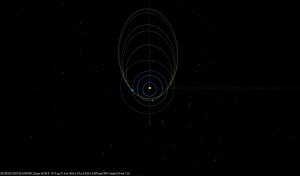
Multiple detections enabled quite detailed analysis of the object. William Stewart of NEMETODE calculated that the object weighed between 190 and 330g, was of asteroidal origin and was between 36 and 60mm in size. The flight path and the meteoroid’s original orbit were also calculated (see below).

This is a great example of the real science that can be done with meteors, and of great collaboration between UKMON, NEMETODE and Scamp to help generate that science.

Now, if only one of these would fall over land….

Mark McIntyre, Meteor Section Director

Data collected by Nick James, Jim Rowe, William Stewart, Mark McIntyre and others.

Fireball reports from 2012 April to July

The lighter evenings and shorter nights of late spring and early summer inevitably lead to a reduction in the number of fireballs being seen. This also makes it more likely that a fireball will only be reported by a single observer and hence it is often not possible to confirm whether an object was definitely a fireball or just a local event, such as a sky lantern.

The following reports have been received :

Sam Mundell (Gosport, Hants) reported seeing a mag -3 fireball at 2058UT on April 21, travelling from Ursa Major towards Cassiopeia and lasting for 5 seconds.

Peter Meadow (Great Baddow, Essex) imaged this Lyrid fireball (below) at 01:55 UT on April 22. It has a short path because it is almost head on from the observing site. The second set of images show the decay of its persistent train.

Peter Grego (St Dennis, Cornwall) imaged a fireball at 0229UT on May 13. He described it as “very slow, flaring and fragmenting mid-flight, 20 degrees alt and almost parallel with horizon, appeared in southeast, brightened, visible in flight for seven or eight seconds, brilliant white head with orange-yellow trail about ten degrees long, trail not persistent. Terminated due east. Magnitude -5 at brightest.”

Katie Sludden (Comrie Forest, Perthshire) saw a fireball descending in the ENE at 2257UT on May 15, including the description “It burned with a slight green haze and left a bright white trail in the sky. It lasted up to 3 seconds but I think I only caught the end of it.”

Nick Wright (Roundswell, Devon) saw a fireball of duration 5 seconds, possible of mag -10, at 0130UT on May 26 low in his western sky. His description included “Trail was very clear, straight and white. The explosion at the end of the flight was very bright and instantaneous”

Melanie Dunkley (Ely, Cambs) saw a fireball at 2325UT on June 15, describing it as “Started as what I thought was a shooting star but then the orange tail appeared which was pretty long.  This tail disappeared and the white became brigher and also looked green until it vanished. The entire show lasted probably between five and ten seconds”

Kelli Hicks (Church Crookham, Hants) reported a fireball seen in the northern sky at approx 2115UT on July 22, describing it as having a glowing red tail. The time of this object roughly coincides with a fireball reported on Twitter as heading in a NNE direction by an observer in Felixstowe.

Peter Grego (St Dennis, Cornwall) imaged a fragmenting fireball at 2217UT on July 27, which included flares to mag -4 and mag -6 as it descended steeply towards the SSE horizon. He described it as ”appearing a golden-yellow with a bright white head. No fragmentation noted, nor was there any sign of a persistent trail. It lasted only around two seconds but it was very impressive.”

Four reports were received of a fireball, possibly around mag -7, at 0058UT on July 28. It was imaged by Alex Pratt (see below) in Leeds and by William Stewart from near Nantwich in Cheshire and was seen visually by Colin Cooper in Tynemouth, Tyne & Wear) and by Ian Matthew (Saltash, Cornwall). The end of the fireball is probably present ion an image secured by the Exmoor camera of the University of Hertfordshire. Alex described the sequence of flares near the end of its path as “Bright Flash – Very Bright Flash – Flash – Flash”. An initial analysis by Alex of the two images suggested that the fireball’s radiant was near the head of Draco.

As always, any new reports of these or other fireballs (meteors of magnitude -3 and brighter) would be welcomed by the Section.
Advice regarding what to record and where to report fireball observations to can be found at :  www.popastro.com/meteor/fireballs/makingobservations/index.php

Fireball reports from 2012 March

(This report has been compiled from the SPA Forum entry posted by Alastair McBeath)

Here is a summary of fireballs spotted from the British Isles and nearby during 2012 March.
 
March 3-4 proved to be a particularly interesting night because of the unusually long-lived fireball (perhaps lasting for 45 ± 15 seconds) which was seen very widely across the UK around 21:41-21:42 UT. Thanks to the publicity generated by that event, several other fireballs that night were reported as well, plus a fireball seen earlier in daylight on March 3rd from North Yorkshire. Many of these additional sightings can be found among those reported for the ~21:41 meteor on the American Meteor Society’s website at: 
 
or on the BBC News’ webpage for the "main" fireball: 
 
Unfortunately, the witness of the March 3 daytime event was unable to give a time for it, noting only that it was moving north to south in the sky (see BBC report 305). 
 
* The first of the overnight events on March 3-4 was around 19:10-19:15 UT, when a bright, slow, orange meteor was seen in the western sky moving southeast according to one unlocated witness, with another possible witness in Hampshire (BBC 159 & 269). 
 
* Then came the 21:41-21:42 fireball, on which 376 reports were received by the Meteor Section from all across Scotland, England and northeastern Wales. A full description of what probably happened, with links to many of the sightings and videos, can be found elsewhere on the Observing Forum, at: 
 
* At some stage within half an hour either side of 22h UT a bright yellow or white possible fireball was spotted from Exeter in Devon (AMS report 322fc). The witness there recorded it at about 45° elevation to the southeast. If correct, and this was a genuine meteor, it would have been likely high above the Channel. As the 45° elevation angle meant any object would have to have been exactly as high above the surface as it was horizontally from the observer, this cannot have been another sighting of the 21:41-21:42 UT fireball, plus it was visible for less than two seconds and had a very short path. 
 
* Within roughly five minutes of 22:25 UT, a magnitude -5/-12 event was seen from at least three places, Dublin, Lancashire and Manchester. Details from the observers suggested this fireball had plausibly occurred over the northern Irish Sea, and was likely red, orange or yellow in colour, visible for a few seconds (AMS 322fh, fi & fj). Three other reports, one from Manchester and two from Glasgow were perhaps timed between 22:30-22:35, but from the descriptions, they seemed more likely to have been mistimed observations of the 21:41-21:42 event instead (AMS 322fm, fn & fo). 
 
* Another bright meteor between 23:00 and 23:15 UT was spotted possibly from North Yorkshire and Kent. The Kent witness indicated the fireball – assuming both reports were of just the one meteor – had likely ended above the Channel to the south-southeast of Kent, or possibly over the French coast (BBC 104 & 227). 
 
* The final March 3-4 event reported to the SPA probably took place between 00:05 and 00:15 UT, according to six reports (BBC 87, 244, 259, 263, 273 & 372), although there were uncertainties in the timing of some of these. Those observers who mentioned their locations were in North Yorkshire, Norfolk, Cambridgeshire and near London, with most describing a steeply-descending meteor which may have ended over East Anglia or the nearby North Sea. 
 
* March 9-10 at 00:04 UT provided a magnitude -7/-10 meteor in their southern skies for two lucky motorists in Essex and East Sussex. The initial sighting from Essex is elsewhere on the Observing Forum, at: 
 
while that from Sussex is on the AMS’s summary page for the March 3 meteor, at: 
 
* On March 10-11, a slow-moving orange-white meteor of magnitude -2/-3 or so produced some small-scale sparkling fragmentation at circa 20:30 UT for an observer in North Yorkshire. 
 
* March 15 brought another daylight fireball report, this time from Hertfordshire at 13:02 UT, from where it was seen low to the north. 
Subsequent investigations located four other sightings beyond the original from Hertfordshire, one on the American Meteor Society’s website from Croydon: 
 
and the remaining three, from Cambridge, Suffolk and Essex, on the Lunar Meteorite Hunter’s Blogspot: 
(note that from this link address, you need to work backwards down the long list of reports to find those from March 15). 
 
Too few details were forthcoming from the witnesses to make triangulation to the object’s atmospheric path practical (though the British and Irish Meteorite Society’s Forum included a noble try, at: 
 
However, it is likely the fireball passed somewhere over northern, probably northeast, England moving towards, or maybe even above, the adjoining North Sea. Two of the witnesses reported it may have shown some fragmentation during its flight. 
 
* March 21-22, at 20:45 ± 15 minutes UT saw a magnitude -7 fireball appear for a witness in Somerset. That event was seen descending almost vertically in the western sky, not far from Venus. 
 
* March 27-28 at 01:37 UT, a magnitude -6/-7 event was recorded crossing the high SSE sky by two observers at the same site in Suffolk. The meteor was described as bright white with a hint of green. 
 
* On March 28-29 around 21:05 UT, a magnitude -3 or so orange-red meteor was seen heading northwards in the western sky from Cornwall. 
 
As always, any new reports of these or other fireballs (meteors of magnitude -3 and brighter) would be welcomed by the Section.
 
Advice on what to record and where to report to  can be found at :

2012 March 03 Fireball

(This analysis by Alastair McBeath of the widely seen UK fireball, which was visible at approx 21:41UT on 2012 March 03, originally appeared on the SPA Forum)

The final analysis of this fireball has taken rather longer than I’d anticipated, largely because of the substantial number of reports received on it, including many comments extracted from the BBC News webpage at:

www.bbc.co.uk/news/world-17248959

161 fully detailed observations from the American Meteor Society – see their website at:

www.amsmeteors.org/fireball2/public.php

and the summary page:

www.amsmeteors.org/2012/03/fireball-over-the-united-kingdom-march-3-2012/

as well as notes from Twitter. I’m especially grateful to Bob Lunsford and Mike Hankey of the AMS for alerting me to the huge number of reports they had been sent, and for making those sightings freely available to me, and to (then) Assistant SPA Meteor Director Tony Markham for rounding-up the Twitter details.

Excluding duplicates, a total of 376 reports, including 15 videos or images of part of the trail, were probably of this event, stretching from Wick and the island of Lewis in northern Scotland to Somerset, Hampshire and Essex in southern England, with several sightings from northeast Wales. Of the 353 observers whose locations could be identified, 116 were in Scotland, 168 in northern England (north of roughly 53° N latitude, somewhat variable to allow for county boundaries), 9 in Wales, and 60 in southern England.

It has been difficult to confirm some of the reports due to differences in the estimated timings, and where in the sky the object was claimed to have been seen. Outlying suggestions for the time of what was plausibly this fireball ranged from 21:00 to 22:30 UT, for instance! However, 80% fell within ten minutes of 21:41:30 UT on March 3, while the fireball most probably happened between 21:41 and 21:42 UT. The longevity of its flight, likely around 45 ± 15 seconds, meant the timing could not be more precisely-determined. A further complication has been that there were at least four, and possibly five, separate fireballs spotted from UK locations overnight on March 3-4.These are discussed elsewhere on the Observing Forum:

www.popastro.com/phpBB2/viewtopic.php

The preliminary estimate for the meteor’s trajectory given earlier has scarcely changed at all. The most plausible start area remains vaguely-defined as between the Faeroe, Shetland and Orkney Islands, perhaps within 100 km of 3.9° W, 60.5° N, assuming a start height range between 140-90 km, but it may have been some way west or north of this zone. The end area was more closely-confined to within 25 km of 0°45.3′ W, 52°13.3′ N, with a best-estimated average for its final visible height of 61.6 ± 8.5 km. As noted before, the centre of this zone on the ground was close to Bozeat, Northants, near the Northants-Beds-Bucks border.

Using this relatively fixed end-point with the data from those observers who suggested the meteor had passed overhead, or very nearly so (and excluding a few outliers), would imply the meteor’s direction of travel across the British Isles was towards azimuths 165° to 170°, so moving NNW to SSE. There was a small majority in favour of the ~170° line, which would have been above the surface track described previously – so, Orkney Mainland – Duncansby Head – Moray Firth – Banff – Inverbervie – North Sea off the Firth of Forth – near Lindisfarne, then passing overhead for Newcastle, Gateshead and Durham, as well as almost so for York, Leeds, Sheffield, Nottingham and Leicester.

Other details derived from this estimated flight-path were chiefly unchanged too, such as its intra-atmospheric trajectory being from 1060 to 900 km long, descending at between 5° to 2° from the horizontal. The larger range for its potential visible flight time, 30-60 seconds, did alter the possible atmospheric velocity range though, which would then have been circa 25 ± 10 km/sec, with no allowance for atmospheric deceleration.

An unusually large range of estimated brightnesses were suggested from magnitude -1 to brighter than the Sun (magnitude -27), although as no one reported any serious eye problems after viewing the meteor, the more extreme brightness estimates seemed more likely a result of the surprise at seeing such an amazing meteor, rather than its actual brilliance. The more reliable estimates averaged magnitude -12 or so, with the likely brightest parts of the trail probably falling in the range from magnitude -9 to -15, roughly of half to full Moon level. The object seemed to have been about at its brightest during its passage between approximately Aberdeenshire to North Yorkshire, and judging by the descriptions (albeit with an unavoidable degree of subjectivity, as not everyone agreed what happened) it may have begun breaking up or shedding small sparkling fragments from about the time it crossed the Northumberland coast onwards, or perhaps a little before then. The degree of fragmentation overall seemed relatively slight and fairly gentle however, with people often reporting a train or tail with and/or after the meteor. There was also a degree of confusion for some people about the difference between the persistent train left after the meteor had gone, and the tail seen behind the head of the meteor while still in-flight, making determining just what took place quite difficult. Some of the videos certainly would support an amount of minor fragmentation during the later flight.

Sounds potentially associated with the fireball were reported from seventeen places, twelve of those simultaneous with the meteor’s flight or almost so, five some time afterwards. The simultaneous sounds were mostly of the kind expected from previous events of this kind, described here as often quite faint, but distinct rustling, hissing, sizzling, crackling or popping. Two witnesses, one each in Derby and Wolverhampton had their attention drawn to the fireball by hearing the sound, which has also occurred before. One report from Dumfries & Galloway (the most distant place from the projected surface track to have reported a sound associated with the meteor) suggested a boom was heard a couple of seconds after the meteor vanished, much too soon for ordinary acoustic waves to have arrived at that site, but which might still have been linked to the event, although a more earthly explanation could not be ruled-out. Another witness in Manchester mentioned sounds like the whirring and banging from a helicopter were noted during the meteor’s appearance. Again, a man-made cause nearby could not be excluded. Four reports of simultaneous sounds were from Northumberland and the Borders almost directly beneath the probable line-of-flight, which provided further support for such a trajectory, with eight of the twelve within 70 km of that projected ground line.

Of the five reports of sounds after the meteor ended, two were of sonic booms from unidentified locations (one possibly in either Derbyshire or Staffordshire), and another was of a similar boom from Worksop in Notts between 60-120 seconds after the meteor vanished, another place almost directly beneath the flight-path. The remaining two reports from Glasgow, of a double shotgun-like detonation an unknown time after the meteor disappeared, and Preston in Lancs, of a rumbling noise barely audible above the local traffic about ten minutes after the meteor, seemed more likely to have had a local cause. Whether any of these delayed noises were genuinely linked to the meteor was uncertain, since assuming the fireball’s estimated trajectory was correct, it would likely have been too high to have generated such noises audibly at the surface.

As for the colours seen in the meteor, various contrasting shades were mentioned, with some people differentiating between hues noticed in the head and tail at times. Of those who reported colours in the head, most preferred red, orange or yellow (65.5%) or white (24%) with the remaining 10.5% made up of green, blue or violet.

Many thanks once more to all the contributing observers in sharing their good fortune at spotting such a marvellous, unusually persistent fireball. Man-made re-entry fireballs, which may last up to a few minutes, can be quite similar, and are relatively commoner. However, such naturally-occurring meteors skimming the meteor layer and lasting for tens of seconds are extremely rare, perhaps no more than a handful per century visible for any given place on Earth. Those who saw this one can thus count themselves particularly lucky!

Alastair McBeath