
Use the sub-menu above to navigate this section of the website.
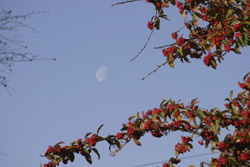
The Moon means far more to us here on Earth than just a little disc in the sky. If it weren’t for the Moon, we might well not be here at all.
So why is the Moon so vital? Here are…
Seven good reasons why everyone needs the Moon
Reason 1: The seasons
It seems that the giant impact event that created the Moon in the first place could well be the reason why the Earth’s axis was shifted over into its current tilt of 23.5 degrees. Calculations of the blow that the early Earth would have received turn out nicely to result in just the right tilt. This tilt gives us our seasons and provides a range of climatically different zones from the poles to the equator that has enabled a wide range of ecosystems to evolve. Without the anchoring effect of the Moon, we might be subject to severe climate changes that only the hardiest organisms could survive.
Reason 2: “There just aren’t enough hours in the day”
Actually, if we didn’t have the Moon then there would be even fewer hours in the day! The Moon slows down the Earth by a fraction of a second per century, so much so that it used to rotate about four times faster than it does today. Without the Moon, a typical day might last just eight hours. And if the Earth did rotate that fast, we would have faster global wind systems, which could have influenced everything from the type of tress that formed to withstand such strong winds, and various forms of tree-dwelling life, to the size of our ears or vocal cords to be able to shout and hear each other above the roaring winds!In the distant past, the Moon was also much closer to the Earth. Currently, it’s receding at the rate of 3.8 cm a year, so when the first Apollo astronauts were walking on the Moon it was a whole 1.5 metres closer to us! A billion years ago, the Moon went round Earth in just 20 days instead of nearly 30.
Reason 3: Tides
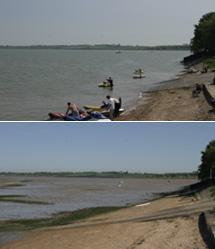
The Moon has a great power over the Earth, conjuring up twice daily tides in our oceans. The Moon’s pull on the Earth results in a bulge of water forming on the side facing the Moon, and at the same time a bulge is also created on the opposite side because the Moon has effectively pulled the Earth away from the oceans there. In fact, the tidal bulge is pushed slightly ahead of the Moon due to the Earth’s rotation, causing the Moon to accelerate to catch up with the bulge while slowing down the Earth. Places in between the two high tides experience low tides. When there is a full moon or new moon the gravitational pull of the Moon and the Sun are combined, resulting in either very high tides or very low tides.
If we didn’t have the Moon then there would still be tides inflicted by the Sun, but that only produces one-third the effect of the Moon’s tides. And billions of years ago, when the Moon was only about a tenth of its present distance, the tides raised by the Moon were tremendous, racing hundreds of miles inland. These tides probably played a crucial role in the development of life on Earth by covering vast tracts of land with water and washing minerals from the land back into the oceans, producing a primeval soup in which life was able to arise. Later, when the Moon had moved farther away, more gentle tides created intertidal habitats that probably encouraged life to leave the seas and venture onto land.
The Moon also exerts a force on the Earth’s crust, which could have helped trigger convection cycles in the mantle which led to the process of plate tectonics. Earth is the only planet to have continental plates – and the only planet teeming with life.
Reason 4: Eclipses
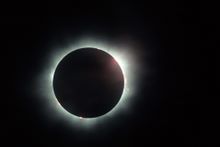
We may blame the full Moon for brightening up the night sky when we’re trying to do some observing, but without the Moon we wouldn’t be treated to the spectacular gem of a solar eclipse, which can only occur then the Moon passes between the Earth and the Sun. Eclipse prediction has been at the heart of astronomy for thousands of years, and the need to foretell what many saw as terrifying events probably stimulated interest in astronomy and science from early times.
Left: Total eclipse of the Sun, photographed from Cornwall, 1999
Reason 5: Universal laws
The Moon has taught us a great deal about the Solar System and Universe we live in. We have learnt about the phases of the Moon and the relative sizes and motions of celestial bodies around the Sun. Because of the Moon’s pristine surface we have a museum of the geological history of the inner Solar System right at the end of a telescope (and even our naked eye!).
The Moon’s craters date right back to the Moon’s youth, and by counting craters of a particular age and seeing how many there are in total, we can infer that the Earth too suffered a similar history. Because the Moon offers completely different conditions to the Earth, we can better understand how physical processes – from impact cratering to volcanism – operate in different environments.
Reason 6: Space exploration
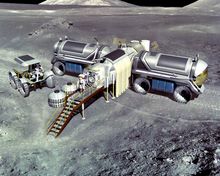
The Moon is just a stone’s throw away, astronomically speaking, and was the ultimate prize for the Space Race, humanity’s great achievement of putting a human being on a completely different world. NASA has pledged that humans are returned to the Moon in the 2020s, and there are plans to build a permanent base there. The Moon could also act as a crucial stepping stone for our future manned exploration of Mars and beyond. Without the Moon, we may not have had the desire to explore our Solar System, or even begin to think what might be out there.
Left: NASA concept proposal for a Moonbase
Reason 7: Inspiration
The Moon has acted as a source of inspiration to poets, artists, songwriters and authors – especially science fiction writers – for as long as we know. Without the Moon we would not have had any werewolf stories, Arthur C Clarke would not have written his epic novel 2001: A Space Odyssey and Beethoven would not have had inspiration for his Moonlight Sonata. And perhaps we wouldn’t even be here to appreciate all these things! For more effects of the Moon on art and culture, see the chapter on Art and Culture.
And finally, we mustn’t forget the romantic inspiration that the Moon has had on countless generations of lovers!
Text by Dr Emily Baldwin
