
Use the sub-menu above to navigate this section of the website.

Credit JPL/Galaxy
Contrary to popular belief the Moon is not made of cheese! It is made up of many different types of rocks, many of which have been broken up and formed back together again and again because of the numerous impacts that have occurred over the Moon’s 4.6 billion year lifetime. These types of rocks are known as breccias.
The compositions of the different rock types are related to the colours of the rocks that make up the highlands and the maria. The most common type of Moon rock is the light coloured anorthosite, which contains a lot of the mineral feldspar, and makes up the rugged lunar highlands. It is also the most common type of rock on the Earth. The sheer amount of anorthosite on the Moon tells geologists that the Moon was entirely molten at some point in its history because the feldspar crystals that began to crystallise out of the melt were less dense than the melt itself, and so floated to the top of this molten ‘magma ocean’, eventually solidifying into an almost entirely feldspar crust.
Another type of highlands rock is similar to anorthosite but contains some other minerals, like olivine, which is rich in magnesium. This rock group is called the Mg-suite. KREEP makes up the rest of the highlands rock and stands for potassium (chemical symbol K), rare earth elements (REE) and phosphorous (P). These chemical elements do not mix with the other rock forming minerals of plagioclase feldspar, pyroxene and olive, so they get left behind in the melt while everything else crystallises. Rocks formed from this left-over melt has unusual mineral compositions, which helps geologists learn about the final stages of the Moon’s geologic evolution.
Basalt is the main component of the lunar maria. Basalt also makes up a large component of Earth and Moon rocks, forming from solidified lava, and is made up of the minerals pyroxene and plagioclase feldspar, sometimes with a bit of olivine. The basalts were erupted into giant impact basins several hundred of thousands of years after the impact event.
Lunar Geology (or should that be Selenology?)
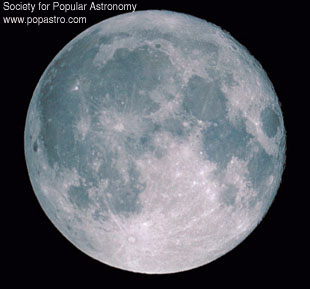
Our Moon is the brightest and most dominant object in the night sky and has influenced human culture throughout time. The Moon affects our daily lives in the form of raising the tides, and has been an instrument of navigation for sailors right up to the present day. There is a vast array of music, art, fiction and poetry based around the Moon, yet it can all too easily be overlooked. The Moon is the perfect starting point for astronomical observations because, like everything in the sky, it is free to look at, but unlike stars and planets, you can make out a variety of features with just your eyes.
This section aims to introduce you to the main geological features of the Moon, some of which you can see with your naked eye, and others which require a pair of binoculars or small telescope. Find out more about how to observe the Moon in the Observing section.
From mountains to seas
You can easily see from looking at the Moon with your unaided eye that there are two types of terrain on the Moon. The grey-coloured regions are called maria, which means seas (the singular form is mare, pronounced mar-ay, and the plural is pronouced mar-rea), so-called because early astronomers believed the basins to be filled with water. We know now that the maria are in fact ancient pools of lava that flooded giant impact basins, that have since solidified. Surrounding the maria are the contrasting bright white and heavily cratered highlands, which represent the most ancient parts of the lunar surface. Most of the far side of the Moon is made up of highlands material, whereas the largest maria are found on the nearside.

Credit USGS/Galaxy
