
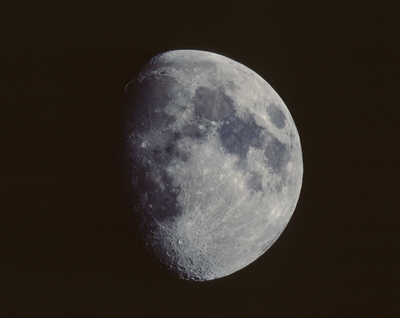
Features to look for with binoculars
Viewed through binoculars, the Moon’s surface resolves into a remarkable collection of seas, mountains and dozens of craters. If the binoculars are of sound optical quality – whether they are diminutive 8 x 20s or a giant pair of 15 x 80s – they will show enough detail to enable the observer to follow the appearance of the larger features throughout the lunar day. There’s more advice about choosing binoculars here.
On the whole, binoculars have the advantage of being less expensive, easier to transport and to use, more able to withstand knocks and more useful for terrestrial purposes than telescopes.
The Moon passes by some lovely star groupings during the lunar month, and binoculars are the best way of viewing the Moon in a low power wide field. The use of a simple steadying rod or a lightweight photographic tripod will increase the effectiveness of any binoculars and enhance anyone’s enjoyment of Moon watching.
Using a telescope
Examples of just about every type of lunar feature can be seen through a telescope as small as a 60 mm refractor, including faults, valleys, wrinkle ridges and domes. It is an impressive sight which, in the four centuries since Galileo first scanned the lunar landscape with his tiny refractor, few amateur astronomers have ever grown weary aof. For help in identifying the features you can see, you can use NASA’s interactive Moon map which shows you the Moon as it will appear in your night sky.
Three good eyepieces of different magnifications should be enough to satisfy any lunar observer:
1. A low power eyepiece with a field of view which can comfortably accommodate the whole lunar disc. This may be used for general sightseeing, introducing friends and family to the Moon’s surface, or lunar eclipse observation.
2. An eyepiece of medium power (say 80x to 150x) for more detailed observation and most lunar observing.
3. A high power eyepiece. As a guide, if the diameter of your objective lens or mirror in millimetres is tripled then this figure will be around the right kind of magnification for this particular eyepiece, eg., 180x for a 60 mm refractor. This eyepiece can be used if seeing conditions permit (when Earth’s atmosphere isn’t making the Moon appear to shimmer too much) and fine detail needs to be discerned.
Eyepieces
Three good eyepieces of different magnifications should be enough to satisfy any lunar observer:
1. A low power eyepiece with a field of view which can comfortably accommodate the whole lunar disc. This may be used for general sightseeing, introducing friends and family to the Moon’s surface, or lunar eclipse observation.
2. An eyepiece of medium power (say 80x to 150x) for more detailed observation and most lunar observing.
3. A high power eyepiece. As a guide, if the diameter of your objective lens or mirror in millimetres is tripled then this figure will be around the right kind of magnification for this particular eyepiece, eg., 180x for a 60 mm refractor. This eyepiece can be used if seeing conditions permit (when Earth’s atmosphere isn’t making the Moon appear to shimmer too much) and fine detail needs to be discerned.
There is no shortage of fine lunar detail, and the ability to resolve it (assuming good seeing conditions) depends on the diameter of the telescope’s objective lens or mirror. Under the right illumination, a crater as small as six kilometres can be discerned in a 60 mm refractor, while a 150 mm telescope will show a crater less than half this size.
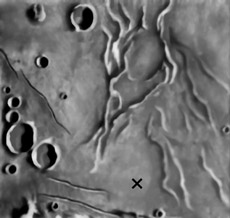
Right: A drawing of the Apollo 11
landing site. The smallest features
visible are about 5 km across
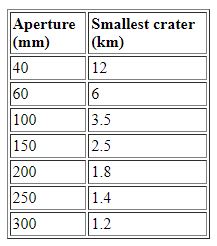
The table here should serve as a rough guide, though the constantly changing angle of illumination engages the Moon’s relief features in a perpetual game of hide and seek.
So you can see that even a large amateur telescope will not show anything smaller than a kilometre or so across, even under ideal observing conditions. And no telescope on Earth will reveal the Apollo capsules or anything similar.
Next: Drawing the Moon
