
Use the sub-menu above to navigate this section of the website.

The Man in the-Moon & Co.
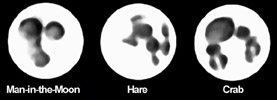
With a little imagination it’s possible to visualise various amusing ‘faces’ and ‘creatures’ on the lunar disc. The most famous of these is the Man in the Moon, a chap familiar to human eyes since ancient times. His eyes are Mare Imbrium and Mare Serenitatis, with a gaping mouth formed by Mare Nubium. The Man-in-the-Moon always appears completely aghast, with his eyes and mouth set wide open! There are many more examples of this type, though most aren’t as readily apparent. An alternative Moon face, nicknamed Cyrano for the obvious nasomegalic reasons, is best seen at first quarter phase. He has eyes of Mare Serenitatis and Mare Crisium, Mare Nectaris makes his small mouth and his very prominent nose is formed out of Mare Fecunditatis.
After identifying Cyrano, the naked eye observer can then attempt to make out the famous leaping hare, an example of a lunar simulacrum as old as the Man in the Moon. The creature is mentioned in the myths and legends of numerous cultures around the world; one ancient Sanskrit word for the Moon can be translated as the ‘hare bearer’.
Three lunar figures
The lunar hare’s anatomy is configured thus: ears, Mare Crisium; head, Mare Fecunditatis; front paws, Mare Nectaris; thorax, Mare Tranquillitatis; haunches, Mare Serenitatis; hind legs, Mare Vaporum; small fluffy tail, Lacus Somniorum. In photographs, the crater Langrenus nicely forms the hare’s gleaming right eye, though it takes superb visual acuity to discern this spot with the naked eye alone. From the very same maria can be constructed a French poodle sitting obediently at heel. As a guide, imagine Maria Serenitatis and Vaporum as the dog’s head and muzzle, with Mare Crisium its tail; the rest of the well groomed dog should then fall neatly into place.
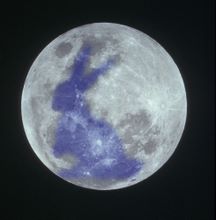
Alternative Hare in the Moon
seen best at moonrise in the northern
hemisphereAt full Moon a giant crab extends its pincers all the way across the Moon’s disc. These fearsome looking appendages are formed out of both the eastern and western maria, attached to the main shell which is Mare Imbrium. One of the most difficult images to identify at full Moon is the ‘Kiss in the Moon’; the faces of this amorous couple, seen in profile, are located in the centre of the Moon’s disc. The mouth and eyes of the figure on the right are Sinus Medii and Mare Vaporum respectively, whilst the outline of the other’s hair may be traced from the top of Mare Imbrium all the way around the western edge of Oceanus Procellarum.
Blue Moons
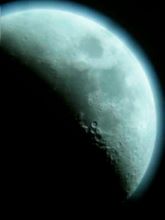
’It happens once in a blue Moon’. That’s the saying, which refers to an event so rare that it is almost impossible. But can the Moon really appear blue, and how rare is it?There are several definitions of the term ‘blue Moon’, but in fact it is possible for the Moon to appear blue. It normal colour when it is high in the sky is silvery, although if you could measure its colour very precisely you would find that it is slightly more reddish than sunlight, on account of the colour of the rocks of which it is made.
Quite often when we see it, however, it looks yellow, orange or red for the same reason that the Sun can appear these colours, when its light passes through a lot of our atmosphere when it is low down, or because of haze or smoke in the air. This is because gas molecules or dust usually filter out the blue light, leaving the yellow or red part of the light. So how is it possible for moonlight to appear blue? This can only happen when a forest fire or volcanic eruption produces particles of such a size that they filter out the red light and allow the blue light through. Under such rare circumstances the Sun will also appear blue.
This purple twilight in Australia in
1983 followed the eruption of El
Chichón and made the Moon
appear blue by comparison
However, volcanic eruptions can cause another effect which may be seen more often. The dust in the upper atmosphere can cause very vivid twilight colours. If the twilight appears purple, the Moon, if it happens to be in the sky at the time, may appear a vivid blue by comparison. The eye does not record colour faithfully, but instead renders colours by comparison with others, unlike the camera, so this type of blue Moon cannot be photographed,

Another Sort of Blue Moon
Another modern definition of a blue Moon, which has nothing to do with its actual colour, is that it refers to the second full Moon in a calendar month. This happens because the interval between successive full Moons is 29.5 days, so if one full Moon occurs on the first or second of the month, there may be another full Moon at the end of the month. Such an event happens every two or three years, so it is not particularly rare.
This occurs for Europe, Africa and America in December 2009. The first full Moon takes place on 2 December, and the next one is at 19.13 UT on 31 December. However, this does not apply to any places which are five hours or more ahead of UT so that the full Moon occurs when it is already 1 January 2010. This applies to much of Asia and Australasia. For them, the blue Moon occurs on 30 January 2010.
