
Use the sub-menu above to navigate this section of the website.
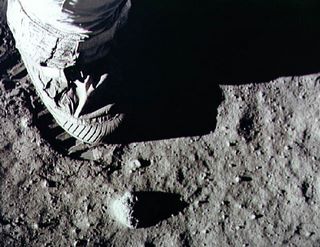
A finely grained dust-like material – the regolith – coats the entire lunar surface and extends to a depth of a few metres. At greater depths it grades into blockier rocky fragments. Regolith forms from the continual bombardment of micrometeorites and the action of solar radiation, which ‘gardens’ the surface, continually turning it over so that the top few centimetres are always well mixed. Would you sink into it? We know from the Apollo astronauts’ experiences of walking around on the Moon that they only sank in a few centimetres, a bit like walking on heavily compacted snow! The fine-grained nature of the surface regolith meant that the astronauts were shaking regolith out of their boots, suits, and pretty much everything, all the way back to Earth.
A Smashing Time on the Moon
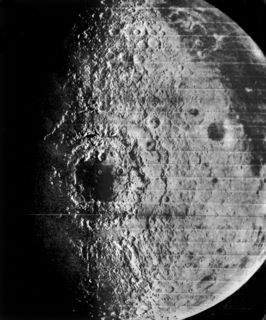
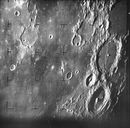
The huge Mare Orientale basinThe Moon’s early life was dominated by a period of intense bombardment of asteroids and comets impacting the surface at speeds of several hundred thousand kilometres per hour. In fact, impact events still occur every day on the Moon because there is no atmosphere to protect the surface from even the tiniest of impacts. The scars from these impacts are recorded on the lunar surface as roughly circular features ranging in size from less than 1 millimetre to diameters of thousands of kilometres. At the upper end of the scale are the giant basins, which often have multiple concentric rings formed outside of the main crater rim, rather like ripples in a pond that have become frozen into place, and some which are infilled with smooth, dark expanses of volcanic basalt, making up the lunar maria.
This section aims to introduce you to the main geological features of the Moon, some of which you can see with your naked eye, and others which require a pair of binoculars or small telescope. Find out more about how to observe the Moon in the Observing section.
Lunar Impacts
The process of impact cratering is extremely dynamic – the fastest known geological process, no less. Geologists are used to working on time frames of millions of years, but an impact crater can be carved out of solid surface in just a few seconds to few hours. Blink and you’d miss the event!
Most craters have a circular outline, with a few more elliptical shapes as a result of the impact event occurring at a highly oblique angle. At the initial point of contact of an asteroid or comet with the planetary surface, such as the Moon, a huge amount of energy is transferred to the surface because the impactor would have been travelling at tens of kilometres per second. Temperatures of hundreds if not thousands of degrees and pressures of hundreds of gigapascals would easily be achieved.
Two shock waves are created as the projectile hits the target, one which goes into the target and one which goes into the impactor. The one which travels into the impactor is reflected off its rear surface, causing it, in some cases, to melt or even vaporise.
Once the shock wave in the projectile hits the surface it starts to excavate the crater in what amounts to an explosion, and the size of the crater is determined by things like the energy of the impactor, the type and strength of the target and the gravity of the planet.
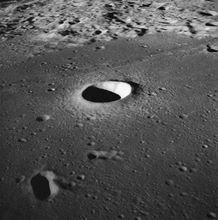
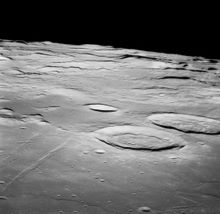
On the Moon, small craters just a few kilometres in diameter have a simple, bowl-like form, with smooth sides and a rounded floor. For higher energy impacts this simple bowl shaped crater is obliterated and a much wider but shallower crater is formed.
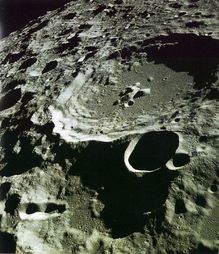
More and more complex features appear with larger and larger impact events. First, a central peak appears; this is formed when material from underneath the crater rises up in response to having so much material blasted away from the surface, and combined with the force of material flowing down the sides of the crater towards the centre. For even larger events still, this central peak overshoots its limit of stability, cascading down into a ring, called a peak-ring crater. The largest crater of all is in fact called a basin, and can exhibit multiple rings outside the main rim of the crater.
Ray Craters
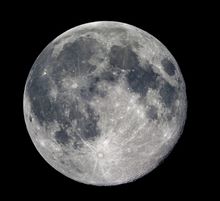
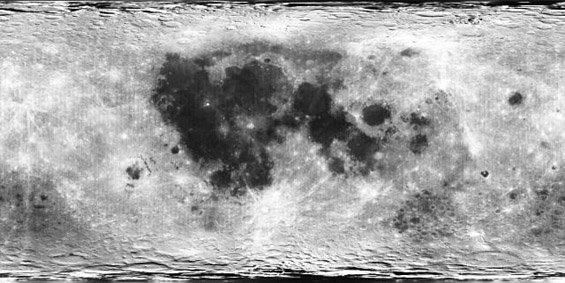
Anyone glancing at a photo of the full Moon spots one feature above all: the giant system of rays that spread out from a point in the southern hemisphere. These look a bit like grid lines on a map – so much so that people sometimes ask whether this is the Moon’s south pole. But of course the real south pole is not marked by any such grid lines.
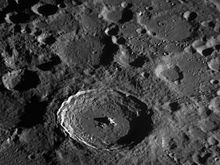
A closer look shows that there are several other ray systems on the Moon. So what causes them?When a large body hits the Moon, a huge amount of material is thrown out from the resulting impact crater. Material that is travelling slowly overturns as it is ejected from the crater and builds up the crater rim, while slightly faster moving material falls as secondary impacts further away, producing what are known as secondary crater chains.Other material gets strewn across the surface, extending tens, hundreds or maybe even thousands of kilometres from the crater itself as bright crater ray systems.
The rays are typically brighter than the surrounding surface as they are fresher and younger than the older surface into which the material was thrown.The rays are very useful to lunar geologists as they can tell us about the relative age of the crater compared with other craters and geological features, since if they overlie another ray system, they must be younger than that other system. The composition of the rays can also tell us about the material that existed below the surface, since it was once buried prior to the impact. Over time the rays will become degraded due to exposure to space weathering or being covered up by other impact events.
A closer look shows that there are several other ray systems on the Moon. So what causes them?When a large body hits the Moon, a huge amount of material is thrown out from the resulting impact crater. Material that is travelling slowly overturns as it is ejected from the crater and builds up the crater rim, while slightly faster moving material falls as secondary impacts further away, producing what are known as secondary crater chains.Other material gets strewn across the surface, extending tens, hundreds or maybe even thousands of kilometres from the crater itself as bright crater ray systems.
