
Use the sub-menu above to navigate this section of the website.
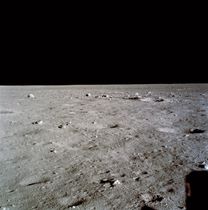
“Tranquillity Base here. The Eagle has landed”.
With these words Apollo 11 commander Neil Armstrong announced the success of the first manned lunar landing. The time was 20.18 UT on 1969 July 20.
(For a video of the final approach and landing, with the view out of the LM window compared with surface features on a Lunar Orbiter photograph, click here: Apollo 11 Lunar Module landing. It’s a 10MB .wmv file, so requires patience even on broadband. It plays for four and a half minutes.)
Around them at their landing site in southwestern Mare Tranquillitatis was a flat, rock-strewn landscape pitted with small craters – in fact, Armstrong had to take over control of the landing from the onboard computer to prevent the LM from descending into such a crater.
Worth the Trip? The view from Apollo 11’s window
Armstrong was the first to climb down the ladder outside the LM, activating a small camera that monitored his movements. As he stepped off the LM, he spoke the now-famous words: “That’s one small step for [a] man – one giant leap for mankind” (Click for a video of the “first footing”.)
Aldrin then joined him on the surface. For the next two hours they set up equipment including a seismometer for measuring Moonquakes and a panel to reflect laser beams back to Earth to measure the changing distance of the Moon with high precision.
Armstrong’s first step onto the Moon
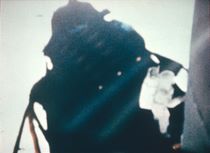
Moving around in the low lunar gravity, one-sixth that on Earth, proved surprisingly easy, even with bulky spacesuits. Armstrong’s Moon walk lasted two and a quarter hours, Aldrin’s half an hour less.
During that time, the two men collected over 20 kg of rocks and soil.
On the airless, waterless Moon, their footprints will remain visible in the soil for millions of years, unless disturbed by careless tourists.
Less than 22 hours after touching down on the Moon, Armstrong and Aldrin took off in the upper half of the LM to rejoin Michael Collins orbiting in the Command Module above. (For a video clip of LM takeoff from the final mission of the series, Apollo 17, see here: LM Take-off. It’s a 4.7 MB .mpg file and plays for 36 seconds). Jettisoning Eagle’s ascent stage, Apollo 11 set course back to Earth, splashing down in the Pacific Ocean on July 24.
On their return, the astronauts had to spend over a fortnight in quarantine in case they had brought back any microorganisms from the Moon. But the Moon samples turned out to be completely sterile, and the quarantine procedures were abolished for later missions.
Most astounding of the findings from the Apollo 11 samples was their extreme age, ranging from 3.6 to 3.9 billion years. This is similar to the age of the oldest known rocks on Earth, yet the lunar maria are among the youngest parts of the Moon’s surface, demonstrating how ancient the face of the Moon really is. As expected, the rocks were like basalt lava, indicating that they had once been molten and had flowed out onto the surface from the Moon’s interior. Chemical differences between various samples implied that they had come from at least two different magma sources.
Repeating the Feat
A second Apollo mission also beat President Kennedy’s deadline for landing a man on the Moon by the end of the decade.
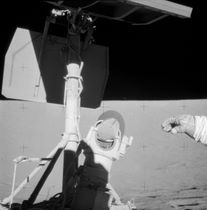
A number of parts from the probe, including the TV camera and soil-sampling arm, were brought back to Earth. Terrestrial microorganisms were found on the camera. At first these were thought to have been there since its launch and survived the harsh conditions on the Moon, but it is now thought likely that the camera was contaminated after its return to Earth.
Apollo 12’s rocks turned out to be around 3.2 billion years old, making this the youngest of the Apollo landing sites. This age difference from the Apollo 11 site, added to slight differences in composition from those previous samples, demonstrated that there had been several episodes of volcanic flooding on the Moon, and also different sources of lava within its interior. The geological history of the Moon was becoming more complex than previously imagined.
Conrad reaches for the Camera
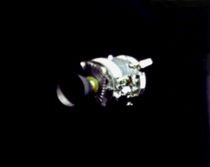
After these two successful landings, disaster struck. Apollo 13’s landing was cancelled when an oxygen tank in the Service Module exploded on the way to the Moon. Unable to turn back, the astronauts had no option but to continue towards the Moon and let its gravity swing them behind it and back to Earth.
All future Service Modules were modified to prevent a repeat of the accident that nearly cost the crew their lives. The story of the mission was subsequently recreated in a feature film, Apollo 13.
Flights resumed in early 1971 with Apollo 14, commanded by Alan Shepard, America’s first man in space, flying for a second time after a gap of nearly 10 years. This mission was sent to the site intended for Apollo 13, the hilly formation called Fra Mauro, which was believed to consist of ejecta from the impact that formed the Mare Imbrium basin.
The rocks were much lighter-coloured and different in composition from the dark lavas of the lowlands collected by Apollos 11 and 12. They proved to be 3,900 million years old, which is when the Imbrium basin was formed.
At the end of his Moon walks, Shepard, a keen golfer, achieved a sporting “first” when he produced a gold ball from his spacesuit pocket, dropped it on the surface and took a swing at it with the handle of a sampling device fitted with the head of a six iron (he needed three attempts to connect properly). His colleague Ed Mitchell responded by making an impromptu javelin throw with a rod from the solar wind collector. Both the golf ball and the javelin ended up in a small crater nearby.
