
Use the sub-menu above to navigate this section of the website.
Ageing wrinkles
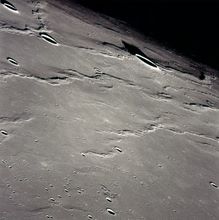
Like us, the Moon also has wrinkles, in the form of “wrinkle ridges”, low sinuous ridges formed on the maria that can extend for several hundred kilometres. They are most likely formed when the part of the Moon’s surface was compressed as the mare lava cooled and contracted as it sunk into the interior of the basin, scrunching up at the surface and buckling into ridges.
Volcanic domes
Volcanic domes are small swellings of relatively low relief, typically found in or near the maria. They have summit pit features like some volcanoes on the Earth, and are formed from a much stickier lava than that responsible for the mare. Marius Hills, located in Oceanus Procellarum, is the largest group of volcanic cones and domes on the Moon; over one hundred domes are surrounded by twenty or so long sinuous lava channels.
We all have faults
The Alpine Valley
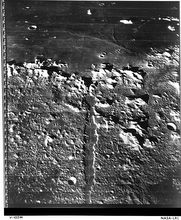
Evidence for faulting appears all over the lunar surface. A fault is a rock fracture which shows evidence of movement compared to surrounding rock surfaces. They are usually a result of differential motion of two rock faces, and are usually the locations for earthquakes on Earth. On the Moon, one particularly prominent fault feature is the 180 kilometre long Alpine Valley, which connects Mare Imbrium to Mare Frigoris. The sequence of events here probably began with a set of two parallel faults that cut right across the mountain range as a result of crustal tension. Further tension probably forced the area bounded by the faults to sink down considerably below the level of the mountain tops. Then, the valley floor was flooded with lavas which flowed from the maria. Finally, a smaller rille appeared in the centre, again due to tension.
Meandering Channels
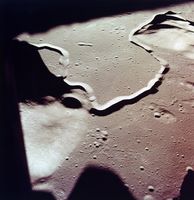
Lunar rilles and channels are associated with volcanic activity, acting as a transport system for huge volumes of flowing lava. The most famous rille is Hadley Rille, which marks the landing site of Apollo 15. Hadley Rille is a giant channel over 120 kilometres long, up to 1500 metres across and over 300 metres deep in some places. Most other lunar rilles are much smaller, enabling them to support a roof of solidified lava while hotter lava flows through the resulting “tube”. In some areas of the Moon there is evidence for collapsed lava tubes where impact craters have busted through the fragile surface.
(The Hadley Rille)
Lunar rilles come in various shapes and forms: sinuous rilles, like Hadley Rille, meander in a curved path like a river, arcuate rilles form sweeping arcs on the surface and are generally found on the edges of the lunar maria, and straight rilles follow long linear paths which extend for hundreds of kilometers, and are related to tectonic features where sections of the crust have sunk between two parallel faults.
Magnetic Swirls
These unusual and unexplained patterns of high and low albedo units, with no relief, are the subject of much controversy, with many conflicting ideas of their origin. Reiner Gamma is the infamous near side example, which spans a distance of 70 kilometres to the west of the crater Reiner in Oceanus Procellarum. It is not even certain if these features are associated with a magnetic field, although some scientists believe that the lunar crust was temporarily magnetised at the time of an impact event, “freezing in” the magnetic field. Or perhaps there is something buried underneath the surface producing this surface effect, although that begins to sound a lot like the Monolith featured in 2001: Space Odyssey!
