
The Moon’s features
Without optical aid the illuminated face of the Moon appears as a patchwork of dark and light areas. If you view the Moon near full when it is close to the horizon, veiled by thin cloud or even seen through sun glasses, you can pick out a surprising amount of detail.
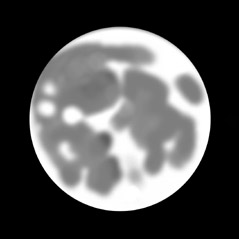
One third of the Moon’s nearside is covered with seas (Latin ‘maria’) which appear as dark patches with the naked eye. The brighter areas which surround them are mountainous, cratered regions (called continents, or ‘terra’) and the bright ray systems surrounding some young impact craters. Of course, the Moon’s seas are such in name only; early observers may once have imagined them to be tracts of water, but astronomers have known for centuries that they are decidedly solid plains. The maria are vast sheets of lava that flooded large asteroidal impact craters several billion years ago.
.
Libration
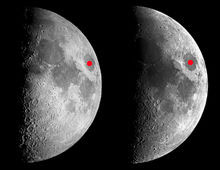
The face of the Moon is not always precisely the same. An effect known as libration makes the Moon appear to rock slightly from side to side and up and down. You can even pick this out with the naked eye. It becomes noticeable when you compare the positions of Mare Frigoris in the north and Mare Crisium near the Moon’s east limb over a lunation. Those with average eyesight will find that both features, when closest to the lunar limb, are something of a challenge to see.
The image to the right shows the first quarter moon at two different stages of Libration. Mare Crisium (red dot) is a good indicator.
Next: How Much can you See?
