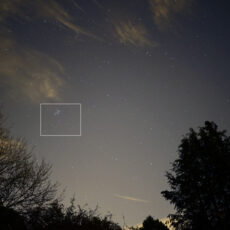
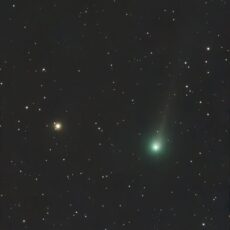
Everyone gets excited by a new comet, especially the media, which make you think that all you have to do is nip outside and look up, and you’ll see something amazing. Comet Lemmon, currently in UK skies (October 2025), is making news, but even experienced sky-watchers will need a bit of help in finding it right now. Here’s how to find it, and what to expect.
Read moreAuthor: Robin Scagell
How to spot the space station this month

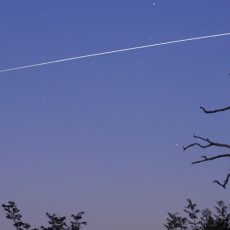
The International Space Station is making a spectacular series of evening passes over the UK during September 2025, continuing until the end of the month. It’s very easy to spot this giant spacecraft, as it’s one of the brightest objects in the sky. Here’s how to know exactly where and when to look, so you can amaze your friends with your powers of prediction!
Read moreGet ready for Sunday’s lunar eclipse

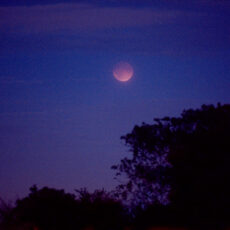
There will be an eclipse of the Moon on the evening of this coming Sunday, 7 September. For observers to the east of the UK this will be a total eclipse, with the Moon going completely dark as it passes through Earth’s shadow. But for most of the UK the total phase ends about the same time that the Moon rises, or even before moonrise, so all we’ll see is the later stages as the shadow moves off the Moon. Even so, it could be a spectacular sight – and you need to prepare in advance if you want to get the best view.
Read moreFinding Neptune

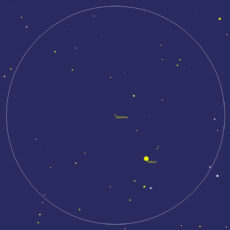
Everyone knows that Neptune is the outermost giant planet, beyond Uranus. But how many people, even amateur astronomers, have actually seen the planet? In the second half of 2025, Neptune is actually quite easy to find, as there’s a big signpost to it in the sky – Saturn. All you’ll need is binoculars and a clear, dark sky. Read more
The eclipse that isn’t – yet!

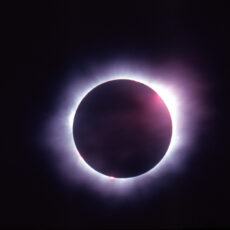
Social media pages are full of a story that there will be a total eclipse of the Sun on 2 August 2025 that will make the whole world go dark for six minutes. Actually, there won’t be, though there is a six-minute eclipse on 2 August 2027. And much of the world won’t even see it, let alone go dark. The story was good clickbait, but here’s the truth about eclipses – and where the six-minute eclipse will actually take place.
Read moreHere comes summer – and it’s NLC time

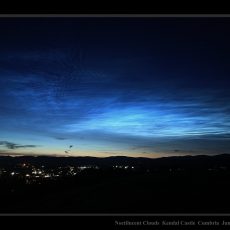
Midsummer skies are not ideal for stargazing as it doesn’t get dark until late in the UK. But this is the time of year when spectacular clouds can appear at the edge of space. Normally astronomers hate clouds but these are special.
Read moreWatch Mars race through the stars

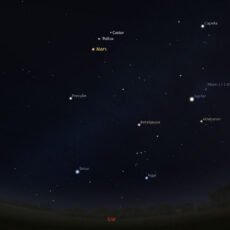
During April and May 2025, the planet Mars moves swiftly through the stars – and you can watch the changes night by night as it passes through the constellation of Gemini then into Cancer. No telescope or binoculars needed – just your eyes!
Read moreSee the Moon graze the Pleiades on 1 April

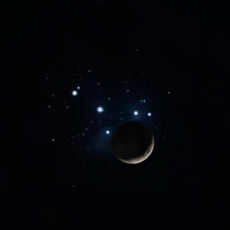
As the Moon moves through the sky, it’s constantly passing in front of stars. On the evening of Tuesday 1 April it goes in front of the beautiful Pleiades star cluster The Seven Sisters), as seen from the UK, giving the opportunity to see it hide the brighter stars of the cluster using binoculars or a telescope. The stars disappear abruptly as the Moon covers them.
Read moreHow to view the partial eclipse on 29 March

There’s a partial eclipse of the Sun from the UK on Saturday, 29 March 2025 – and it’s at a really convenient time of day, mid-morning, so if skies are clear it offers a great spectacle. The big question is how to view it safely – you shouldn’t use makeshift filters or sunglasses. Many of the suggestions, such as using a pinhole in a cereal packet, aren’t very useful. But we have some great alternatives.
Read moreThe planetary parade – your guide

All the planets are in a line in the sky – or so we are told. But what can you expect to see, and how can you find them? Here’s the Society for Popular Astronomy’s realistic and authoritative guide to the planetary parade, written by astronomers in the UK, not hacks!
Read more