
In October 2025 two comets are in the UK evening sky – but don’t get too excited, both will require some optical aid to see them, or maybe a photograph if you have the right equipment. Here’s how to see them. The comets are named 2025/A6 (Lemmon) and 2025/R2 (SWAN).
Comert Lemmon is the brighter of the two. It’s currently around magnitude 4, which is about as bright as the faintest star in The Plough (the Big Dipper). However, that’s its total brightness, and because it is more spread out than a star, it won’t be as easy to see as a star of the same brightness. So unless you have a very clear and dark sky, you’ll probably need at least binoculars to see it.
It’s currently in the north-western sky, passing above the bright star Arcturus. To find Arcturus, first locate The Plough and follow its curved handle to the left and downwards. It moves position from night to night, so you’ll need to look at our sky map below to find its position on each night. Its position is marked for 0:00 h BST for the start of each date, so on the evening of the night before it will be not far from the next night’s marked position.

The map shows the horizon from the centre of the UK at 8 pm BST on 20 October, but the horizon will be lower in the sky towards the end of October. Also bear in mind that on Sunday 26 October the clocks change so it will be 7 pm GMT.
Comet Lemmon is closest to the Earth on 21 October (90 million km) but is likely to be at its brightest as seen from Earth toward the end of October. At its closest to the Sun (perihelion) on 8 November it is about 80 million km from the Sun and 150 million km from Earth.


Comet SWAN is considerably fainter, around total magnitude 6.5, so you’ll certainly need either good binoculars or a telescope to see it. Those with smart telescopes that stack photographs to display an image on your phone or tablet should be able to image both SWAN and Lemmon as the comets should be in the database or sky atlas already. But you’ll need to check the maps shown here to make sure the comets are visible from your location. Limit your total exposure time to a few minutes to avoid the comets smearing out on the photo, as their movement through the sky starts to build up.
In Michael Barratt’s photos above, Lemmon has smeared noticeably in only three minutes. It shows fewer stars than the picture of SWAN, partly because the exposure was shorter but mostly because SWAN is in the star clouds of the Milky Way whereas Lemmon is in a barren area of the sky.
The nearest bright star to Comet SWAN is Altair, which is due south at about 8 pm. It has a fainter star on either side of it, though the southernmost of the two stars may not be easy to see if your sky isn’t very dark. Use our map to find the right part of the sky. Again, the horizon is shown for 8 pm on 20 October.
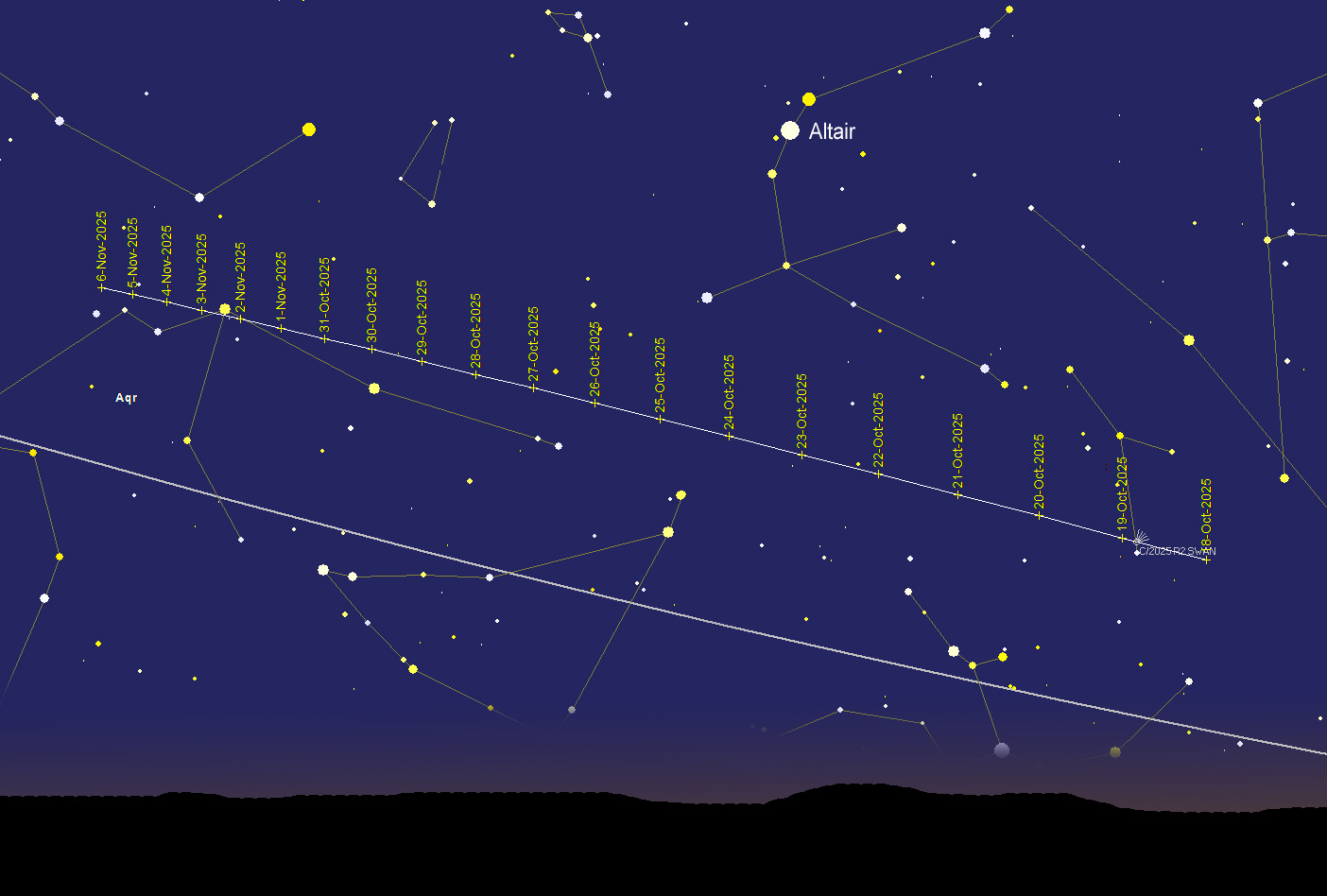
The comet was at perihelion in September, and is currently about 40 million km from Earth.
Bear in mind that towards the end of October and the beginning of November the Moon will become increasingly bright, making the comets harder to see.
Where did the comet names come from? Comets are now usually named after the sky survey that picked them up, in these cases the Mount Lemmon Survey in the US and the SWAN instrument aboard ESA’s SOHO spacecraft. So there are other comets with the same names, hence the need for the year and a code for the month of discovery in each case.