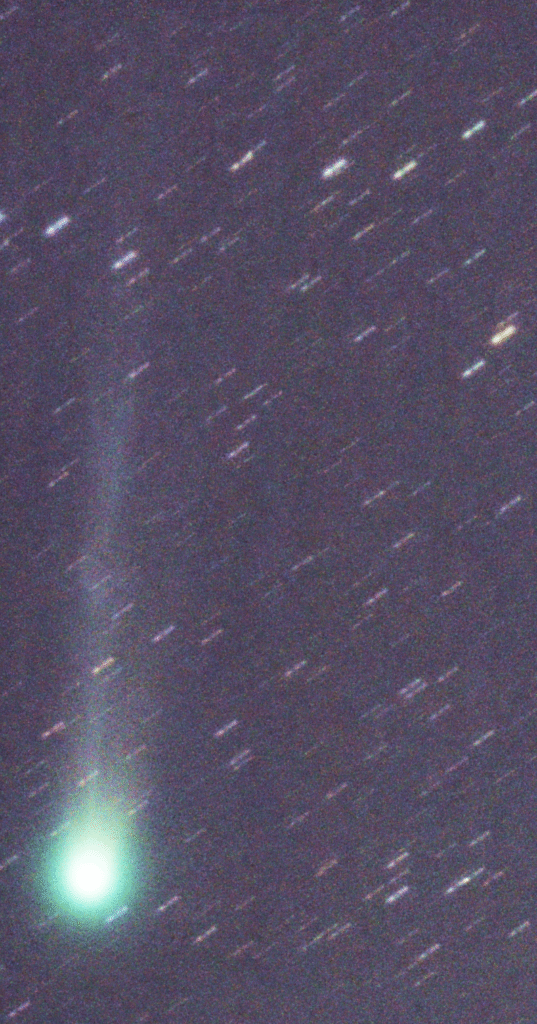
Everyone gets excited by a new comet, especially the media, which make you think that all you have to do is nip outside and look up, and you’ll see something amazing. Comet Lemmon, currently in UK skies (October 2025), is making news, but even experienced sky-watchers will need a bit of help in finding it right now. Here’s how to find it, and what to expect.
Although the comet is in the evening sky, at the start of October 2025 it’s very low down and well below naked-eye visibility. Even so, those equipped for astrophotography could image it, especially if they wait until it’s risen higher, after midnight and after the full Moon of 7 October. Smart telescopes will produce good images, but limit the stack time to a few minutes so as to avoid smearing as the comet moves against the starry background.

Later in October the comet will be closer to the Sun, will be higher in the early evening sky and could be more easily visible with binoculars. A lot depends on whether it continues to brighten up as it has done recently. Even so, on the most optimistic predictions it will only be visible with the naked eye from clear and dark skies well away from city lights.
It’s expected to be at its brightest around 27 October, and could be as bright as magnitude 3. This is around the brightness of the faintest star in the Plough (Big Dipper), but bear in mind that the light of a comet is spread out over a large area, rather than concentrated into a point, so it won’t be as easily visible as a star of the same brightness.
Read much more about the comet, its visibility and what we might expect in news from our Comet Section director, Stuart Atkinson.
The finder chart below shows its positions as seen from the UK, with the horizon shown looking north-west for 21:00 BST on 5 October, plus a table of positions made using SkyMap.

| Date | R.A. | Dec |
| 04 Oct 2025 | 10h 01m 04.6s | +40° 49′ 48″ |
| 06 Oct 2025 | 10h 19m 35.9s | +41° 29′ 32″ |
| 08 Oct 2025 | 10h 41m 21.0s | +42° 00′ 08″ |
| 10 Oct 2025 | 11h 06m 49.1s | +42° 14′ 23″ |
| 12 Oct 2025 | 11h 36m 17.4s | +42° 01′ 58″ |
| 14 Oct 2025 | 12h 09m 36.1s | +41° 09′ 53″ |
| 16 Oct 2025 | 12h 45m 53.2s | +39° 24′ 24″ |
| 18 Oct 2025 | 13h 23m 30.3s | +36° 35′ 27″ |
| 20 Oct 2025 | 14h 00m 22.7s | +32° 42′ 12″ |
| 22 Oct 2025 | 14h 34m 35.4s | +27° 56′ 09″ |
| 24 Oct 2025 | 15h 04m 53.2s | +22° 38′ 28″ |
| 26 Oct 2025 | 15h 30m 47.7s | +17° 13′ 03″ |
| 28 Oct 2025 | 15h 52m 25.2s | +11° 59′ 27″ |
| 30 Oct 2025 | 16h 10m 10.7s | +07° 09′ 43″ |
| 01 Nov 2025 | 16h 24m 35.7s | +02° 48′ 52″ |