
The International Space Station is making a spectacular series of evening passes over the UK during September 2025, continuing until the end of the month. It’s very easy to spot this giant spacecraft, as it’s one of the brightest objects in the sky. Here’s how to know exactly where and when to look, so you can amaze your friends with your powers of prediction!
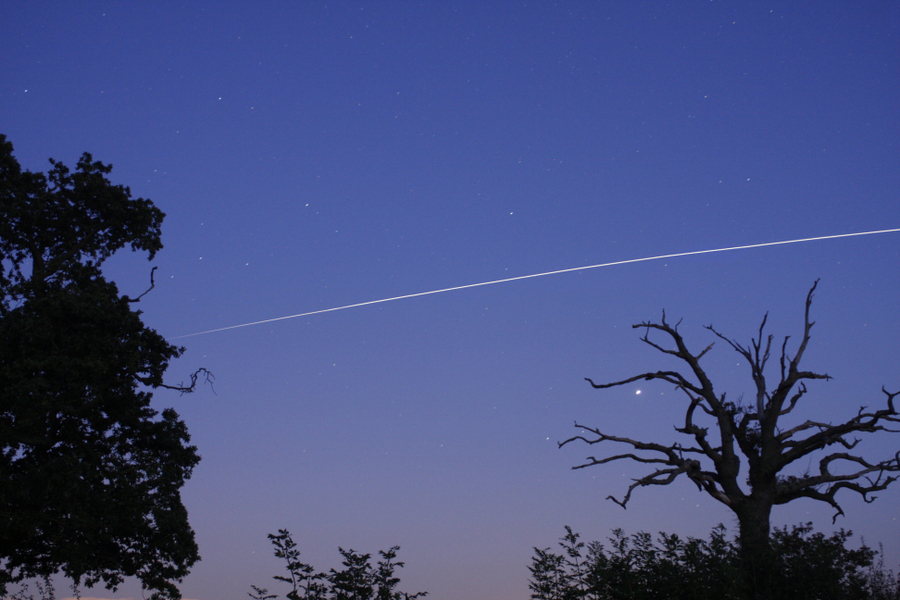
There’s no mistaking the International Space Station (ISS) when it glides silently through our skies. It is often brighter than any celestial object at night other than the Moon, and moves as swiftly as a nearby aircraft, but without any accompanying flashing lights or noise. Yet it’s at least 400 km above your head, and as you watch the station rapidly passes over the rest of Europe, travelling at around 460 km every minute.
A typical pass lasts about 10 minutes, although it is only easily visible for about six minutes. It always moves from the west side of the sky to the east, although its exact track depends on where you are viewing from and the stage of its orbit. It can pass directly over southern England, and even from the North of Scotland you can still view it easily.
Quite often the Station fades as you view it, as it passes into the Earth’s shadow. From the astronauts’ point of view, sunset has arrived, which is repeated every 90 minutes.
This is a great opportunity for photography, and also for showing off your predictive powers to your friends and family. To find out how to get predictions for your own location go to our help page: https://www.popastro.com/main_spa1/predicting-the-iss-and-other-satellites/. This explains how to use the prediction tables and get a map of the sky showing its track against the starry background.
The current series of evening passes over the UK ends on 29 September, with the next series of evening passes taking place from mid November until the start of December.
Currently there are seven astronauts aboard the ISS, and in a rare case of US–Russian cooperation, three are from NASA and three are from Roscosmos, the Russian space agency. Also a board is an Japanese astronaut.