Meteor Sky Notes November and December 2025

The Northern Taurids (NTA) peak around 5th of November, but in the UK, will be washed out by fireworks.

The Leonids (LEO) peak on 17 November and this year the Moon is favourable, so a rate of 7-8 per hour is possible. 

The Geminids (GEM) peak on 13-14 December and this year will also be relatively Moon-free. If the skies are clear, then rates of 60-70 per hour are possible when the radiant is high in the southeast around midnight.

The last significant shower of the year is the Ursids (URS) which peak on the 22nd of December and again, miraculously, will be relatively unaffected by moonlight, leading to a possible rate of five per hour.

During the whole of November and December there are also many minor showers active so the background meteor flux is often high.

Meteor Sky Notes September and October 2025

The Aurigids (AUR) peak on 1st September around 0100UT, and there will be no moonlight interference.

The September eta-Perseids (SPE) peak around the 9th September, but the waning gibbous Moon will interfere.  Both showers have nominal rates of around five per hour but realistically two or three per hour is likely.

In October, the Orionids (ORI) peak in the early morning of 22nd, under a nearly new Moon. A rate of 12 is possible. Both the Northern and Southern Taurid peaks, on 13th October and early November, are blighted by moonlight and rates are unlikely to be even one or two per hour.

Finally, it’s worth mentioning the Draconids (DRA). This shower is very variable but the Earth may pass through a denser dust trail this year, leading to enhanced rates on or around 8th of October although a Full Moon will wash out the fainter ones.

Meteor Sky Notes July and August 2025

The July Pegasids (JPE) peak on 10th of July, but will be washed out by moonlight. The Gamma Draconids (GDR) should peak 28th July and might produce an outburst this year.

The southern Delta-Aquariids (SDA) and alpha-Capricornids (CAP) peak around dawn on 30th July. Capricornids can be distinguished by a lower velocity. Combined rates of around five to six are possible.

The Perseids (PER) peak on the night of 12th/13th August are unfortunately blighted by a nearly Full Moon. Visual rates of about 30 are still possible.

The kappa Cygnids (KCG) peak a few days later and are also likely to be washed out by moonlight. However, both showers do sometimes produce bright fireballs.

The eta-Eridanids (ERI), peak around 8th August but will only really be visible at the very start of the month, due to the Moon’s waxing phase.

Meteor Notes for January to June 2025

This year’s Quadrantids (QUA) peak at 1500 UT on the 3rd of January. The best time to view will be after midnight when the radiant will be high in the North East. Rates of up to 60 an hour are possible and the waxing crescent Moon will not interfere too much.  Note that rates tail off quite slowly and its possible you may continue to see high rates and the occasional fireball for a week or so after the peak.

There are no other significant showers till April, though there are a few minor showers.

The Comae Berenicids (COM) are active from December through to February, though rates will be under three per hour. This year’s gamma-Ursae Minorids (GUM) on 18th of January will be badly affected by moonlight. There are no meteor showers in March but the Anthelion Source is active through the spring. This large, diffuse source of meteors drifts through Virgo and Libra, heading for Scorpius.

The next major shower is the April Lyrids (LYR) which peak on the afternoon of 22nd April and will be affected by the waning Moon, though if skies are clear, you may see rates of around twelve per hour. The η-Aquariids (ETA) shortly after will be unaffected by moonlight but they are only really visible in the early morning. The peak is on the morning of the 6th of May but some will be seen from mid-April onwards so on any clear early morning you may see them. The Moon will have set, but dawn will be at 4am so you won’t have much of a window. Rates of ten per hour are possible.

Back to minor showers, the Eta Lyrids (ELY) peak on the 10th of May but will be washed out by a nearly Full Moon. The June Bootids (JBO) peak between 20th and 25th of June. Their strength is very variable – anything from zero to 100 per hour! Nothing unusual is expected this year but more observations are required so do keep an eye out. All other showers during May and June are daytime showers and so you’ll need a radio receiver to detect them. There are details of how to build one on our website.

Mark McIntyre, Meteor Section Director

Meteor Outlook for December 2019

December is one of the best months for meteor hunters. Although the nights are cold, they’re long and dark, and we have one of the most active meteor showers of the year to look forward to.

Early in the month, watch out for the Phoenecids (PHO). Researchers think that the Earth may be about to pass through a denser patch of cometary debris on 2nd Dec, with a possible hourly rate of 12 around 21:30UT and a radiant near theta Ceti (much higher than the normal radiant of this shower which is not a northern hemisphere object).

The Geminids (GEM) are the big event of the year, usually producing even greater numbers than the Perseids. The peak this year on 13th/14th Dec is unfortunately close to the Full Moon but Gemini is well placed from 22.00 onward and with an hourly rate of 150, you should spot some meteors in the early evening even against the moonlight. They’re quite slow moving, can be bright and colourful but do not usually leave trails.

Taking into account the moonlight, a realistic rate is between 7 and 10 per hour. The Geminids run from 4th to 17th Dec. The screenshot below shows the radiant high in the East at 22.00 with that annoying Moon just below!

The Ursids (URS) run from 17th to 26th Dec with a peak on 21st/22nd Dec and an hourly rate of around 10, but with a 20% waning crescent Moon and the radiant high in the North near the box of Ursa Minor, observation conditions are good.

Finally although they peak in early January, the Quadrantids (QUA) start in late December. With an hourly rate of 120 and the moon a waxing crescent, there’s a good chance of seeing some if the skies are clear. The radiant is low in the north east.

There are also several minor showers during December. The Monocerotids (MON) peak on the 9th with a rate of two,  the σ-Hydrids (HYD) peak on the 12th with a rate of around three, the Comae Berenicids (COM) peak on the 16th also with a rate of around three, and the December Leonis Minorids (DLM) peak on the 20th with a rate of around 5. None of these are individually spectacular but it does mean there’s almost constant shower activity in December!

If you do see something please send in a report to meteor@popastro.com or use the link on our website to report it via the IMO. When making a report of a sighting, please include the date, time, your location, the direction in which you saw the object, and rough direction it was going in. This can help us link it to other sightings, and maybe even work out more about the meteoroid that caused it.

Meteor Outlook for November 2019

Most of 2019’s meteor showers are cursed by bright Moons and November’s are no exception. Of course its still possible to see meteors, and here’s a summary of what you might see.

At the start of the month we still have the Northern Taurids (NTA) and Orionids (ORI) going on. The Orionids tail off by the 7th. The Northern Taurids peak on about 11th Nov but a nearly full Moon will interfere with an hourly rate of five and you are not likely to see much except the brightest. NTAs are medium speed meteors.

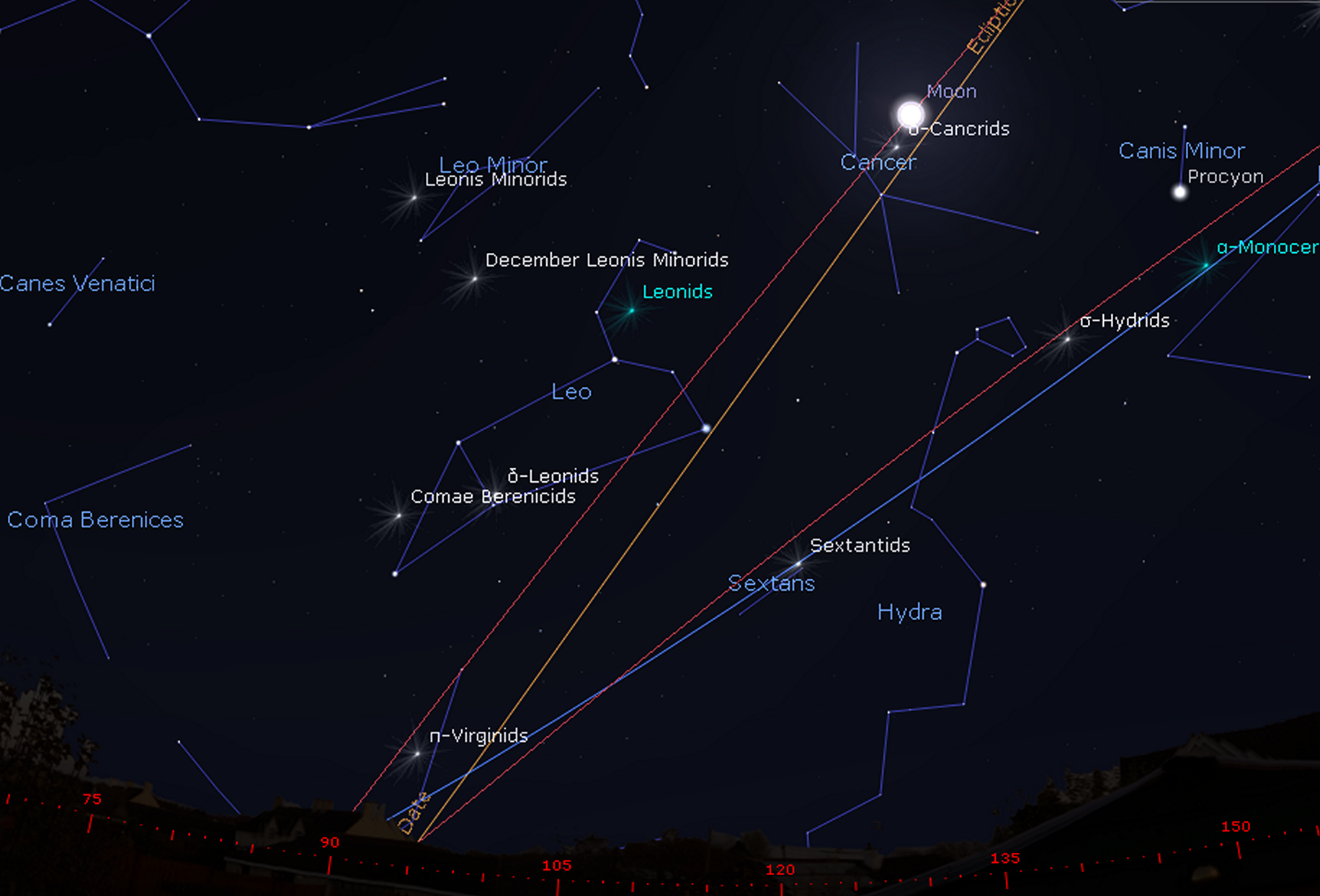
The Leonids (LEO) are next. They peak on 16/17th Nov, but an 80% Moon will get in the way. Worse, the radiant doesn’t rise till midnight by which time the Moon will be high in the sky. Quoted rates are 15 but with half the sky below the horizon and the Moon bleaching the sky, i reckon five would be a good rate. Leonids do often have persistent trails though, and a weak outburst is possible if the Earth passes through a denser patch of debris from 55P/Temple-Tuttle, the parent body. Leonids are fast-moving and the radiant is in the “crook” of Leo’s tail as shown in the picture below which shows the view looking East at around 3am.

Later in the month there are two lesser showers, starting with the α-Monocerotids (AMO) which peak dawn on 22nd at a rate of five per hour. The radiant will be low in the south east and a crescent Moon will rise at 01.30 so check early. The Northern Orionids (NOO) run from 14th Nov to 6th Dec with a peak around 28th. The rate of three per hour is low but fast moving and the Moon is new so you should spot one or two.

If you do see something please send in a report to meteor@popastro.com or use the link on our website to report it via the IMO. When making a report of a sighting, please include the date, time, your location, the direction in which you saw the object, and rough direction it was going in. This can help us link it to other sightings, and maybe even work out more about the meteoroid that caused it.

Meteor Outlook for October 2019

We have several meteor showers coming up – though please don’t believe the press hype about massive fireballs as bright as the moon, thats not really likely. I’d be delighted if you saw one though and if you do, please do let me know and send pics if you have them.
 
The Camelopardalids (international code OCT) peak tonight (6th October). This is a minor shower with a rate of around five per hour but with the radiant high in the north east, you may spot some despite a 60% Moon. They’re quite fast moving.
 
The Southern Taurids (STA) have actually been going on since mid Sept and will continue to mid Nov, though they have a weak maximum on the 9th of October. Peak rates are around five an hour, though unless you live on a hilltop with a 360 degree horizon you are not going to see that many. Southern Taurids do produce slow-moving fireballs but the 86% Moon will make it hard to see faint meteors.
 
The Draconids (DRA) are a short-lived shower (6-10th Oct) with a peak rate of around ten per hour. Again moonlight will interfere with visibility though the radiant is high in the north west which improves your chances.
 
The Orionids (ORI) peak on 21st October, but are already in progress and will go on till early November. Peak rates are officially about 20, but a 45% Moon will drown out faint ones, and the radiant doesn’t rise till around 11pm in the UK so I reckon five an hour would be more likely. Orionids are usually quite fast moving.
 
Finally later in October the Northern Taurids (NTA) kick off and continue through to December. These are very similar to the Southern Taurids, but the Moon will be nearly full at the peak of 11th Nov, so you’re more likely to see something in late October when the radiant will be high in the south east after sunset and the Moon won’t interfere.
 
When making a report of a fireball, please include the date+time, your location, direction in which you saw the object, and rough direction it was going in. This can help us link it to other sightings, and maybe even work out more about the meteoroid that caused it. You can also use the link on our website which submits a report to the International Meteor Organization.