
Here, in reverse chronological order, is a summary of notable meteors and fireballs reported to the section during January 2018:
2018 Jan 19th 02:25 UT
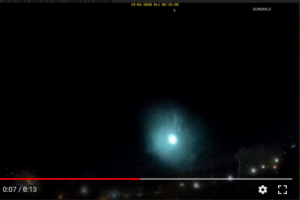
This fireball was captured on video by Stan Armstrong (Loudwater Valley, Bucks).
It also appears to have been imaged low in the NE sky by the all-sky Bayfordbury camera of the University of Herts
http://star.herts.ac.uk/allsky/imageget.php?jde=2458137.60035&c=1
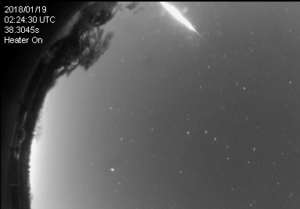
Five members of the NEMETODE group have reported detecting this fireball. Nick James (Chelmsford) imaged the start of the fireball via his NW facing camera. Stephen Bosley (Clanfield, Hants) also captured part of its track via his NE facing camera. James Dawson (Nottingham) also captured it at the edge of the field of view of his SE facing camera. Ray Taylor (East Yorkshire) captured most of it, low in the sky, via his SE facing camera.
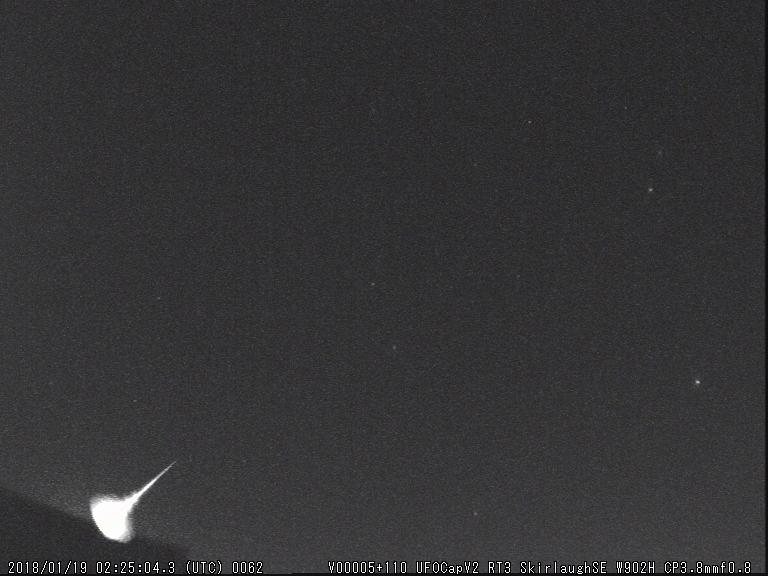
From the Chelmsford and Clanfield images, Nick has derived a provisional ground track heading in an easterly direction over southern Norfolk. The early stages were found to be of mag -2, but it can be clearly seen from Stan’s video and Ray’s image that the later stages were much brighter.
William Stewart (Ravensmoor, Cheshire) reports having captured a spectrum of it and detecting its radio detection via forward scatter.
There were also many reports to the IMO
http://fireballs.imo.net/members/imo_view/event/2018/221
The IMO’s automatically generated provisional ground track from this was initially somewhat further northwest. This was due to the inclusion of a number of reports which referred to the event at 01:06 UT (see below). These reports were initially also responsible for their average report time for the event being skewed earlier by around 20 minutes. These extra reports have now been removed, bringing the average report time closer to the true value and moving their provisional ground track into Norfolk.
2018 Jan 19th 01:06 UT
The five earlier reports in the IMO list referred to above tie in with a visual fireball report received from Kevin Boyle (Stoke-on-Trent). Kevin saw the fireball in his southern sky, starting below Cancer and ending about 10 degrees above the horizon. He described it as being slow moving (duration 3-4 seconds), bright green in colour and comparable at its brightness with Venus.
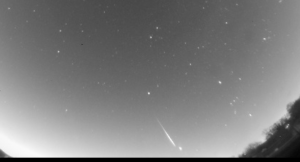
This fireball also shows up on an image captured by the Bayfordbury camera of the University of Hertfordshire.
http://star.herts.ac.uk/allsky/imageget.php?jde=2458137.54576&c=1
The other IMO reports were from witnesses in south midlands who also reported the fireball to be in their southern sky, suggesting that the fireball may have been over southern England or the English Channel. Unfortunately there seem to have been no reports of the fireball from France and so the trajectory remains uncertain.
The reports to the IMO can be viewed here:
http://fireballs.imo.net/members/imo_view/event/2018/308
2018 Jan 7th 05:17 UT
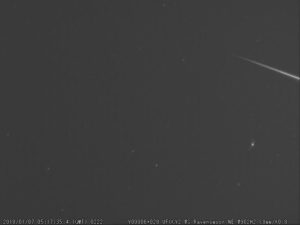
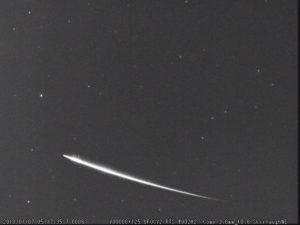
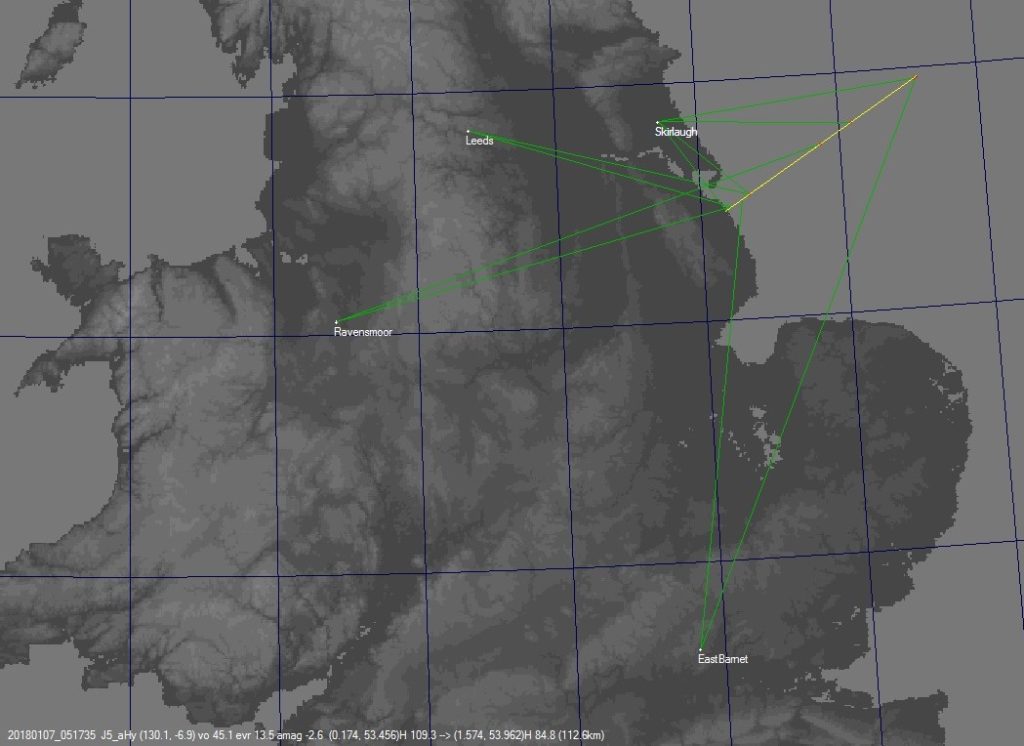
This fireball was captured on video by 4 cameras of the NEMETODE network ( http://www.nemetode.org ). Three of the extracted still images are reproduced below, along with a map showing the ground track derived from the videos.
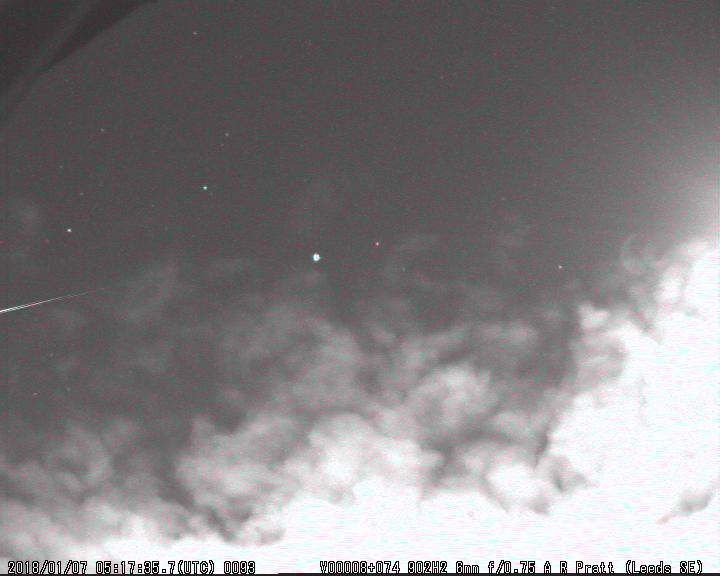
Alex Pratt (Leeds) only captured the start of the path near the edge of his NE facing camera.
William Stewart(Ravensmoor, Cheshire) also captured just the start.
Ray Taylor (Skirlaugh, East Yorkshire) fared better, capturing the whole of the path – the curvature being an image artefact.
Jim Lowe (East Barnet) also imaged the while of its path.
Analysis of the four images by William indicated that the fireball started near the coast of Lincolnshire and was heading in a SW to NW trajectory.
It was probably around mag -3 and a member of the Alpha Hydrids, this being a minor shower that reaches its peak during the first week of January.
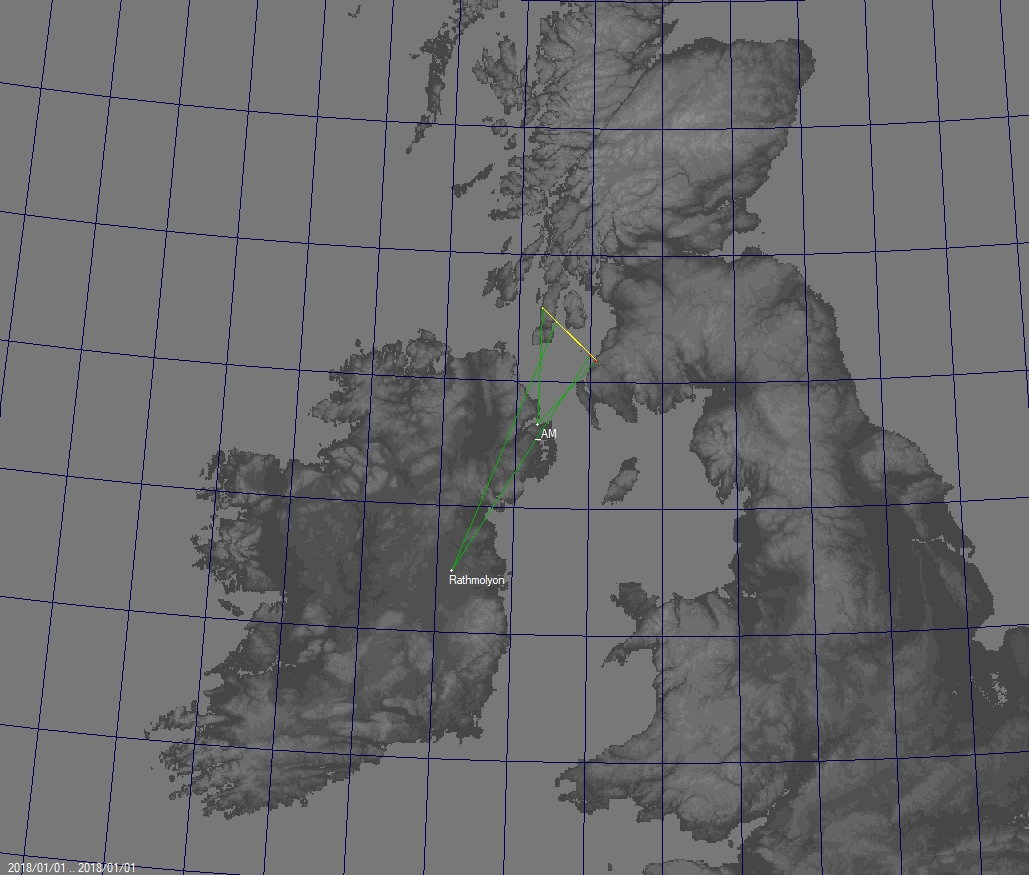
2018 January 1st 22:40 UT
This fireball, probably around mag -5, was reported by Nick Froom (Tyneside), Shaun Turner (Lauder, Berwickshire) and Mackay Lauren (Lanarkshire).
Nick saw the event in his western sky, heading from the WNW to WSW, showing colours of yellow and orange and having a duration of 1-2 seconds.
Mackay saw the fireball heading from the WSW to the SSW, having a duration of 3-4 econds and being yellow in colour.
Shaun saw the fireball heading from the WSW to the SW, being orange in colour, having a duration of 1-2 seconds and fragmenting into three pieces near the end.
These and other visual reports of the fireball can be viewed here http://spa.imo.net/imo_view/event/2018/13
The fireball was also imaged by several cameras in the NEMETODE network http://nemetode.org
Two of these images were captured by Mike Foylan (Rathmolyon, Ireland) and Andy McCrea (Bangor, N Ireland). The accompanying map shows (in yellow) the trajectory as determined from these images. It is quite similar to that automatically derived from the visual reports. Allistair Gordon (Carrickfergus, N Ireland) also reports having imaged it. David Anderson (Ayrshire) may also have imaged the fireball through cloud.

 Images and Video clips