
Alongside the sight of Venus, Mars and Jupiter in the pre-dawn sky, the constellation of Leo is also emerging from the morning twilight.
Variable Star news
Chi Cygni : heading for a bright maximum
2014 was a disappointing year for observers of the variable star chi Cygni,… but 2015 is already much better!
R Scuti is fading
Recent observations indicate that the star R Scuti is fading into a minimum.
R Serpentis heading for maximum
The Mira type variable R Serpentis is now readily visible in binoculars as it closes in on its 2015 maximum.
Chi Cygni : looking good for 2015
A year ago, the Mira type variable chi Cygni produced one of its faintest ever maxima, reaching only about mag 6.5.
Choosing stars to observe
Which type of variable star is suitable for you?
This depends on how often you can observe in a given month and how long you can observe for on each occasion.
The variable stars on the programme of the SPA VSS can be divided into five categories:
1. One-Nighters
These are stars for which it is possible to see significant variation in brightness in the course of several hours on a single night, although not necessarily on every night.
This category includes RR Lyrae and the Algol type eclipsing variables.
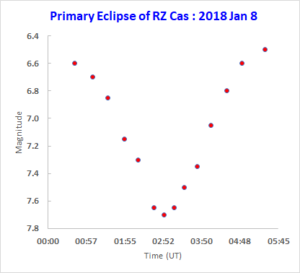
One such eclipsing variable is RZ Cassiopeiae, whose primary eclipse is shown in the accompanying light curve.
In the case of RZ Cas, the whole eclipse lasts for nearly 5 hours but, as can be seen in this light curve, most of the brightness changes occur during the middle 3 hours.
Algol (beta Persei) is the most famous example, although its eclipses are about twice as long as those of RZ Cas.
2. One-Weekers
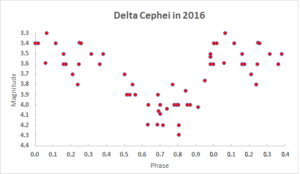
These are stars for which significant changes in brightness can be seen over the course of a week or two, in some cases from one night to the next.
These would suit people who are able to observe on every clear night, but only short a short time.
This category includes the Cepheid variables, such as Delta Cephei, and the beta Lyrae type eclipsing variables.
3. Medium-Rangers
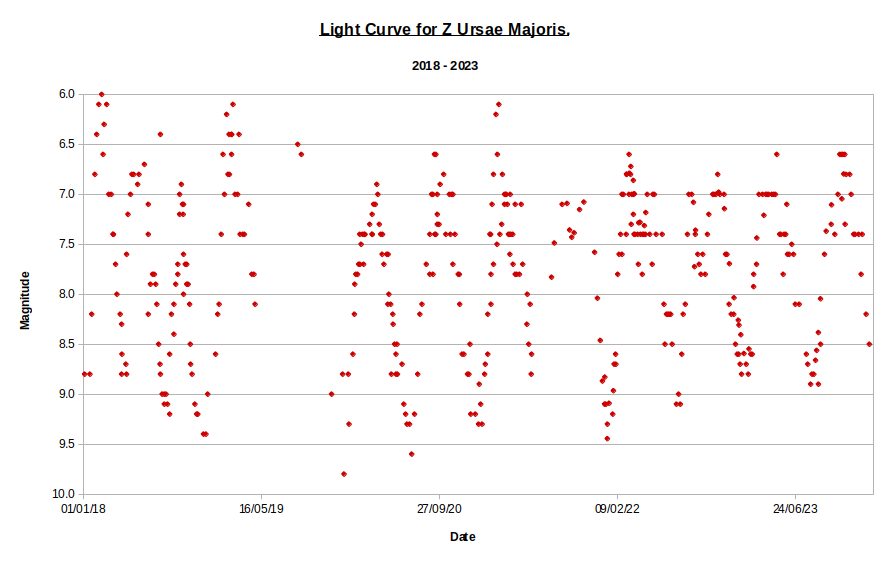
These are stars that vary more slowly, but which show significant changes in brightness over the course of several months or a year.
The brightness changes don’t repeat exactly from one cycle to the next, although there are clear signs of periodicity, all is illustrated by the accompanying light curve for Z Ursae Majoris.
Sometimes these stars spring surprises – by brightening beyond the published upper limits of their brightness ranges or fading below the published lower limits.
They would suit people who can observe several times per month, but not necessarily on every clear night.
This category includes R Scuti and the semi-regular variables.
4. Big-Rangers
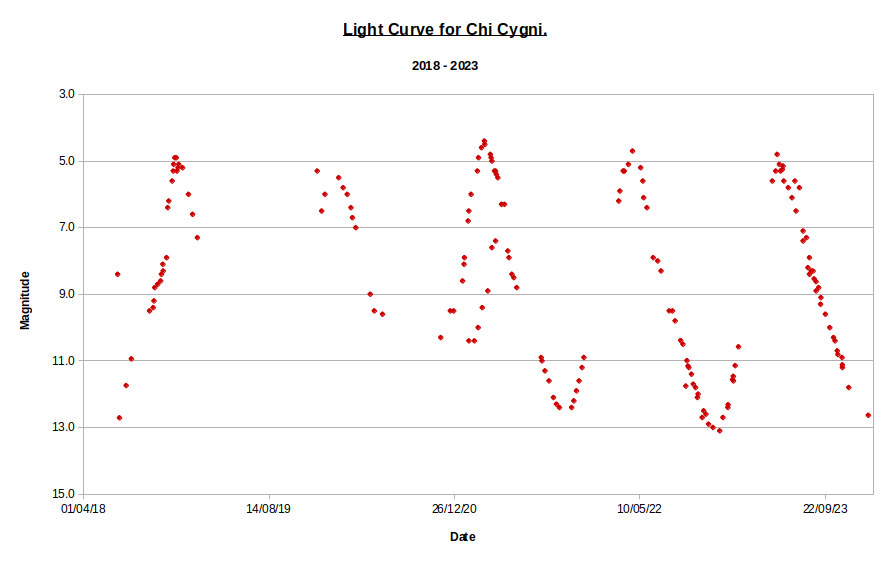
These are stars that show large changes in brightness over the course of a year.
Their brightness changes are so large that for several months they become too faint to be seen using binoculars and are only visible telescopically.
The accompanying light curve for Chi Cygni shows its brightness changes during 2018 and 2023. The maxima were observable using binoculars, but a telescope was required to follow it down to minimum.
These stars would also suit people who can observe several times per month, but not necessarily on every clear night.
This category includes the Mira type variables.
5. Rebels
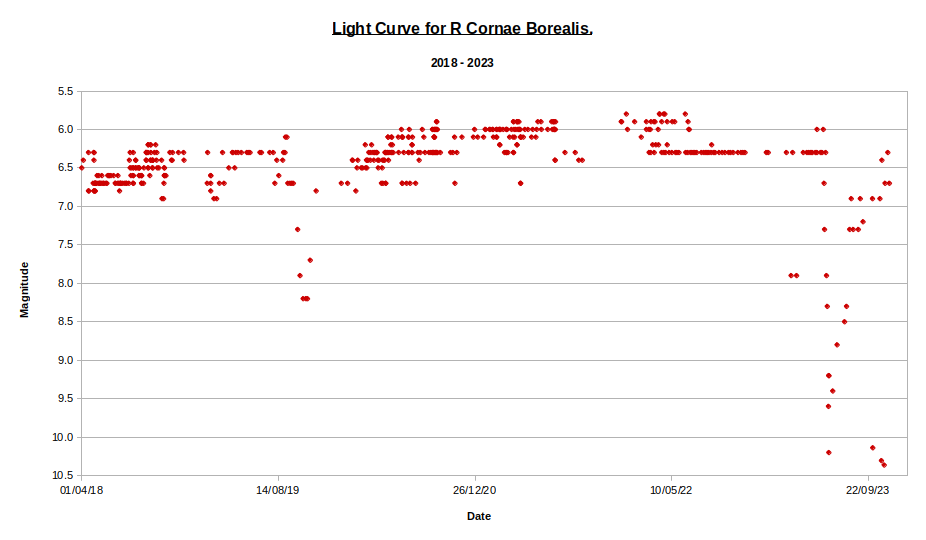
These are variable stars that are totally unpredictable.
These variables would mostly appeal to people who can observe on every clear night, but other observers may also enjoy monitoring them when their circumstances permit.
The category includes R Coronae Borealis and Novae.
R CrB plummets!
No sooner had we published the news item The slow fade of R CrB continues on June 4th, when the fade then accelerated !
Observing Programme 2015 onwards
Variable Star section members are, of course, free to observe and submit observations of any variable star.
The “programme” which follows has been designed, however, with beginners in mind and lists stars that are (hopefully!) not too difficult to locate and which usually show a good amount of variation.
Click on the name of each variable to access a finder chart and more information about the star.
Stars that can show significant brightness changes over a few hours
Star |
RA |
Dec |
Range |
Type |
Period(s) |
| U Cephei | 01h02.3m | +81o53′ | 6.7 – 9.3 | EA | 2.493d |
| RZ Cassiopeiae | 02 49.8 | +69 38 | 6.4 – 7.8 | EA | 1.195d |
| Beta Persei (Algol) | 03 08.2 | +40 57 | 2.1 – 3.4 | EA | 2.867d |
| U Coronae Borealis | 15 18.1 | +31 39 | 7.8 – 8.8 | EA | 3.45d |
| RR Lyrae | 19 25.5 | +42 47 | 7.0 – 8.1 | RRLyr | 0.567d |
Stars that show brightness changes over a week, sometimes from night to night
Star |
RA |
Dec |
Range |
Type |
Period(s) |
| Zeta Geminorum | 07h04.1m | +20o34′ | 3.7 – 4.3 | Cep | 10.150d |
| Beta Lyrae | 18 50.1 | +33 22 | 3.4 – 4.3 | EB | 12.941d |
| Delta Cephei | 22 29.2 | +58 25 | 3.4 – 4.3 | Cep | 5.366d |
Stars that show brightness changes over the course of several months
Star |
RA |
Dec |
Extreme Range |
Type |
Period(s) |
| Betelgeuse (Alpha Ori) | 05h55.2m | +07o24′ | 0.4 – 1.3 | Semi Reg | 1600d? |
| W Orionis | 05h05.5m | +01o10′ | 5.9 – 7.7 | Semi Reg | 212d |
| RX Leporis | 05 11 | -11 51 | 5.1 – 6.7 | Semi Reg | 80d |
| Z Ursae Majoris | 11 56.3 | +57 52 | 6.3 – 9.6 | Semi Reg | 195d |
| RW Bootis | 14 41.2 | +31 34 | 7.4 – 8.9 | Semi Reg | 209d? |
| Alpha Herculis | 17 14.6 | +14 23 | 3.0 – 4.0 | Semi Reg | 100d, 6yr? |
| R Scuti | 18 47.5 | -05 42 | 4.5 – 8.6 | RV Tau | 142d |
| U Monocerotis | 07 31 | -09 46 | 5.1 – 7.1 | RV Tau | 92d |
| AF Cygni | 19 30.2 | +46 09 | 6.4 – 8.4 | Semi Reg | 92d |
| R Lyrae | 18 55.3 | +43 57 | 3.9 – 5.0 | Semi Reg | 46d |
| RY Draconis | 12 56.5 | +65 59 | 6.0 – 8.0 | Semi Reg | 200d |
| W Cygni | 12 36 | +45 22 | 5.1 – 8.9 | Semi Reg | 132d |
| Mu Cephei | 21 43 | +58 47 | 3.4 – 5.1 | Irr | 860d |
| EU Delphini | 20 38 | +18 16 | 5.4 – 6.7 | Semi Reg | 58.6d |
Stars that show large brightness changes over the course of a year
The ranges given in brackets for these Mira Type variables are the mean ranges.
The other ranges given are extreme ranges.
All of these stars can be followed using binoculars when they are near maximum (a couple may be visible to the naked eye), but a telescope will be needed if you wish to follow them all the way down to minimum brightness.
Star |
RA |
Dec |
Range |
Type |
Period(s) |
| R Bootis | 14h37.2m | +26o44′ | 6.2 – 13.1 | Mira | 223d |
| (7.2-12.3) | |||||
| T Cephei | 21 09.5 | +68 29 | 5.4 – 11.0 | Mira | 389d |
| (6.0-10.3) | |||||
| Omicron Ceti (Mira) | 02 19.3 | -02 59 | 1.7 – 10.1 | Mira | 332d |
| (3.6-9.3) | |||||
| Chi Cygni | 19 50.6 | +32 55 | 3.4 – 14.2 | Mira | 407d |
| (5.1-13.4) | |||||
| R Leonis | 09 47.6 | +11 26 | 4.8 – 11.0 | Mira | 310d |
| (5.8-10.0) | |||||
| U Orionis | 05 55.8 | +20 10 | 5.3 – 12.6 | Mira | 372d |
| (6.3-12.0) | |||||
| R Serpentis | 15 50.7 | +15 08 | 5.7 – 14.4 | Mira | 357d |
| (6.9-13.4) | |||||
| R Trianguli | 02 37.0 | +34 16 | 5.4 – 12.0 | Mira | 266d |
| (6.2-11.7) | |||||
| R Ursae Majoris | 10 44.6 | +68 47 | 6.7 – 13.4 | Mira | 302d |
| (7.2-13.0) | |||||
| S Ursae Majoris | 12 43.9 | +61 06 | 7.2 – 12.7 | Mira | 226d |
| (7.9-11.7) | |||||
| T Ursae Majoris | 12 36.4 | +59 29 | 6.6 – 13.5 | Mira | 257d |
| (7.7-12.9) |
Stars whose brightness changes are totally unpredictable
Star |
RA |
Dec |
Range |
Type |
Period(s) |
| R Coronae Borealis | 15h48.6m | +28o09′ | 5.8-15.0 | RCB | none |
| Rho Cassiopeiae | 23h54.4m | +57o29′ | 4.2 – 6.2 | SDOR | none |
| Gamma Cassiopeiae | 00h56m | +60o43′ | 1.6 – 3.0 | Gamma Cas | none |
This category will also include any bright novae that appear.
Reference
About the Section
Director Profile
Downloadable Forms
Variable Stars Overview
Choosing stars to observe
How to observe Variable Stars
Submitting Variable Star Observations
Finding Eclipse Predictions
Finding maxima predictions for Mira variables
Useful Variable Star links
History of the Variable Star Section
The slow fade of R CrB continues
There was a time when R Coronae Borealis would behave in the way described in astronomy texts. It would spend most of its time near maximum (around mag 6.0) but then, at times that were unpredictable in advance, it would fade dramatically. Sometimes it would fade by a few magnitudes; sometimes it would fall all the way down to 15th magnitude. Then, after an interval of between a few months and a year, it would return back to maximum.