A Mira type variable near the ‘head’ of Serpens, that currently reaches its annual peak in the second half of July.

R Serpentis is a red giant star whose brightness variations are primarily related to pulsations in its outer layers.
As can be seen from the above light curve, the rise to maximum is much steeper than the fade afterwards.
| Extreme brightness range | 5.7 – 14.4 |
| More typical range | 6.9 – 13.4 |
| Period of variation | 357 days (8 days shorter than a year) |
| Frequency of observation | Worth checking a few times per month |
| Observe using | 50mm binoculars will suffice when near maxima. Larger binoculars will be required as it fades. A telescope will be required to follow it all the way down to minimum |
| Visibility | Can be observed all year round, but is only visible in the morning sky from December to February |
| Dates of maxima | April 2025 |
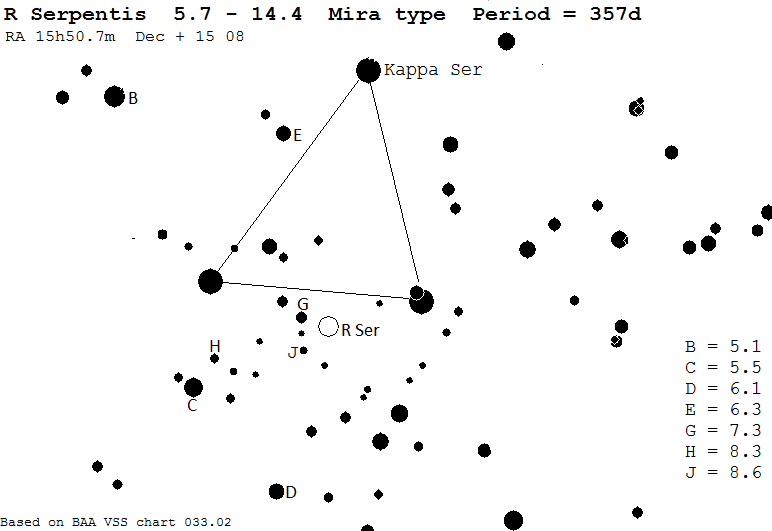
The finder charts which follow show the location of R Serpentis.
The first shows a wider view showing its location relative to Arcturus and Corona Borealis:

The second chart shows the area close to R Ser in more detail.