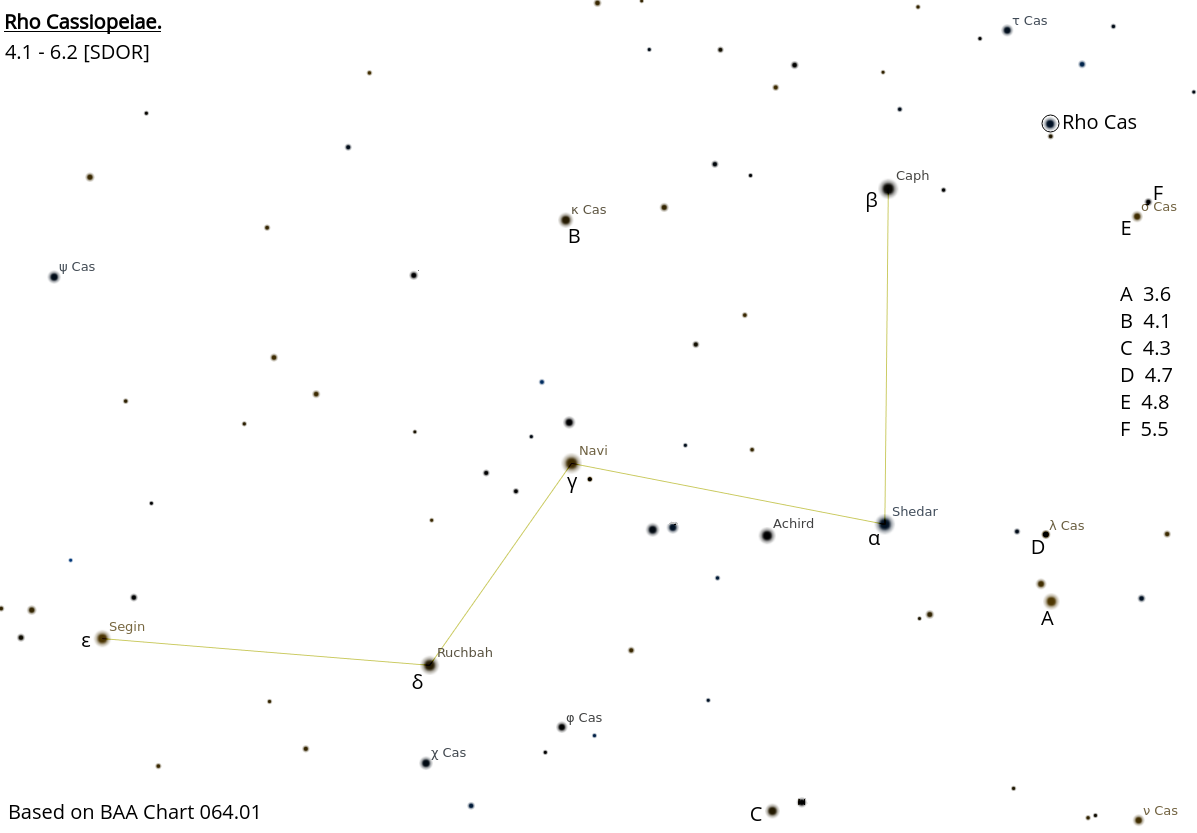
Rho Cassiopeiae is a naked eye variable that is easy to find and estimate. It has an extreme range of 4.1 – 6.2, although it more typically varies between magnitude 4.0 and 5.0. It is an irregular variable, so has no know period. It is best observed once a week, and can be observed with the naked eye, if you have dark enough skies. If your skies are too badly light-polluted you can still observe this star using a small pair of binoculars.
Rho Cassiopeiae is classified as a yellow hyper-giant, and is one of the most luminous stars known. It is about 300,000 times more luminous then the Sun, and its immense luminosity is demonstrated by the fact that its visible with the naked eye, despite being around 3,400 light years away.
Rho Cassiopeiae is a S-Doradus type variable. These stars are very massive, very luminous, and very unstable, and regularly eject large quantities of material. It is these eruptions that cause a drop in brightness, and therefore, a subsequent drop in brightness.
| Extreme brightness range | 4.1 – 6.2 |
| More typical range | 4.2 – 5.0 |
| Period of variation | None |
| Frequency of observation | Once a week |
| Observe using | Naked eye – if you have a reasonably dark observing site. Otherwise use 40mm or 50mm binoculars. |
| Visibility | Can be observed all year round – but is low in the sky during the summer months. |