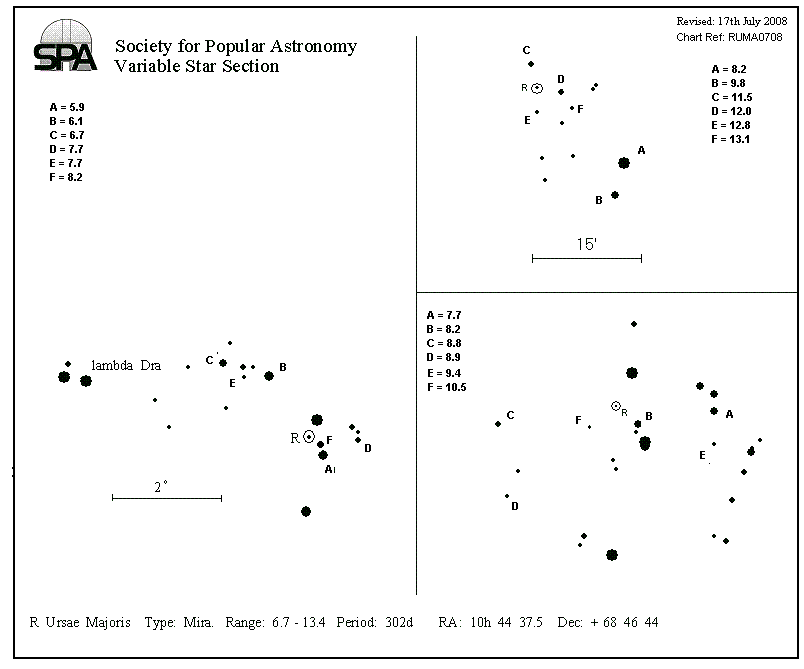
A Mira type variable star located a few degrees north of the ‘pointers’ of the Plough.
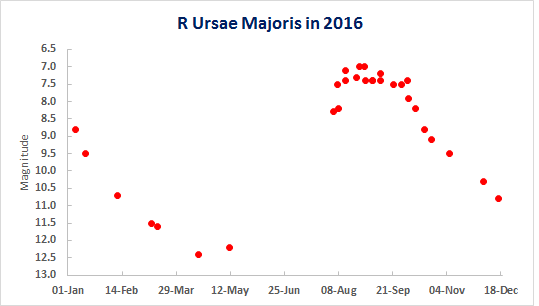
Like other Mira type variables, R Ursae Majoris is red giant star. The brightness variations are mostly due to pulsations in its outer layers. However, the brightness doesn’t rise and fall at a constant rate because as the star’s surface cools during the expansion phase, some very simple molecules are able to form and these absorb some of the light being emitted. When the surfaces warms again during the contraction phase, these molecules split apart.
| Extreme brightness range | 6.7 – 13.4 |
| More typical range | 7.2 – 13.0 |
| Period of variation | 302 days – approx 10 months |
| Frequency of observation | Worth checking a few times per month |
| Observe using | 50mm binoculars will suffice when it is near maximum. Larger binoculars will be needed when fainter. A telescope is required if you want to follow it down to minimum |
| Visibility | Circumpolar – can be observed all year round. |
| Dates of maxima | September 2025 |
The finder chart below shows the location of R Ursae Majoris.