Guide to Delta Cephei

The “prototype” Cepheid variable star, going up and down in brightness every 5.366 days in a very predictable way.

delta cep


This light curve was created using all of the observations made by SPA VSS members during a single year.

Since the brightness changes repeat exactly from once cycle to the next, it is possible to combine all observations into a single light curve showing how the brightness changes during each 5.366 day cycle.

For each observation, the phase (i.e. fraction of the 5.366 day cycle completed) of Delta Cephei was calculated. This might seem a daunting task, but you can do this for your own observations via this  helpful spreadsheet (which will also plot a light curve for you)

As can be seen from the resulting light curve, the rise to maximum is somewhat steeper than the fade back down to minimum. This is the case for the majority of Cepheids, There are exceptions to this pattern, however – one such exception is the star Zeta Gem (which also on the section’s programme) in which the light curve is more symmetrical.

Extreme brightness range 3.4-4.3
More typical range always the same range
Period of variation 5.366 days
Frequency of observation Worth checking on every clear night
Observe using Naked eye – if you have a reasonably dark observing site. Otherwise use 40mm or 50mm binoculars.
Visibility Can be observed all year round, but is fairly low in the evening sky from March to May

Delta Cephei, like other Cepheid variables, is a yellow pulsating supergiant star whose outer layers pulsate in a very regular way.

Its brightness variations were first recognised in 1784 by the York-based amateur astronomer John Goodricke. Although it subsequently came to be regarded as the “prototype” Cepheid variable, it wasn’t the first Cepheid variable discovered – the brightness changes of Eta Aquilae had been discovered a few weeks earlier. However, Delta Cephei is better placed for observation from the UK and consequently it was Delta Cephei that was more closely studied.

DeltaCep_chartThe accompanying chart shows the location of Delta Cephei.

You can follow the brightness changes of Delta Cephei by comparing it with the lettered comparison stars.

Although Delta Cephei is generally described as being a naked eye variable star, the truth of that description depends on the amount of light pollution affecting your observing site.

If light pollution is a problem, then you may find it easier to observe Delta Cephei using 40mm (e.g 8×40) or 50mm (e.g. 7×50) binoculars.

At maximum, Delta Cephei will be almost as bright as comparison A.

At minimum, Delta Cephei will be slighty fainter than comparison E.

Mu Cephei is also a variable star. It varies in brightness much more slowly (and less predictably), typically varying over a range of about half a magnitude every two years.

Guide to AF Cygni

A star that steadily fluctuates up and down in brightness, going through several cycles of variation each year.

af cyg

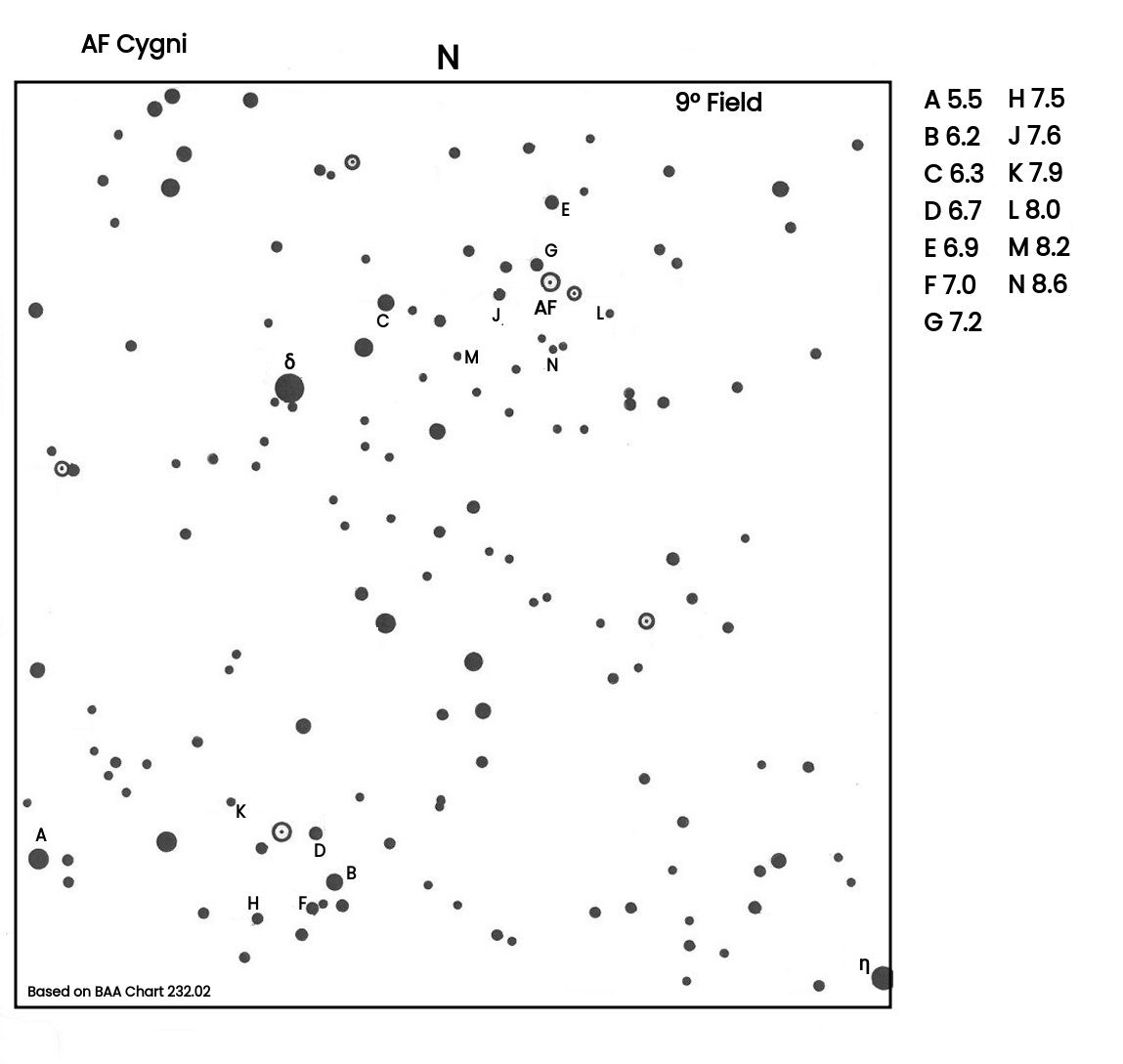
A pretty reliable variable star that is easy to locate given that it is located not too far from Delta Cygni (mag 2.9). The brightness changes don’t repeat exactly from one cycle to the next and so every new cycle is a new observing experience. The amplitude in each cycle is mostly close to a magnitude, but from time to time it does go through cycles in which the amplitude may somewhat larger or somewhat smaller.

During 2014, the 92 day period seemed to be replaced with a period close to double that value but in the second half of 2015, as can be seen in the above light curve, the 92 day period seemed to be becoming more apparent again. A similar apparent doubling occurred in early 2017. It is likely that the 92 day period is present throughout but with some maxima being much less prominent than others.

AF Cygni is a red giant star. The brightness changes are related to pulsations in the star’s outer layers. The star probably has more than one pulsation period and the combination of these different periods results in a light curve whose shape and amplitude change from one cycle to the next.

Extreme brightness range 6.4 – 8.4
More typical range 6.7 – 7.7
Period of variation About 3 months (but seemed to be longer in 2014)
Frequency of observation Worth checking a few times per month
Observe with 40mm or 50mm binoculars will suffice for most of the time, but 50-80mm binoculars may be required during the deeper minima
Visibility Can be observed all year round, but is rather low in the evening sky from January to April

Here is a finder chart (approx 9 degrees) that labels comparison stars that you can use when making brightness estimates of AF Cygni:

AF_Cyg

About the Section

The Variable Star Section was formed in 1961.

In the 1960s, telescopes were somewhat more expensive in real terms than they are nowadays and little thought had been given to the possibility of observing variable stars using binoculars.

Hence the original observing programme focused on naked eye variable stars.

Since then of course, telescopes have become cheaper in real terms. A bigger difference however is that Variable Star observing groups have come to value the contribution that binoculars can make to variable star observing. A

Alongside this, however, light pollution has become more widespread and as a result many “naked eye” variables are barely visible (if at all) from the locations where most SPA members live.

The SPA VSS has amended its observing programme to take these factors into account.

Some of the original naked eye variables were soon dropped because they showed little or no regular variation in brightness and therefore were not interesting targets for newcomers to variable star observing. More have been dropped in recent years because the majority of section members now find it more convenient (and feasible!) to observe using binoculars.

How to “join” the Variable Star section

Anyone who submits observations is effectively a section member – there is no formal process for asking to join the section !

rz casLight Curves

Observations received from members are combined into light curves – effectively, these are graphs in which the brightness of the star is plotted vertically and the time is plotted horizontally.

You can of course also plot your own by using spreadsheet packages such as Excel.

Reports

Reports are published on the section’s web pages and in the society’s bi-monthly magazine Popular Astronomy.

Which type of variable star is suitable for you?

This depends on how often you can observe in a given month and how long you can observe for on each occasion.

Find out more in our guide Choosing stars to observe


2014 Light Curves

Here is a selection of light curves from 2014 for stars on the programme of the Variable Star Section:

RW Bootis
rw boo

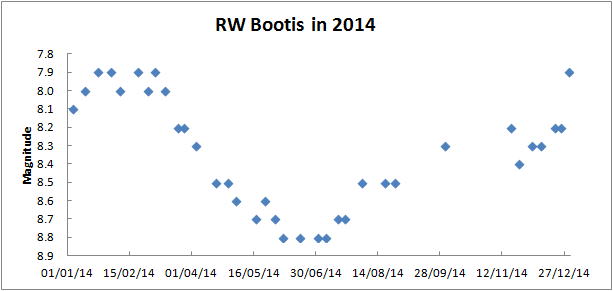
A good amount of variation in brightness was seen during 2014. The “irregularities” in the later part of the year may well, in part at least, be related to the star being low in the sky during the autumn months, making brightness estimates more tricky to carry out.

RZ Cassiopeiae
rz cas

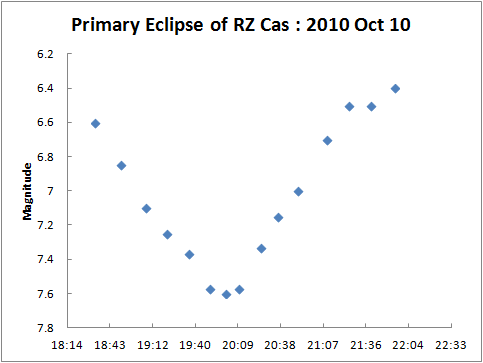
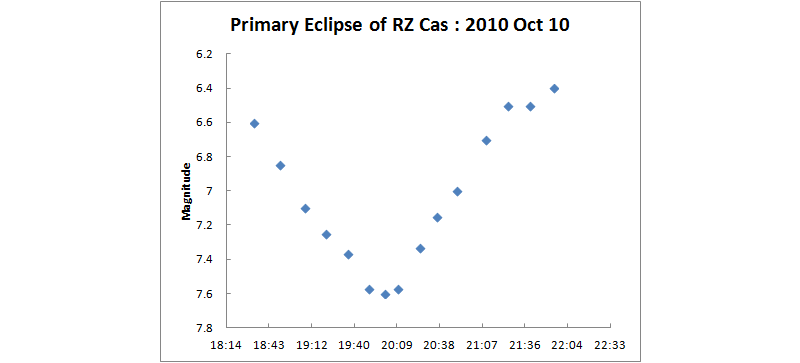
RZ Cas is an eclipsing variable star with an orbital period of approx 29 hours. All of the observations made during 2014 have been combined into this single light curve. As can be seen, it so happened in 2014 that RZ was seen emerging from eclipse much more often than it was seen fading into eclipse.

The primary eclipse occurs when the brighter star in the RZ Cas system is eclipsed by the fainter star. The eclipse is believed to be borderline between being a partial eclipse and being a total eclipse.

If the eclipses were occurring in line with the predictions, then the primary eclipse would be centered on (predicted) phase 0.

Although there is some scatter, much of which will be due to the differences in observing conditions (moonlight, haze, etc) for each observed eclipse, the suspicion is that the eclipse is centered slightly to the left of phase 0, and so was occurring very slightly earlier than predicted. The discrepancy probably amounts to around 10-20 minutes.

Gamma Cassiopeiae
g cas

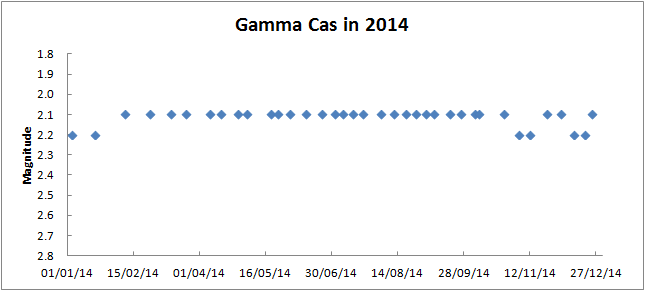
Another(!) rather quiet year for this star. Indeed the star has shown little variation in brightness since the 1960s and so is likely to be dropped from the programme in the next review.


T Cephei

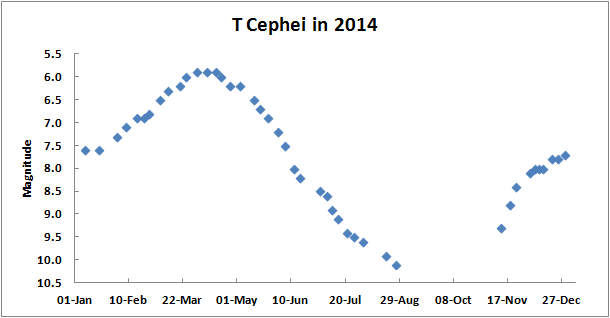
T Cephei is a Mira type variable whose maxima are separated by just under 13 months. Being located near the star beta Cephei, it is quite easy to locate and is also circumpolar from the UK. It can be followed using binoculars over most of its brightness range.
t cep

U Cephei

u cep

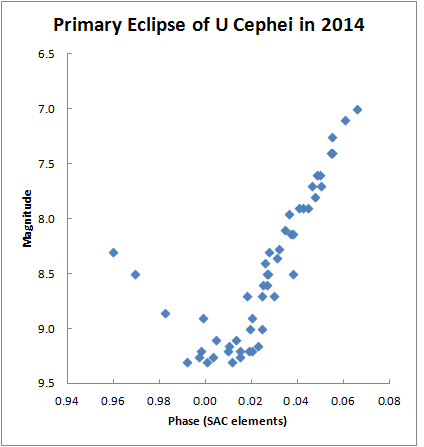
U Cephei is an eclipsing variable star, similar to Algol (beta Persei) and RZ Cassiopeiae.

In the case of U Cep, the eclipses last about 9 hours, are total eclipses and occur approx every 2.5 days.

As in the earlier RZ Cas report, all of the observations made during 2014 have been combined into a single light curve.

Also as in the case of RZ Cas, it so happens that most observations were made during mid eclipse and the rise from minimum, with few observations made during the fade into eclipse.

However, it is still fairly obvious that the primary eclipse is centred to the right of (predicted) phase 0, indicated that the eclipses were occurring later than predicted in 2014.

As an example, if the eclipse was centered on phase 0.01, then it would be coccurring approx 36 mins later than predicted.

Omicron Ceti (Mira)
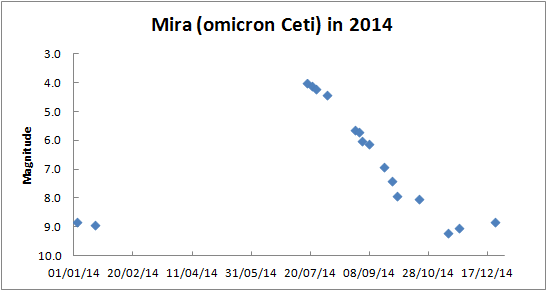
o cet

Maxima of Mira are currently taking place during the spring months when Mira is close to conjunction and not observable from the UK. It only emerges from the morning twilight around mid July.


R Coronae Borealis
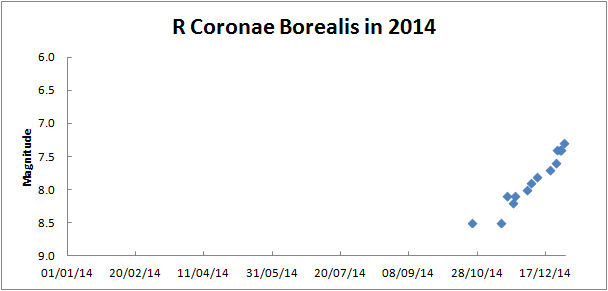
r crb

For many years – since its deep fade started in the summer of 2007 – R CrB had not been visible in binoculars. Indeed it had spent much of its time down near 15th magnitude. However, it started to brighten during the summer of 2014 and by the mid autumn it was visible again in binoculars. By the end of January 2015, it had reached mag 7.0 as it closed back in on its “normal” maximum brightness.


chi Cygni

chi cyg

Chi Cygni produced an unusually faint maximum in 2014. Indeed,this may well have been the faintest maximum that this Mira type variable has ever produced in the three centuries since its variations were first recognised. In contrast, some maxima in recent years have reached mag 4.0 or brighter.


Alpha Herculis
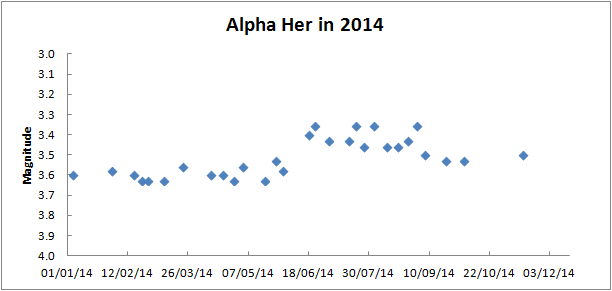
a her

Only a small amount of variation in brightness was seen during 2014 from this semi-regular variable. Alpha Her appears to have been brightest during the summer months.


R Leonis
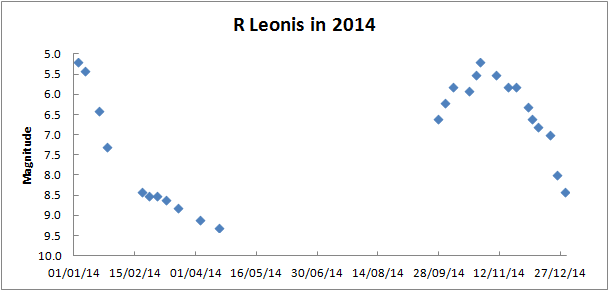
r leo

This Mira type variable star was fading from its late 2013 maximum at the start of the year. By mid spring it had been lost in the evening twilight as the constellation of Leo approached conjunction with the Sun. By the time that it emerged from the morning twilight in the early autumn, it was well on the way towards its November maximum.


U Orionis
u ori

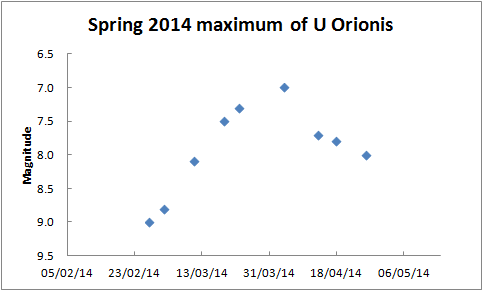
U Ori is a Mira type variable that has an average interval between maxima of 372 days.

Hence maxima are getting later each year by about a week.

The 2014 maximum occurred in early April … this is quite late in the apparition of U Ori. Less than a decade from now the maxima will have disappeared into the late May evening twilight.

Despite being located in the constellation of Orion, U Ori is located a long way from the main pattern of Orion – it is actually located just south of the ecliptic, close to whether Taurus meets Gemini.

Rho Persei
rho per

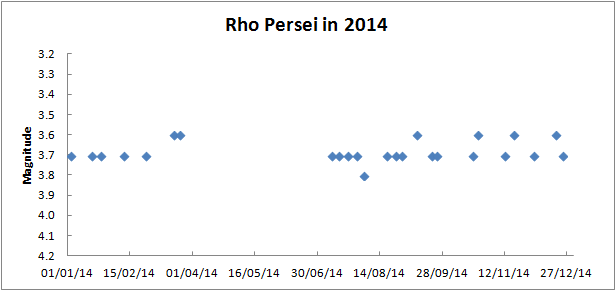
Although Rho Persei is often described as showing a brightness range of nearly a magnitude, any brightness changes that do occur seem always to be much smaller. Indeed, the light curve shown below shows no clear evidence of any brightness changes. This is rather typical behaviour for Rhp Per and hence it is not a very interesting star for beginners. Hence it may well be dropped when the programme is next revised.

The gap in observations during May and June is due to Rho Per being very low in the northern sky and thus not really observable.


R Scuti
r scuti

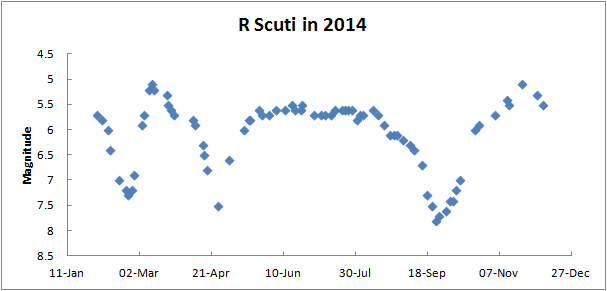
2014 was another very interesting year for R Scuti. As in 2013, it showed no sign of following its “standard” description of being a star that produces alternate deep and shallow minima.


R Trianguli
r tri

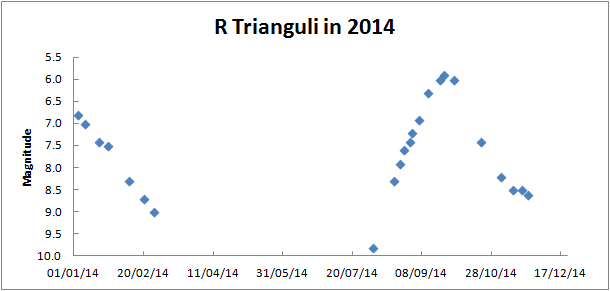
R Trianguli is a Mira type variable that has an interval between maxima of approx 9 months. At the start of 2014, R Tri was fading from its late 2013 maximum. The 2014 maximum was seen in September.


R Ursae Majoris
r uma

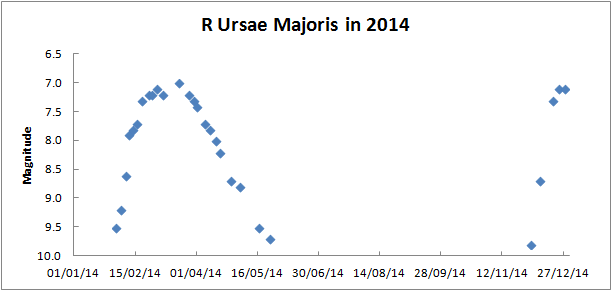
This Mira type variable rose sharply in brightness during February as it approached its March maximum. By June, it had become too faint to be seen using binoculars, but was picked up again at the start of December as it brightened rapidly towards its January 2015 maximum.


Z Ursae Majoris
z uma

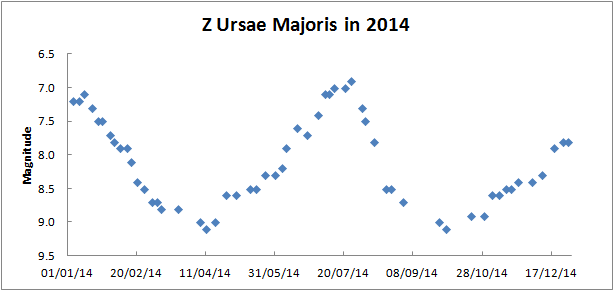
Z UMa is a semi-regular variable star located in the ‘bowl’ of Ursa Major. The interval between maxima is usually around 6 months. As the light curve shows, Z UMa varied over a range of about 2.5. magnitudes during 2014.


New Variable Star Section Director

After nearly 7 years in the role, David Scanlan stepped down as Section Director during January 2015.

The SPA Council meeting at the end of the month appointed Tony Markham as the new Section Director.

This is Tony’s second spell as Variable Star Section Director, having previously held the role between 1992 and 2000.

Here is Tony’s account of how he became a variable star obsever and how his observing has developed over the years:

I never intended to become a variable star observer. It was only by accident that I started to observe them. Soon, however, I was hooked!

Towards the end of 1977, I decided to investigate how faint I could see using my 10×50 binoculars. The easiest way to do this was to see which of the comparison stars that I could see on a finder chart for the variable star R Ursae Majoris. I did this on several occasions. On the first few nights, R UMa itself was too faint for me to see. Then, on one night in early November it had brightened enough to become visible. I compared its brightness with that of the comparison stars and estimated it to be of magnitude 8.6. I repeated this on each clear night and found that my observations produced quite a nice light curve.

I then tried observing some other variable stars. Some produced quite nice light curves. For others, to be honest, my light curves looked like scatter diagrams!

Over the years, the number of variable stars that I followed steadily increased. The vast majority of the observations have been made using binoculars, with 11×80 binoculars taking over from the 10×50’s during 1992-93. I have also made observations with the naked eye but have never made a variable star observation using a telescope (I almost did once. Someone showed me the Perseus double cluster through a telescope and I came close to estimating the brightness of a variable star within it … but I resisted the temptation …).

In the early years, my variable star observing had to compete with my meteor observing – I once carried out over 100 hours of meteor watches in one year. However, since my move to Leek in late 1989, variable star observing has dominated. Whereas meteor observing requires long clear spells (which are rare in Leek), variable star observers can make good use of short clear spells and quickly take advantage of any gaps in the clouds.

In 1992, I was invited by John Isles to take over from him as the Variable Star Section Director and held the post for 8 years. Now I’m back again!

I have had many variable star highlights over the years. I particularly remember how the summer of 1984 produced a dramatic fade in the star CH Cygni and an unusually prolonged Nova in Vulpecula. More recently, chi Cygni has produced some unusually bright and unusually faint maxima and R Scuti has also shown some rather interesting activity.

The joy of variable star observing is that you never know which star will surprise you next.

SPA VSS – 2013 Yearly review

2013 Annual Activity Report for the Variable Star Section

There can be no doubt that 2013 has been one of the most exciting years for the section for a long time.

The turbulent star R Scuti went through a great period of activity throughout 2013 and we saw the star jumping back and forth from between naked eye visibility and back again to being visible only in telescopes and binoculars. R Scuti varies between magnitudes 4.2 to 8.6 and this year we saw the star go through its entire magnitude range. The light curve below shows the stars activity throughout 2013 and is constructed using observations from SPA members and others from around the world.

Back in April/May of the year we were treated to lovely brightening of the star Chi Cygni. This star has an incredible magnitude range from 3.3 to 14.2 and during the first part of the year we saw the star hitting magnitudes as high as 3.5 making it easily visible to the naked eye. Sadly the brightness was not to continue and the star steadily faded throughout the coming months and at the time of writing this review (Feb 2014) Chi Cygni’s current magnitude estimates are a faintly 12.6 !

The next few months saw the occasional very faint supernova and continued observations of many of the stars both in our observational programme and also observations of stars that are currently not in our programme. Regardless, all observations are welcomed and all of them are recorded in the society’s records.

In May we were treated to a dwarf nova in the constellation of Aquila. Officially designated as PNV J19150199 the dwarf nova remained a firm telescopic object and was tricky for some to observe. The next stunning astronomical variable star event that occurred in 2013 was the sudden appearance of an unexpected nova on the 14th August. This nova involved a star in the constellation of Delphinus and is now known as V339 Del. This sudden novae amazed the variable star community and many astronomers, amateur and professional, turned their scopes to this new star as it became an easy binocular object and a naked eye object under dark skies. An event like this obviously generates a great deal of interest and the section had numerous observations in the form of magnitude estimates, sketches and images. The American Association of Variable Star Observers stated that “At one point, more than thirty visual observers an hour were estimating and submitting data for this object.”

Observations for this year have been received from Rod Cuff, Tony Markham, Matthew Barrett, Jeff Stevens, Robin Scagell, Steven Coe, Thomas Jones, Ian Phelps, Ray Pearce, Steven Anderson, Graham Taylor & the Director (apologies if I have missed anyone)

2014 also looks like its going to be an exciting year as R Scuti has already returned to naked eye magnitude and we have also been treated to a supernova in Messier 82 which has become so bright it is easily discernible in binoculars. Hopefully, more fascinating variable star events are to come in the next 12 months.


David Scanlan, FRAS

Director

SPA VSS

R Scuti starts Apparition

15th January 2014

Apparition of the variable star R Scuti has began. John Toone of the British Astronomical Association reports his observation of the star, which is now visible in the morning sky, as follows:

14 Jan 2014    0652GMT    4.7    15X70B

R Scuti can be found in the constellation Scutum which is pictured below (many thanks to Robin Scagell for the graphic)

A chart to locate the star can be found HERE

Amateur astronomer and SPA Meteor Section Director, Tony Markham, added:

For Deep Sky observers Messier 11, the ‘Wild Duck Cluster’ is the highlight of the constellation of Scutum. Deep Sky observers have no need to leave their warm beds on cold winter mornings to observe this cluster, however, since it will look the same during warm summer evenings.

For Variable Star observers there is only one candidate for the highlight of Scutum and that is the variable star R Scuti. With R Scuti constantly changing in brightness, observers don’t want to miss something dramatic that might happen during the winter months.

Although R Scuti is routinely described as spending most of the time around 5th magnitude and showing two fades (one deep and one shallow) in each of its 140 day cycles, that gives a false impression. It is much less predictable (and a lot more interesting) than that. It can sometimes change from being visible with the unaided eye to being a challenging binocular object (or the reverse) in as little as two weeks.

2013 was a particularly dramatic year for R Scuti. After a quiet start, a fade set in during late April and it was soon obvious that this would be a deep minimum. However, rather than brightening again after a couple of weeks, R Scuti kept on getting fainter and didn’t reach minimum brightness until early June … and stayed there through to early July. Eventually it brightened again. Then, in early August, just as it seemed to be getting close to 5th magnitude, R Scuti faded again. Would this be the expected shallow minimum? No – it turned out to be another prolonged deep minimum. Indeed, this minimum was showing signs of lasting even longer than the earlier one when R Scuti dramatically shot up in brightness in late October, brightening by nearly 4 magnitudes in only about a fortnight. Finally, in December,  just as R Scuti was sinking into the evening twilight it started to faded into another(!) deep minimum, reaching magnitude 7.1 by the evening of Dec 22.

The Light Curve above shows the magnitude fluctuations as recorded by Tony Markham

How will R Scuti perform in 2014?  We don’t know! The only way to find out is to go outside and observe it.

Mid January sees R Scuti low in the ESE as it emerges from the morning twilight and Variable Star observers are keen to spot it as soon as possible. The SPA’s Tony Markham scanned the ESE sky on the morning of Jan 13, but was thwarted by cloud close to the horizon. However John Toone of the BAA VSS had more luck the following morning and has reported an observation of R Scuti at magnitude 4.7.

This shows that R Scuti has brightened again following the minimum at the end of 2013. It takes a brave man to predict the future brightness changes in R Scuti, However, given R Scuti’s behaviour during 2013, there is a good chance that it may fade again in the coming month.

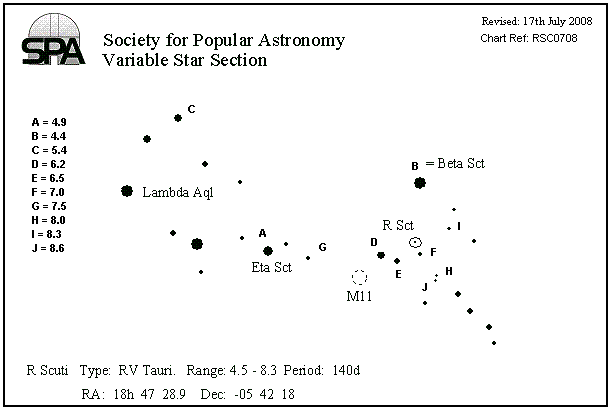
You can locate R Scuti using this finder chart. When near maximum brightness, R Scuti will be the brightest of the stars in the small trapezium that it makes up along with the comparison stars labelled D, E and F. In shallow minima (of which we didn’t see any in 2013!), R Scuti becomes fainter than star D, but remains brighter than F. Deep minima take it fainter than star H and, in exceptional minima, such as those seen in 2013, it can become as faint as the stars labelled I and J. If you keep an eye on R Scuti throughout 2014, you will be able to plot your observations and produce an impressive light curve showing its rises and falls in brightness.

Fascinating as it is to monitor, R Scuti isn’t only of interest to amateur astronomers. It is of interest also to professional astronomers because it and several other similar yellow supergiant stars appear to be going through a (astronomically speaking) short lived phase in their evolution. Changes in their behaviour give clues as to whether models of stellar evolution are correct or may need tweaking. Where do professional astronomers get their light curves from?   They rely on observations made by amateur astronomers.

2013 : A dramatic year for R Scuti

The standard description of R Scuti is that of a variable star that shows alternate deep and shallow minima. In 2013, however, R scuti decided to do something different (and record breaking):

The early part of the year was relatively uneventful, with R Scuti emerging from the morning twilight by late January.
In late April, the first fade started. It turned out to be a rather deep minimum. Few minima go down as far as mag 8.0, but this one dropped all the way to around mag 8.4.

It was also a long one – an analysis by John Toone of the BAA VSS showed it to have spent a record breaking 42 days below mag 8.0.

Rather than returning for several weeks to around mag 5.0-5.5 (as is the norm), the recovery from the fade had only reached mag 5.9 in early August, when it reversed and headed back down into another deep minimum, once more dropping below mag 8.0.

The rise from this minimum was very steep, reaching 0.4 magnitudes per day. This time it brightened all the way to about mag 4.8.

By the time that R Scuti disappeared into the eving twilight just before Christmas, another deep minimum was underway …

Nova Delphini 2013

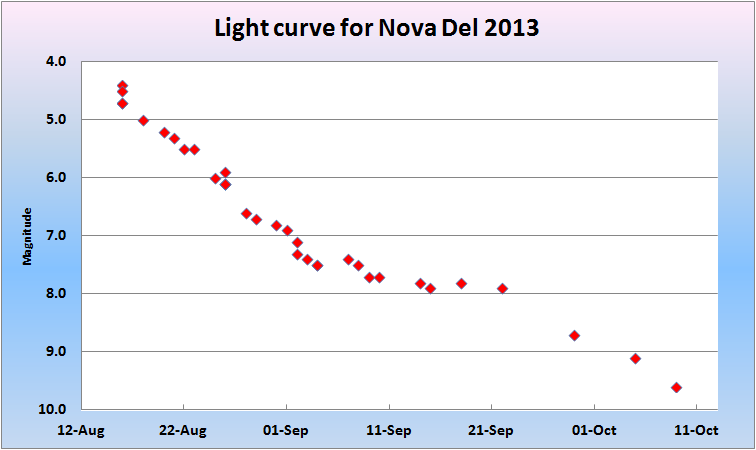
The brightest nova for many years was discovered by the Japanese observer Koichi Itagaki on Aug 14th 2013. At discovery it was approx mag 6.8.
Unfortunately, that evening was cloudy in the UK, as was the following evening and UK based observers didn’t get their first view of the nova until Aug 16th.

The nova peaked in brightness about two days after discovery, having brightened by another two magnitudes.

By early September, the nova had faded by approx 2.5 magnitudes. The fade then slowed briefly before picking up speed again.

The nova was allocated the "permanent" designation of V339 Delphini.

Breaking News – Nova discovered in Aquila

31st May 2013 – Breaking News – Nova discovered in Aquila

News has just been recieved by the SPA VSS that a Nova has been discovered in the constellation of Aquila. The news release from the International Astronomical Union reads as follows:

PNV J19150199+0719471 (provisional designation)  
2013 05 31.5974*  19 15 01.99 +07 19 47.1  10.8 U             Aql       I 

2013 05 31.5974

Discovery report from K. Itagaki, Yamagata, Japan. Detected during the survey using 0.21-m refl. + CCD. The object was below 15.5 mag on his unfiltered survey image taken on 21.608 UT. Image can be seen at: http://www.k-itagaki.jp/images/pnv-aql.jpg

Any SPA VSS members that happen to observe this nova, the section would appreciate your observations and any images you may obtain of the nova

Regards

David Scanlan, FRAS

Director, SPA VSS

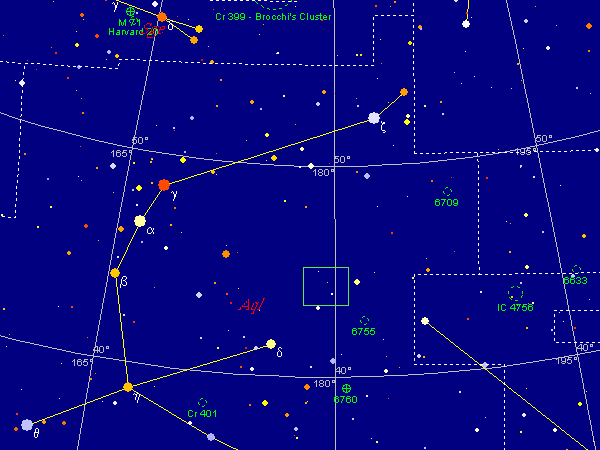
Here are finder charts for the object, produced using SkyMap software by Robin Scagell:

NAql2013a.png
Area of the nova in Aquila outlined in green shown below (click to enlarge)

Photo of the area in green above, taken 1 June at 01.10 by Robin Scagell using 80 mm refractor and modified Canon 10D camera: