SPA VSS – 2013 Yearly review

2013 Annual Activity Report for the Variable Star Section

There can be no doubt that 2013 has been one of the most exciting years for the section for a long time.

The turbulent star R Scuti went through a great period of activity throughout 2013 and we saw the star jumping back and forth from between naked eye visibility and back again to being visible only in telescopes and binoculars. R Scuti varies between magnitudes 4.2 to 8.6 and this year we saw the star go through its entire magnitude range. The light curve below shows the stars activity throughout 2013 and is constructed using observations from SPA members and others from around the world.

Back in April/May of the year we were treated to lovely brightening of the star Chi Cygni. This star has an incredible magnitude range from 3.3 to 14.2 and during the first part of the year we saw the star hitting magnitudes as high as 3.5 making it easily visible to the naked eye. Sadly the brightness was not to continue and the star steadily faded throughout the coming months and at the time of writing this review (Feb 2014) Chi Cygni’s current magnitude estimates are a faintly 12.6 !

The next few months saw the occasional very faint supernova and continued observations of many of the stars both in our observational programme and also observations of stars that are currently not in our programme. Regardless, all observations are welcomed and all of them are recorded in the society’s records.

In May we were treated to a dwarf nova in the constellation of Aquila. Officially designated as PNV J19150199 the dwarf nova remained a firm telescopic object and was tricky for some to observe. The next stunning astronomical variable star event that occurred in 2013 was the sudden appearance of an unexpected nova on the 14th August. This nova involved a star in the constellation of Delphinus and is now known as V339 Del. This sudden novae amazed the variable star community and many astronomers, amateur and professional, turned their scopes to this new star as it became an easy binocular object and a naked eye object under dark skies. An event like this obviously generates a great deal of interest and the section had numerous observations in the form of magnitude estimates, sketches and images. The American Association of Variable Star Observers stated that “At one point, more than thirty visual observers an hour were estimating and submitting data for this object.”

Observations for this year have been received from Rod Cuff, Tony Markham, Matthew Barrett, Jeff Stevens, Robin Scagell, Steven Coe, Thomas Jones, Ian Phelps, Ray Pearce, Steven Anderson, Graham Taylor & the Director (apologies if I have missed anyone)

2014 also looks like its going to be an exciting year as R Scuti has already returned to naked eye magnitude and we have also been treated to a supernova in Messier 82 which has become so bright it is easily discernible in binoculars. Hopefully, more fascinating variable star events are to come in the next 12 months.


David Scanlan, FRAS

Director

SPA VSS

R Scuti starts Apparition

15th January 2014

Apparition of the variable star R Scuti has began. John Toone of the British Astronomical Association reports his observation of the star, which is now visible in the morning sky, as follows:

14 Jan 2014    0652GMT    4.7    15X70B

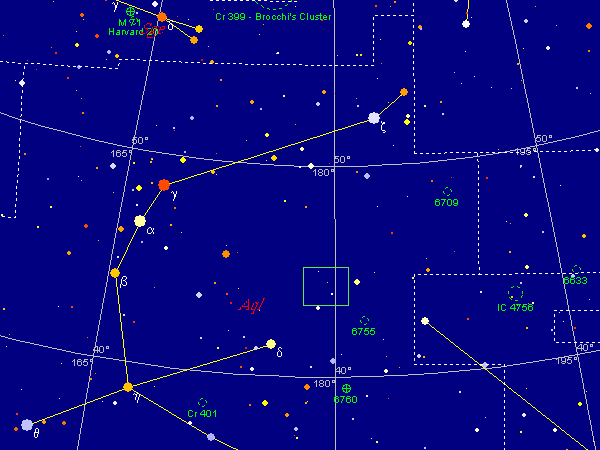
R Scuti can be found in the constellation Scutum which is pictured below (many thanks to Robin Scagell for the graphic)

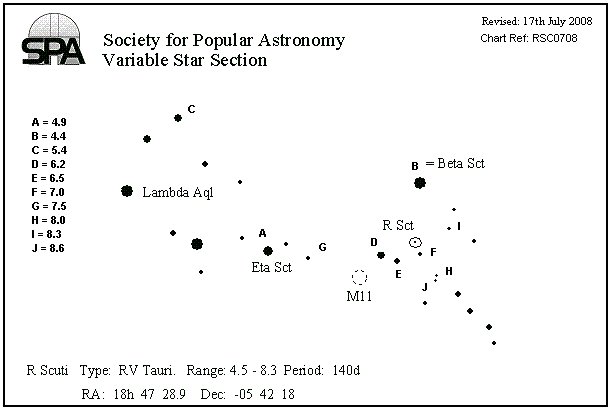
A chart to locate the star can be found HERE

Amateur astronomer and SPA Meteor Section Director, Tony Markham, added:

For Deep Sky observers Messier 11, the ‘Wild Duck Cluster’ is the highlight of the constellation of Scutum. Deep Sky observers have no need to leave their warm beds on cold winter mornings to observe this cluster, however, since it will look the same during warm summer evenings.

For Variable Star observers there is only one candidate for the highlight of Scutum and that is the variable star R Scuti. With R Scuti constantly changing in brightness, observers don’t want to miss something dramatic that might happen during the winter months.

Although R Scuti is routinely described as spending most of the time around 5th magnitude and showing two fades (one deep and one shallow) in each of its 140 day cycles, that gives a false impression. It is much less predictable (and a lot more interesting) than that. It can sometimes change from being visible with the unaided eye to being a challenging binocular object (or the reverse) in as little as two weeks.

2013 was a particularly dramatic year for R Scuti. After a quiet start, a fade set in during late April and it was soon obvious that this would be a deep minimum. However, rather than brightening again after a couple of weeks, R Scuti kept on getting fainter and didn’t reach minimum brightness until early June … and stayed there through to early July. Eventually it brightened again. Then, in early August, just as it seemed to be getting close to 5th magnitude, R Scuti faded again. Would this be the expected shallow minimum? No – it turned out to be another prolonged deep minimum. Indeed, this minimum was showing signs of lasting even longer than the earlier one when R Scuti dramatically shot up in brightness in late October, brightening by nearly 4 magnitudes in only about a fortnight. Finally, in December,  just as R Scuti was sinking into the evening twilight it started to faded into another(!) deep minimum, reaching magnitude 7.1 by the evening of Dec 22.

The Light Curve above shows the magnitude fluctuations as recorded by Tony Markham

How will R Scuti perform in 2014?  We don’t know! The only way to find out is to go outside and observe it.

Mid January sees R Scuti low in the ESE as it emerges from the morning twilight and Variable Star observers are keen to spot it as soon as possible. The SPA’s Tony Markham scanned the ESE sky on the morning of Jan 13, but was thwarted by cloud close to the horizon. However John Toone of the BAA VSS had more luck the following morning and has reported an observation of R Scuti at magnitude 4.7.

This shows that R Scuti has brightened again following the minimum at the end of 2013. It takes a brave man to predict the future brightness changes in R Scuti, However, given R Scuti’s behaviour during 2013, there is a good chance that it may fade again in the coming month.

You can locate R Scuti using this finder chart. When near maximum brightness, R Scuti will be the brightest of the stars in the small trapezium that it makes up along with the comparison stars labelled D, E and F. In shallow minima (of which we didn’t see any in 2013!), R Scuti becomes fainter than star D, but remains brighter than F. Deep minima take it fainter than star H and, in exceptional minima, such as those seen in 2013, it can become as faint as the stars labelled I and J. If you keep an eye on R Scuti throughout 2014, you will be able to plot your observations and produce an impressive light curve showing its rises and falls in brightness.

Fascinating as it is to monitor, R Scuti isn’t only of interest to amateur astronomers. It is of interest also to professional astronomers because it and several other similar yellow supergiant stars appear to be going through a (astronomically speaking) short lived phase in their evolution. Changes in their behaviour give clues as to whether models of stellar evolution are correct or may need tweaking. Where do professional astronomers get their light curves from?   They rely on observations made by amateur astronomers.

Breaking News – Nova discovered in Aquila

31st May 2013 – Breaking News – Nova discovered in Aquila

News has just been recieved by the SPA VSS that a Nova has been discovered in the constellation of Aquila. The news release from the International Astronomical Union reads as follows:

PNV J19150199+0719471 (provisional designation)  
2013 05 31.5974*  19 15 01.99 +07 19 47.1  10.8 U             Aql       I 

2013 05 31.5974

Discovery report from K. Itagaki, Yamagata, Japan. Detected during the survey using 0.21-m refl. + CCD. The object was below 15.5 mag on his unfiltered survey image taken on 21.608 UT. Image can be seen at: http://www.k-itagaki.jp/images/pnv-aql.jpg

Any SPA VSS members that happen to observe this nova, the section would appreciate your observations and any images you may obtain of the nova

Regards

David Scanlan, FRAS

Director, SPA VSS

Here are finder charts for the object, produced using SkyMap software by Robin Scagell:

NAql2013a.png
Area of the nova in Aquila outlined in green shown below (click to enlarge)

Photo of the area in green above, taken 1 June at 01.10 by Robin Scagell using 80 mm refractor and modified Canon 10D camera:

Happy Birthday U Sco

John Toone from the BAA VSS has informed us that:

"20th May 2013 marks the 150th anniversary of the first recorded outburst of
a recurrent nova (U Sco). On 20th May 1863 Norman Pogson at Madras, India visually
detected U Sco at mag 9.1. Within 8 days it had faded to mag 12.4 and then
disappeared. Pogson had only recently defined the modern magnitude scale
and his observations of U Sco in 1863 are remarkably similar to the outburst
template derived from later eruptions by Schaefer in 2008. The discovery
of U Sco was just 7 years after Pogson had confirmed the recurrent nature of
U Gem the first dwarf nova. Pogson was also the first observer to report
flickering in a dwarf nova (U Gem again). So CV fanatics have plenty to
thank Pogson for and ought to take a little time out tomorrow (20th May)to
think about this remarkable Victorian visual observer." 

Cygnus Gets a new star!

An extra naked-eye star is currently visible in the neck of Cygnus the Swan. This is the Mira-type variable Chi Cygni, which is putting in a particularly bright maximum this spring writes Tony Markham.


The extreme brightness range of the Chi Cygni is usually quoted as being between magnitudes 3.3 and 14.2. However, not all maxima of Mira-type variables are equally bright and for Chi Cygni a peak magnitude in the region of 4.5 has been more typical. The upper limit quoted for Chi Cygni’s brightness range is largely based on a number of bright maxima that occurred around the middle of the 19th century. Few, if any, 20th century maxima of Chi Cygni exceeded magnitude 4.0. The 2006 maximum was, however, somewhat brighter than this and 2013 looks like producing another bright maximum, with some recent reports indicating that it may have edged brighter than magnitude 4.0 again.


The period of Chi Cygni is around 407 days, meaning that, on average, Chi Cygni should reach peak brightness around 6 weeks later each year. However, in the same way as the peak brightness in each cycle can’t be predicted in advance, the timing of the next maximum can only be predicted to within a week or two. In 2013, the best that can be said is that maximum will occur in late April or early May. This means that in order to see Chi Cygni at maximum in 2013 you will need to be able to observe after midnight as Chi Cygni is not visible in the evening sky at this time of the year.

The unpredictability in the timing and brightness of maxima, together with their very large brightness ranges are the reasons why variable star observers find Mira-type variables so interesting to monitor. The SPA comparison chart for the star, including both bright and faint comparison stars, is shown below. It covers a binocular field of view, approximately the same area as in the two comparison photos shown above.These are red giant stars in which the brightness variations are related to pulsations in their very tenuous outer layers. Over time, the pulsations will slowly cause these outer layers to be shed into space to produce a planetary nebula. Indeed, our Sun is destined become a Mira type variable in the final stages of evolution 

Incidentally, if you are wondering when Mira itself (Omicron Ceti) will reach its 2013 peak, the answer is that this will occur during June. Unfortunately, Mira is not visible in the night sky from the UK in June. Fortunately, in Mira’s absence, Chi Cygni is putting on a good show for us

.    


Citizen Science….Get involved with the SPA

If your interested in astronomy then you would have heard, no doubt, that this is just one of only two sciences in the world where the amateur can make a valuable contribution to science and assist the professionals in work.

This is obviously very true and amateur astronomers have made valuable contributions to astronomy over years by discovering supernovae, unexpected storms and blemishes on the planets, observing transient lunar phenomena and many more. Variable Star astronomy is another area where we desperatley need amateur astronomers to help make a difference to our understanding of the stars.

Observing variable stars lets us understand the stars in a fantastic way and you can help science by contributing to the SPA VSS. You dont need an expensive telescope, costly CCD Cameras or even the dark skies of the countryside to get involved !

If you want to find out more about variable star astronomy start of by following the list below:

  1. Visit the SPA VSS Observation Programme. This will give you an idea of varied types of stars we want observations of. /variablestar/observingprogramme/index.php
  2. Check out our observing notes /variablestar/reference/reference.php?id_pag=126
  3. Download the charts of the stars you want to observe /variablestar/reference/reference.php?id_pag=125 if you have not got a printer then dont panic….just contact the section and we will print off the charts and post them to you
  4. Contact David Scanlan, SPA VSS Director, variablestar@popastro.com for more help, guidance and advice.

Remember…..the Society for Popular Astronomy is your society and your input and observations is make this a great society to be part of.

So get out there, start observing varible stars and make a difference to science and have a great time.

The Universe is our playground……lets play!

Sir Patrick Moore Interview

Sir Patrick Moore in his studySir Patrick Moore in his study (photo credit: Ricky Halpin)

On the 7th February I was privileged enough to meet and interview Sir Patrick Moore and ask him some questions about his work and thoughts on observing variable stars and what the future holds for variable star observers in the years to come.

We met at his 15th Century house, Farthings, in Selsey, West Sussex, and the interview was held in his study where oh so many of his now world famous books were written on his old Woodstock typewriter.

(David Scanlan)Thank you for taking the time to talk to me today about Variable Stars, I am sure your views and knowledge on the subject will hopefully encourage more people into observing variable stars in the future.

(Sir Patrick Moore)

Your very welcome and I hope what words of encouragement I can offer will inspire people to observe these amazing stars.

(DS)

I know you have spent some time observing SS Cygni and SUB Tauri type stars in the past but what was it that prompted you to observe variable stars initially?

(PM)

I’m essentially an observer of the moon and planets but back many years ago there wasn’t many people that had big enough telescopes to get down to lower magnitudes but I was fortunate enough to have a telescope that could do this so I started to observe some of the variables and that’s what got me interested in them.

(DS)

Most people think that estimating magnitudes is very difficult. Do you think this is true and do you have any tips or advice for people in helping them to understand magnitudes a little better?

(PM)

No it’s not difficult as long as you select your right comparison stars. I use the step method and I have found this to be sufficient in obtaining magnitudes. There are other methods such as the fractional method but I find the step method works best for me.

(DS)

People also think you need a large aperture telescope to observe variables but this is not the case is it?

(PM)

You don’t need to own a large telescope but it depends on what magnitude you want to go down to. I have a lovely old 3″ refractor and I have used that quite a lot on some of the variables and it has served me very well indeed.

(DS)

Variable star observing is important to both the amateur and professional astronomical community but it isn’t spectacular work when compared to modern day astroimaging. We have all seen amazing pictures of planets, galaxies and nebulas imaged by amateur astronomers but what encouragement would you give to a young, or beginning, amateur astronomer to encourage them to observe variable stars?

(PM)

You can do one of two things. You can do some fantastic work and produce stunning images and you can do work of real scientific value, a personal friend, John Fletcher, has the capability of producing stunning images but he doesn’t, instead he concentrates of very faint objects. Variable star observing is not spectacular though…there are no amazing pictures but the work done on recording their magnitudes is vital of our understanding of these stars. There are thousands of variables out there and the professional astronomers rely on amateurs to keep a watch of these stars as there simply are too many for the professional to cope with.

(DS)

Variable star observing is an area where the amateur can make a serious scientific contribution. Recently you told me about the discovery of a nova by amateur astronomer George Alcock some years back, a nova which you helped to confirm. Can you tell me a little bit more about this discovery?

(PM)

(Laughs)George Alcock rang me in the middle of the night, about 10 minutes before sunrise, so I dashed out with my binoculars and there it was. George had discovered a nova but no credit to me, it was George’ discovery and he told me exactly where to find it.

(DS)

So it is true….an amateur astronomer with even the most modest of equipment can make a discovery?

(PM)

That’s perfectly true and it can happen at any time. Amateurs have a great record of discoveries not only with variables but also with comets and various other celestial objects. You should also remember that the average amateur has a much greater knowledge of the night sky compared to a professional astronomer. I remember an episode some time ago a professional astronomer, whom I wont name (Laughs), rang me and said he has discovered a nova but he had actually made a completely independent discovery of Saturn (Laughs) so it goes to show that the amateur does indeed know the skies better than their professional counterparts (Laughs)

(DS)

In Mid 2009 Epsilon Aurigae will undergo its first eclipse since 1984 but very little is known about this star and some theories suggest that a black hole may exist in the area of the stars. Do you think this is a possibility?

(PM)

No. I have been observing Epsilon Aurigae for a very long time now and I have seen many of its eclipses. There’s a supergiant star there and it’s purely eclipsed by a small companion star of which its nature we don’t know. Even in the time of its eclipse it’s not entirely constant. You also have a good comparison star there, Eta Aurigae, but don’t use Zeta Aurigae as that’s a variable as well (Laughs). When I was very young I remember noticing that Alpha Cassiopeiae appeared to dim and brighten as well but we are told that Alpha Cassiopeiae is not a variable but I have my suspicions that it is indeed variable. Rho Cassiopeia is also one to watch as no one knows when that will go supernova but unfortunately I won’t see that, my observing career is all but over now due to an old spinal injury which is a nuisance.

(DS)What do you think the future holds for amateur variable star astronomers in the future?

(PM)

I think the same as in the past. The amateurs are there doing the work that the professionals cant. They are providing a vital role and making discoveries all the time so hopefully that will continue as the continued observation of variable stars is very important.

(DS)You have achieved a lot in your lifetime but what is the one thing that you wish you could have achieved or may even still do so?

(PM)

In the field of astronomy all I want to achieve now is the promotion of astronomy and helping to encourage others into the role of astronomy, I think I am just about done with writing books, doing lectures and the sky at night. That’s my main aim now…to help people and encourage people into astronomy.

My sincere thanks go out to Sir Patrick for taking the time out of his very busy schedule to talk to me and make this interview possible.

Epsilson Aurigae Mystery – Close to being solved

Nasa Simulation of the Epsilon Aurigae SystemNasa Simulation of the Epsilon Aurigae System
For almost two centuries, humans have looked up at a bright star called Epsilon Aurigae and watched with their own eyes as it seemed to disappear into the night sky, slowly fading before coming back to life again. Today, 2009, as another dimming of the system is underway, mysteries about the star persist. Though astronomers know that Epsilon Aurigae is eclipsed by a dark companion object every 27 years, the nature of both the star and object has remained unclear.

Now, new observations from NASA’s Spitzer Space Telescope — in combination with archived ultraviolet, visible and other infrared data — point to one of two competing theories, and a likely solution to this age-old puzzle. One theory holds that the bright star is a massive supergiant, periodically eclipsed by two tight-knit stars inside a swirling, dusty disk. The second theory holds that the bright star is in fact a dying star with a lot less mass, periodically eclipsed by just a single star inside a disk. The Spitzer data strongly support the latter scenario.

“We’ve really shifted the balance of the two competing theories,” said Donald Hoard of NASA’s Spitzer Science Center at the California Institute of Technology in Pasadena. “Now we can get busy working out all the details.” Hoard presented the results today at the 215th meeting of the American Astronomical Society in Washington.

Epsilon Aurigae can be seen at night from the northern hemisphere with the naked eye, even in some urban areas. Last August, it began its roughly two-year dimming, an event that happens like clockwork every 27.1 years and results in the star fading in brightness by one-half. Professional and amateur astronomers around the globe are watching, and the International Year of Astronomy 2009 marked the eclipse as a flagship “citizen science” event. More information is at http://www.citizensky.org .

Astronomers study these eclipsing binary events to learn more about the evolution of stars. Because one star passes in front of another, additional information can be gleaned about the nature of the stars. In the case of Epsilon Aurigae, what could have been a simple calculation has instead left astronomers endlessly scratching their heads. Certain aspects of the event, for example the duration of the eclipse, and the presence of “wiggles” in the brightness of the system during the eclipse, have not fit nicely into models. Theories have been put forth to explain what’s going on, some quite elaborate, but none with a perfect fit.

The main stumper is the nature of the naked-eye star — the one that dims and brightens. Its spectral features indicate that it’s a monstrous star, called an F supergiant, with 20 times the mass, and up to 300 times the diameter, of our sun. But, in order for this theory to be true, astronomers had to come up with elaborate scenarios to make sense of the eclipse observations. They said that the eclipsing, companion star must actually be two so-called B stars surrounded by an orbiting disk of dusty debris. And some scenarios were even more exotic, calling for black holes and massive planets.

A competing theory proposed that the bright star was actually a less massive, dying star. But this model had holes too. There was no simple solution.

Hoard became interested in the problem from a technological standpoint. He wanted to see if Spitzer, whose delicate infrared arrays are too sensitive to observe the bright star directly, could be coaxed to observe it using a clever trick. “We pointed the star at the corner of four of Spitzer’s pixels, instead of directly at one, to effectively reduce its sensitivity.” What’s more, the observation used exposures lasting only one-hundredth of a second — the fastest that images can be obtained by Spitzer.

The resulting information, in combination with past Spitzer observations, represents the most complete infrared data set for the star to date. They confirm the presence of the companion star’s disk, without a doubt, and establish the particle sizes as being relatively large like gravel rather than like fine dust.

But Hoard and his colleagues were most excited about nailing down the radius of the disk to approximately four times the distance between Earth and the sun. This enabled the team to create a multi-wavelength model that explained all the features of the system. If they assumed the F star was actually a much less massive, dying star, and they also assumed that the eclipsing object was a single B star embedded in the dusty disk, everything snapped together.

“It was amazing how everything fell into place so neatly,” said Steve Howell of the National Optical Astronomy Observatory in Tucson, Ariz. “All the features of this system are interlinked, so if you tinker with one, you have to change another. It’s been hard to get everything to fall together perfectly until now.”

According to the astronomers, there are still many more details to figure out. The ongoing observations of the current eclipse should provide the final clues needed to put this mystery of the night sky to rest.

R.E. Stencel of the University of Denver, Colo., is also a collaborator on this research. NASA’s Jet Propulsion Laboratory, Pasadena, Calif., manages the Spitzer Space Telescope mission for NASA’s Science Mission Directorate, Washington. Science operations are conducted at the Spitzer Science Center at Caltech. Caltech manages JPL for NASA. For more information about Spitzer, visit http://www.spitzer.caltech.edu/spitzer and http://www.nasa.gov/spitzer .