Welcome to the Variable Star Section

What is a Variable Star ?

A variable star is quite simply a star whose brightness changes.

Some variable stars change in brightness by large amounts; others only show very small changes.

Some change very rapidly (over a few hours); others are more leisurely (taking years).

Some are highly predictable; others are totally erratic. In between lie many that are only predictable to a certain extent.

Observer or Follower ?

If you do not currently observe variable stars, we would, of course, encourage you to try it out. However, we realise that not everyone has the free time available or has regular access to a good view of the night sky. If you are merely interested in following the results obtained by other observers, you are of course also welcome. You can find recent reports via the Section Reports menu

How do you join the Variable Star section?  There is no formal process – anyone who submits observations is considered to be a member of the section.

Reports based on observations received are also published in the SPA’s bi-monthly magazine Popular Astronomy. If you are not currently a SPA member, you are missing out on these SPA membership benefits

Why Observe Variable Stars?

There are two main reasons why people observe variable stars:

– one reason simply combines the challenge of monitoring the variable star and the experience of seeing its brightness go up and down

– the other is a scientific reason – to help improve our understanding of the stars involved and why they vary in brightness in the way that they do. This could involve monitoring for outbursts of dwarf novae, could involve comparing the observed times of eclipses with the predicted eclipse times or might simply involve monitoring variable stars on a regular basis and hence adding to our understanding of their long term behaviour. Professional astronomers do not have the resources or the available telescope time to be able to follow the vast number (tens of thousands) of known variable stars and so are dependant on observations made by amateur astronomers.

Choosing Variable Stars to Observe

A list of the variable stars on the programme of the SPA VSS can be found in our Programme Listing . You are, of course, free to observe and submit observations for any variable star whether it is in this list or not. This programme is merely a list of stars that we feel would be good choices for newcomers to variable star observing. Guides and Finder Charts for these stars can be found by clicking on their names in the Programme listing.

How can you make observations of variable stars?

Instructions describing how to observe variable stars can be found in this Guide to Variable Star Observing

Facebook Page

The section also has its own Facebook page: https://www.facebook.com/SPAVSS

Why do stars change in brightness?

Explaining that is the challenge for professional astronomers. In some cases, the changes are merely due to eclipses; in others they are due to pulsations in the outer layers of the star; in others the cause can be more “explosive”.

Some prove quite a challenge.

Here are light curves that have been published for two somewhat ‘unique’ examples:

tago

The first is for “Tago’s variable”, also known as GSC 3656-1328, a perfectly normal star of magnitude 11.4 that brightened sharply over around 10 days in late October 2007, reaching a peak brightness of about mag 7.5 on Oct 31 before fading back to normal over the following 10 days.

Nothing unusual happened in the star’s spectrum at the time and no brightness changes have been seen in subsequent years.

The favoured explanation is that this was a ‘microlensing’ event, with the brightening being caused by a low mass  object crossing our line of sight to the star.

More information can be found in  BAA VSS Circular 130
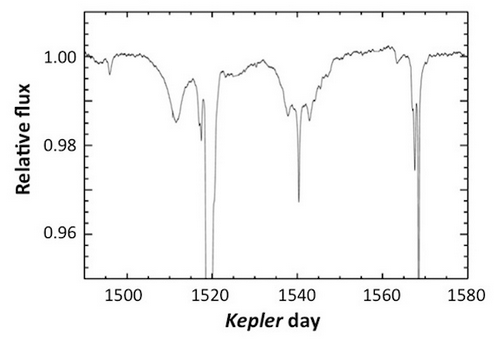
tabby's star

The second is for “Tabby’s star”, also known as KIC 8462852, an 11th magnitude star whose unusual light curve was detected by the Kepler spacecraft.

There have been many sensationalist articles written on-line suggesting that the brightness changes relate to an alien megastructure orbiting the star.

A more likely explanation is that the dips are related to scattered material surrounding the star, such as a cloud of comets or asteroids, resulting from the break up of a planet. However, the exact nature of such material remains unclear.

Starspots seem unlikely as these would reappear at regularly intervals due to the star’s short 0.88 day rotation period.

Another suggestion has involved dense globules of interstellar dust along our line of sight to the star.

Future dips in brightness will be the subject of intense study be professionals and amateurs and these should hopefully lead us to the true explanation

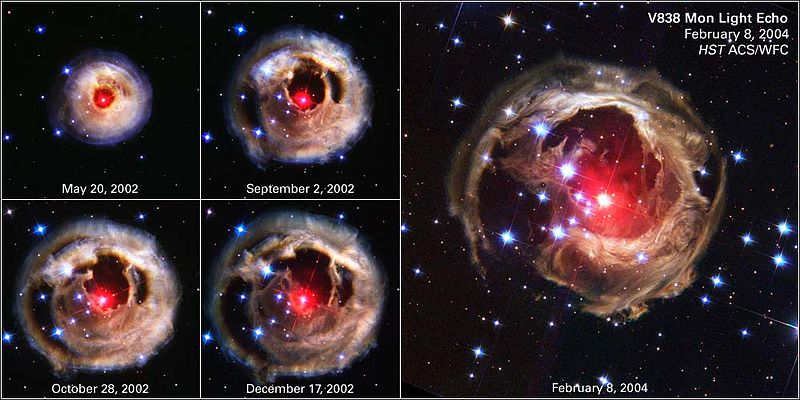
Other ‘oddballs’ have been explained. Below is a set of images showing the evolution of light echoes from dust around the star V838 Monocerotis, a previously unremarkable star that increased dramatically in brightness in early 2002 before fading away again a few months later. An overview of what happened and suggestions as to why can be found in http://www.aavso.org/vsots_v838mon
Guide to R Scuti

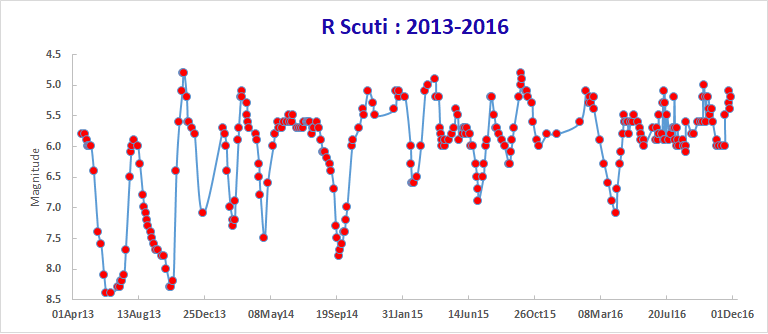
R Scuti, located a degree north west of the Wild Duck cluster (Messier 11), is a variable star that can be relied on to produce a good amount of brightness changes, although attempts to predict the timing and depth of the next minimum often fail!

r sct

As can be seen from the above light curve, the amplitude observed changes from year to year.

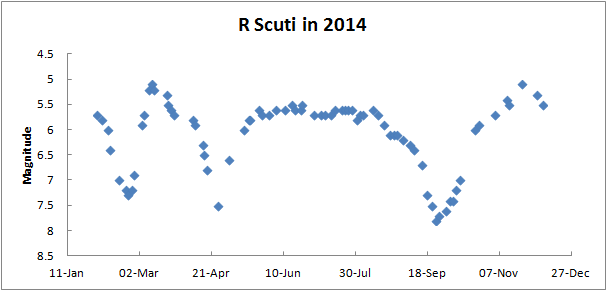
It is usually described as showing alternate deep and shallow minima, but sometimes decides to do something different!  In 2014, for example, it produced consecutive deep minima.

R Scuti is a yellow-orange supergiant star. The brightness changes are due to pulsations in the star’s outer layers. The depth of the deep minima seems to vary from year to year – in some years they drop below mag 8.0 ; in others they don’t even reach mag 7.0. There may even by a long term periodicity (about 30 years?) regarding this.

Extreme brightness range 4.5- 8.6
More typical range 5.0 – 7.5
Period of variation 142 days (often including one deep and one shallow minimum)
Frequency of observation Worth checking a couple of times per week – possibly every other day during deep minima
Observe using 40mm or 50mm binoculars will suffice for most of the time, but 50-80mm binoculars may be required during the deeper minima
Visibility Can be observed from mid January to mid December, but is rather low in the morning sky until April

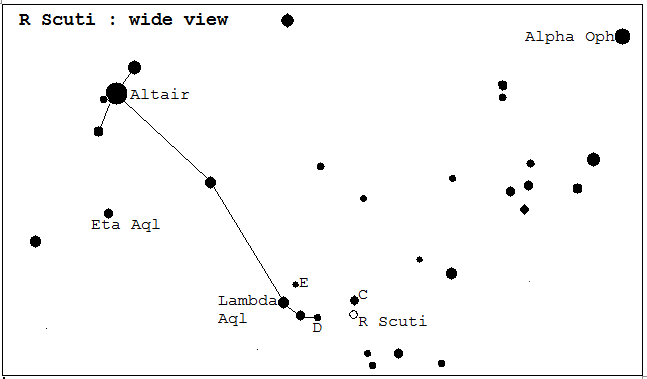
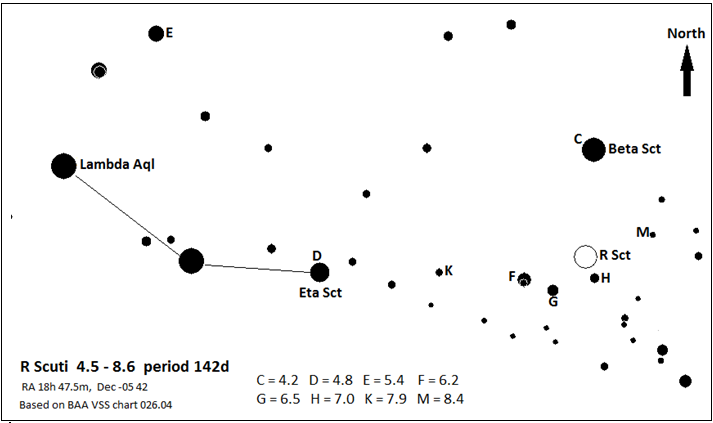
Here are two finder chart that show the location of R Scuti. Both have north at the top.

The first shows its general location (Altair is a good starting point when using binoculars to locate R Scuti).

Wide field finder chart for R Scuti

You can follow the brightness changes of R Scuti by comparing it with the lettered comparison stars on this second chart (which is approx 7 degrees by 4 degrees). At maximum, R Scuti will be easily the brightest of the stars in the small trapezium that also contains stars F, G and H. In deeper minima it can become fainter than comparison K.

Binocular chart for R Scuti

Guide to RW Bootis

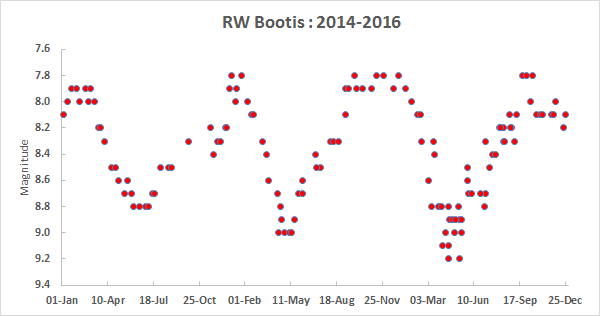
A star that shows periodic variations in brightness, sometimes with a range of over a magnitude, over the course of about 7 months (supposedly).

RW Bootis is a red giant star. The brightness changes seen are due to pulsations in the star’s outer layers.

It is classed as being a semi-regular variable star. This means that it shows periodic variations, but these don’t repeat exactly from one cycle to the next. The brightness range in some cycles will exceed one magnitude, but may be smaller in others.

Extreme brightness range 6.4 – 9.2
More typical range 7.9 – 8.7
Period of variation Listed as about 7 months, but recent observations suggest it is more like 10-11 months
Frequency of observation Worth checking a few times per month
Observe using 50 – 80mm binoculars will suffice for most of the time. However, 70 – 80mm binoculars may be required if your observing site is not particularly dark and may also be needed when RW Boo is low in the sky
Visibility Can be observed all year round, but is rather low in the evening sky during November and December. Not visible in the evening sky for most of January. Can be observed in the morning sky from late October onwards.

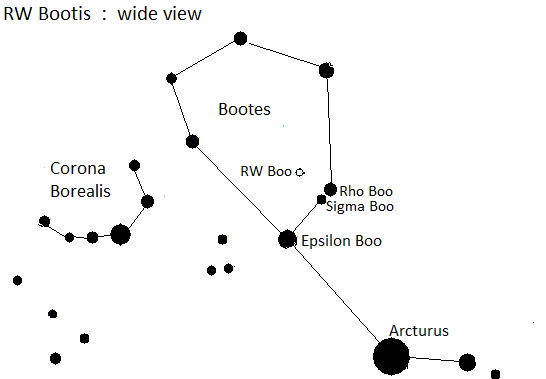
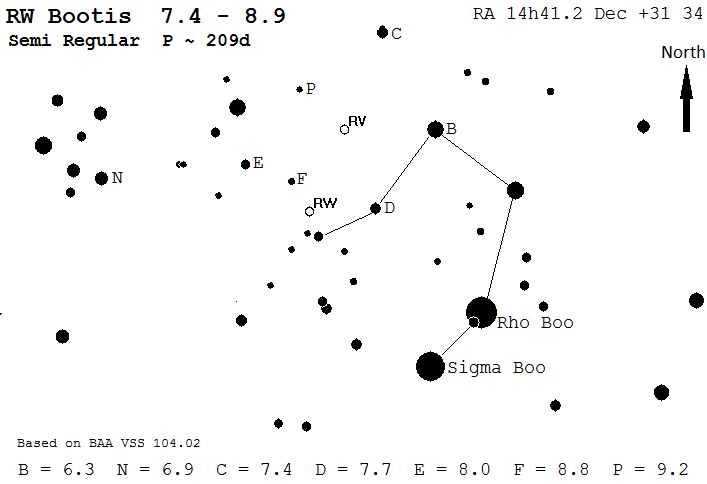
The finder charts which follow show the location of RW Bootis. North is at the top in each case.

The first shows the position of RW Bootis relative to the brighter starts of Bootes.

The second chart, which is approx 7 degrees by 5 degrees, shows the area around RW Bootis in more detail.

You can use the lettered comparison stars to make brightness estimates of RW Bootis.

When locating RW Bootis, bear in mind that it might be brighter than comparison D or might be as faint as comparison F!

RV Bootis is another semi regular variable, but is usually somewhat fainter than RW Bootis.

Guide to R Bootis

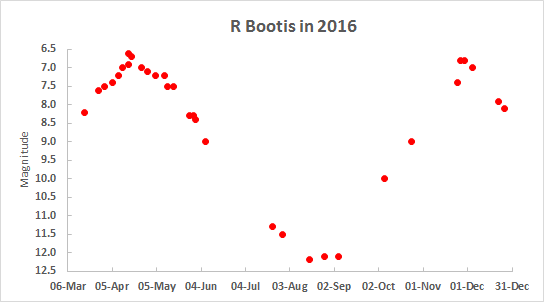
An easy to locate Mira type variable that can reach 6th magnitude.

R Boo

R Bootis is a red giant star. As for other Mira type variables, the brightness variations are primarily due to pulsations in the star’s outer layers, with some ‘irregularities’ during the rise and fall that are related to the formation and break up of very simple molecules in the star’s cool(ish) surface layers.  Since these changes don’t repeat exactly from one cycle to the next, the brightness at maximum differs between cycles and published predictions for maxima can be uncertain by +/- 2 weeks.

Extreme brightness range 6.2 – 13.1
More typical range 7.2 – 12.3
Period of variation 223 days (approx 7.5 months)
Frequency of observation Worth checking a few times per month
Observe using 50mm binoculars will suffice when in the upper part of its brightness range. Larger binoculars will be required when it gets fainter. A telescope is required to follow it down to minimum.
Upcoming maxima June 2025

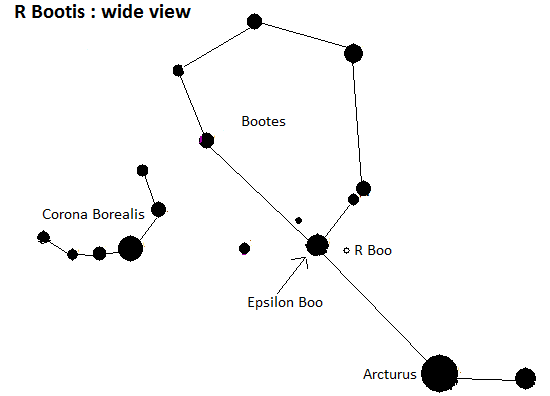
The finder charts which follow have north at the top and show the location of R Bootis.

The first shows the location of R Bootis relative to the main stars of Bootes.

.

The second shows the area close to R Bootis in more detail.

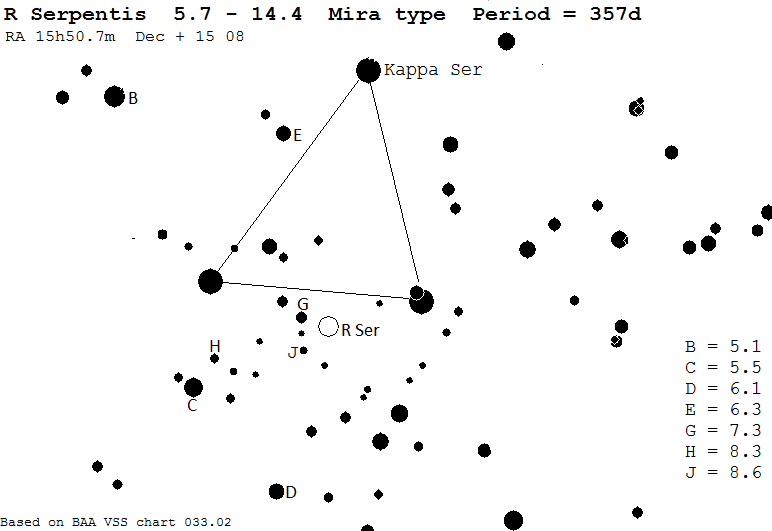
You can follow the changes in R Bootis by comparing its brightness with that of the comparison stars. These are labelled with their magnitudes (with the decimal points omitted). Thus, for example, ’70’ labels a comparison star of magnitude 7.0.

.

Guide to T Cephei

A circumpolar Mira type variable that can be followed over most of its brightness range using binoculars.

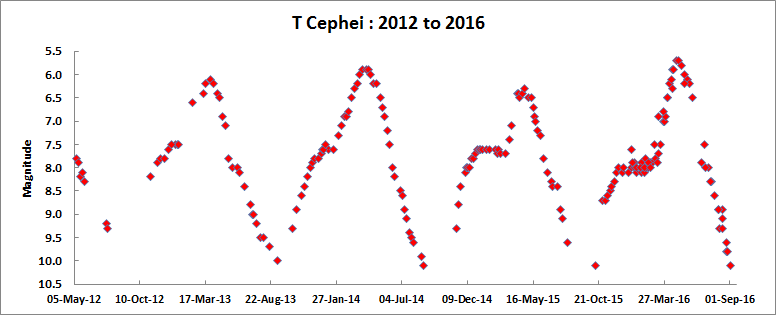
T Cep

The brightness changes don’t repeat exactly from one cycle to the next. As can be also seen in the above light curve, the brightness doesn’t rise and fall at a constant rate – it is quite normal to T Cep to “pause” for several weeks close to mag 8.0 during its rise to maximum (the six week “pause” in early 2015 was unusually long!  Long pauses also occurred during the rises to the 2016 and 2017 maxima).

T Cephei is a red giant star. The brightness changes seen are primarily due to pulsations in the star’s outer layers. However, these outer layers are also sufficiently “cool” for it to be possible for some very simple molecules to form when the expansion phase causes further cooling and to then break up when the subsequent contraction causes the temperature to rise again.

Extreme brightness range 5.4 – 11.0
More typical range 6.0 – 10.5
Period of variation 389 days (nearly 13 months)
Frequency of observation Worth checking a few times per month
Observe using 40mm or 50mm binoculars will suffice when the star is near maximum, but 50-80mm binoculars will be required when it gets fainter and a telescope will be needed at minimum
Visibility Can be observed all year round
Dates of maxima August 2025

The chart below shows the location of T Cephei. North is at the top.

T_Cephei

Guide to U Cephei

A circumpolar eclipsing variable with a deep (2.5 magnitude) eclipse.

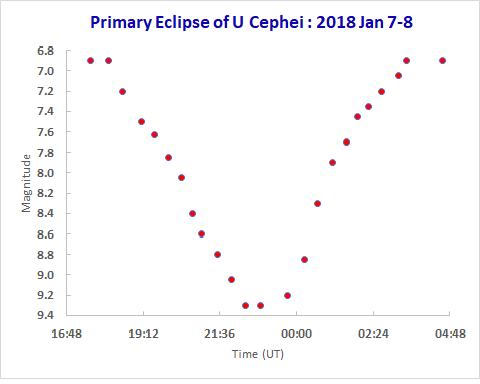
Tracie Heywood’s light curve showing a primary eclipse

The primary eclipse occurs when the fainter star in the system passes in front of the brighter star.

The eclipses are “flat-bottomed”, indicating that a total eclipse is taking place.

The orbital period of U Cephei is approx 2.493 days. Hence, if you see an eclipse on a particular night, another will be visible at a similar time of night 5 nights later.

Extreme brightness range 6.7 – 9.3
More typical range always the same
Period of variation 2.493 days
Frequency of observation Every 30 minutes during an eclipse
Observe using 50mm binoculars will suffice for most of the time, but larger binoculars may be required during the deepest part of the eclipse
Visibility Can be observed all year round (although there may be a spell during the spring and/or summer when no eclipses are falling during the hours of darkness)


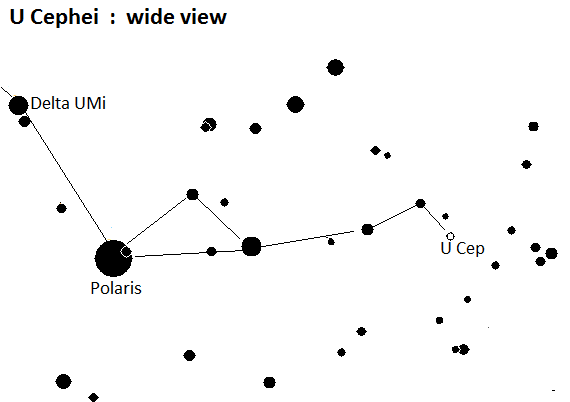
The following finder charts show the location of U Cephei. You can follow its brightness changes by comparing its brightness with that of the labelled comparison stars on the second chart.

U Cephei
.


Chart for U Cephei

A new look to the VSS Programme Listing

Traditionally, the section’s programme listing has grouped stars according to the type of variability seen. Hence you would see a list of Eclipsing variables, a list of Cepheid variables, a list of Semi-regular variables … and so on.

However … with the SPA particularly focussing on newcomers to observing, it would seem better to order the list of variable stars to take into account how often and for how long the potential observer is able to observe.

Hence the new look, in which the stars are split into 5 categories:

– stars that can show significant brightness changes over the course of a few hours

– stars that show brightness changes over a week, sometimes from night to night

– stars that show brightness changes over the course of several months

– stars that show very large brightness changes over the course of a year

– stars that are totally unpredictable

To see the list of stars, click on this Programme Listing

For each variable star listed, clicking on its name takes you to a guide and finder chart(s) for that star.

As you will see, the programme includes a mixture of naked eye and and binocular variables (for stars in the 4th category you would also need a telescope if you wanted to follow them all the way down to minimum).

Section members are, of course, free to observe and report observations of any variable star, but experience has shown that the stars in the Programme Listing do tend to prove very rewarding to follow.

Guide to Chi Cygni

A Mira type variable in the ‘neck’ of the Swan, that has a brightness range of over 10 magnitudes.

chi cyg

In May 2013, Chi Cygni reached an impressive magnitude of 3.8 when at maximum.

2014 brought a marked contrast with the early July maximum only reaching about magnitude 6.4 – possibly the faintest maximum since the discovery of the brightness variations of chi Cygni in the late 17th century.

The 2015 maximum was somewhat brighter, peaking at around magnitude 4.4, whereas that of 2016 was fairly “normal” at around mag 5.0.

As is the case for all Mira type variables, chi Cygni is a red giant star and the brightness variations are primarily due to pulsations in the tenuous outer layers of the star.

The brightness changes that we see are “enhanced” by the fact that during the course of these changes a sizeable part of the output of Chi Cygni moves to and fro between the infrared (which our eyes can’t see) and visible light (which we can see). If we could see both visible light and infrared, we would only see an overall change of about 1.5 magnitudes, but the transfer of output from the infrared to the visible increases this range to around 10 magnitudes.

Additional smaller brightness changes are due to simple molecules that form and absorb light when the pulsations cause the surface temperature to cool and split apart again when the surface temperature rises again.

Extreme brightness range 3.4 – 14.2
More typical range 5.1 – 13.4
Period of variation 407 days (approx 13.5 months)
Frequency of observation Worth checking a few times per month
Observe using naked eye for the brighter maxima ; binoculars when fainter ; a telescope to follow it all the way down to minimum
Visibility Can be observed all year round, but is only visible in the morning sky from mid January to April
Dates of maxima August 2025

The finder charts which follow show the location of chi Cygni.

The first shows the wider view and some of the brighter comparison stars that are suitable for naked eye observations.

.

This second chart shows the area around chi Cygni in more detail and labels several comparison stars suitable for use when observing using binoculars.

.

Guide to R Serpentis

A Mira type variable near the ‘head’ of Serpens, that currently reaches its annual peak in the second half of July.

R Ser

R Serpentis is a red giant star whose brightness variations are primarily related to pulsations in its outer layers.

As can be seen from the above light curve, the rise to maximum is much steeper than the fade afterwards.

Extreme brightness range 5.7 – 14.4
More typical range 6.9 – 13.4
Period of variation 357 days (8 days shorter than a year)
Frequency of observation Worth checking a few times per month
Observe using 50mm binoculars will suffice when near maxima. Larger binoculars will be required as it fades. A telescope will be required to follow it all the way down to minimum
Visibility Can be observed all year round, but is only visible in the morning sky from December to February
Dates of maxima April 2025

The finder charts which follow show the location of R Serpentis.

The first shows a wider view showing its location relative to Arcturus and Corona Borealis:

.

The second chart shows the area close to R Ser in more detail.

.