
This month, three section members sent in a total of ten deep sky images.
David Davies imaged NGC 6822 (Barnard’s Galaxy) in the constellation of Sagittarius, using an APM 107mm refractor and ZWO ASI294 MC Pro colour camera:

Barnards galaxy is part of the local group of galaxies which includes our milky way, M31 and M33. It is a barred irregular galaxy similar to the Small Magellanic cloud.
Mark Beveridge used a Celestron C8 SCT with a 0.63x focal reducer and ZWO ASI294 MC Pro colour camera to image emission nebula IC 1470 and reflection nebula NGC 7129 both in the constellation of Cepheus and NGC 6543 the Cat’s Eye planetary nebula in Draco:


NGC 7129 is being illuminated by a cluster of over 130 stars which are under a million years old. Some parts of the nebula glow in the characteristic pink/red of HII emission, indicating some ionisation of the gas present

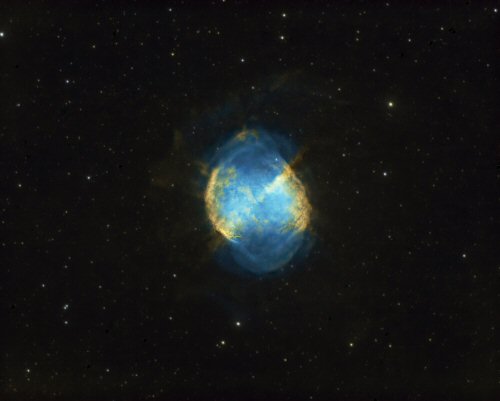
Steve Norrie forwarded six images. The first two, taken with a Celestron C8 SCT and Starlight Xpress Trius 694 mono camera plus narrow band filters to give the Hubble palette are NGC 7635 the Bubble nebula in the constellation of Cassiopeia, and M27 the Dumbbell planetary nebula in Vulpecula:



Steve also imaged Sh2-132 again and IC 1396 the Elephant’s Trunk emission nebula in Cepheus with a WO Redcat 71 refractor and Altair Astro Hypercam 26C colour camera and Optolong L-eXtreme filter:

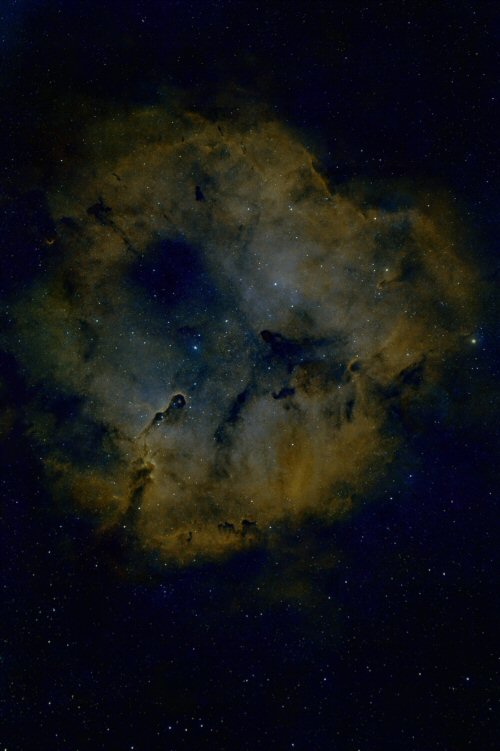
IC 1396A, specifically the Elephant’s trunk part of IC 1396, is a site of new star formation, some less than 100,000 years old, which were discovered twenty years ago in infra red images taken by the Spitzer Space Telescope. The central multiple star HD 206267 is ionising the whole nebula, and contributing to the compression of the rim of the Elephant’s Trunk, triggering the creation of protostars.
Dave Finnigan