
A good start to the new year, with six section members sending in their observations; twelve images and twenty drawings in all.
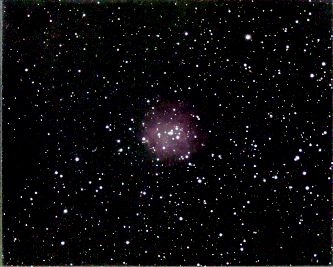
Ian Papworth, SPA membership secretary and council member, imaged NGC 2392, the Eskimo planetary nebula, which is in the constellation of Gemini, from Bedfordshire using a Celestron Nexstar 6SE f6.3 SCT and a ZWO ASMM camera and RG and B filters.
NGC 2392, also known as Caldwell 39, is a bipolar double – shelled planetary nebula. It was discovered by Sir William Herschel in 1787, and has an apparent magnitude of around 9; with a high surface brightness the 15” diameter central part is easy for visual observers to spot with a small telescope.

Dale Holt, observing from Chippingdale,sent in 18 drawings of deep sky objects. Planetary nebula Abell 12, and planetary nebula NGC 2022 are both in the constellation of Orion. Abell 12 is the faint disc to the above right of the much brighter star mu Orionis.


Staying in Orion, Dale observed barred spiral galaxy NGC 1924, NGC 1964, a barred spiral in Lepus, Arp 186, aka NGC 1614, a distorted barred spiral galaxy in Eridanus and NGC 2371-2, a planetary nebula in Gemini. The latter was given two entries in the New General Catalogue by Sir William Herschel since it appeared to be two separate objects.


Still in Gemini, Dale drew a group of galaxies, NGC 2385, 2388 and 2389. The next three drawings are face-on spiral galaxy NGC 2967 in Sextans, NGC 3023 and 3018 also in Sextans, and another pair of galaxies NGC 3636 and 3637 in Crater.


Dale also observed galaxy NGC 3660 in the constellation of Crater, and, galaxy NGC 3686 in Leo; a group of 3 galaxies NGC 3790, 3801, 3802 and galaxy NGC 3800 (with NGC 3799 to the upper right of it) also in Leo.


Dale’s final four drawings are NGC 3810, a galaxy in the constellation of Leo, galaxy NGC 4420 and galaxy group NGC 4440 both in Virgo, and 3C 273, a quasar, also in Virgo; the very first to be found. 3C 273 is so bright it has an absolute magnitude of around -26, so at a distance of 10 parsecs (32.6 light years) would rival the sun in our skies! It is in reality about 2.5 billion light years from the Earth, and its apparent magnitude is 12.9.


Dale used a 505mm f3.5 Newtonian telescope plus a Watec 120N+ video camera to make these sketches.
Michael Kinns sent in two drawings; M77, a galaxy in the constellation of Cetus and open cluster NGC 1981 in Orion. M77 is a barred spiral with an active galactic nucleus, it is about 170,000 light years across and is the brightest type 2 Seyfert galaxy. Double star Struve 750 is also shown in Michael’s drawing of NGC1981, which lies in the sword of Orion, and is about 1300 light years from the Earth.

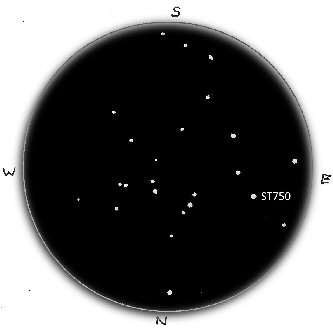
Observing from Eastry, Michael used an Orion Optics (UK) 200mm f6 Newtonian telescope, at a magnification of 75x.
Mark Beveridge of Fife used a 140mm f14.3 OMC Maksutov – Cassegrain telescope, SXR-H814 mono camaera plus colour filters to make the following images:
Galaxy NGC 891 is in the constellation of Andromeda: it is thought that our own galaxy would look much like this, viewded edge – on.

NGC507 is largest and brightest galaxy in a group of galaxies in the constellation of Pisces, NGC 1624 is an open cluster with emission nebulosity in Perseus, M109 a galaxy in Ursa Major, and planetary nebula NGC 1514 lies in Taurus.
NGC 507 has an active galactic nucleus, and Halton Arp gave it the designation Arp 299 in his catalogue of peculiar galaxies.



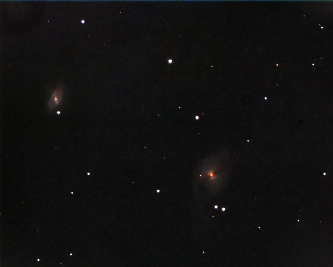
Mark also imaged a pair of galaxies NGC 3718 and 3729 and galaxy NGC 3726, all of which are in the constellation of Ursa Major. NGC 3718 ( the lower right galaxy) has a warped shape, (it is also known as Arp 214) probably due to an interaction with its neighbour.

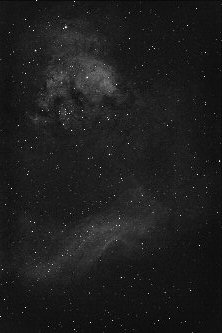
Alan Clitherow, SPA Planetary Section Director imaged NGC 7822 and Cederblad 214, a large molecular cloud and star forming region in the constellation of Cepheus. He used a Canon 600D DSLR doubly modified to be sensitive to H alpha and to image in monochrome, i.e. the Bayer matrix has been removed from the sensor.
The star forming region at the top of this image is Cederblad 214, also known as Sharpless 171, and it contains a cluster of very young (just a few million years old) stars called Berkeley 59. One of the stars, BD+66 1673 is extremely hot (45,000 K) and luminous, and is one of the sources of radiation sculpting this nebula.
Together with NGC 7822 (at the bottom of the image), the nebulosity covers about 6 suare degrees of sky.
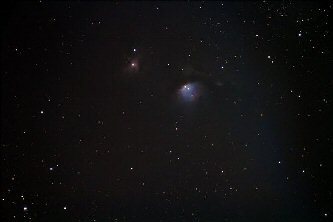
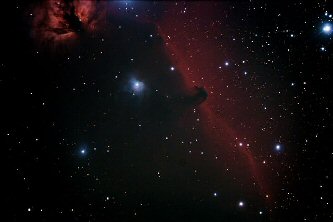
Steve Norrie, imaging from Fife, used an ES 127mm f3.5 apochromatic refractor and modified Canon 600D DSLR colour camera to capture M78, a reflection nebula in the constellation of Orion, and Barnard 33, the famous “horse head” dark nebula, also in Orion. Both are part of the Orion Molecular cloud complex, which also includes the Great Nebula in the sword of Orion, and Barnard’s Loop, which curves around the constellation.
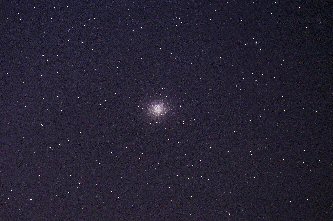
John Tipping imaged NGC 5139, much better known as omega Centauri; the largest globular cluster associated with our own milky way. John was in Portugal at the time, and this object, spectacular when viewed from the Southern Hemisphere, was extremely low in the sky. He used a Canon 700D DSLR and a 300mm telephoto lens, on a driven mount.
Ther is an argument that omega Centauri is not a typical globular cluster at all, but rather the central core of a dwarf galaxy, captured by the milky way long ago and stripped of its outer parts. It is about 170,000 light years in diameter, and some sources estimate there to be around 10 million stars within it, giving a mass of around 10 times the average globular cluster.
Dave Finnigan