
During the month, four section members submitted their observations; a total of 16 images and13 drawings.
Mark Beveridge of Aberdeen sent in all 16 of the images.
The first six were taken using a 140mm f14.3 OMC Maksutov telescope on an HEQ5 mount, and a SXR-H814 camera plus RGB filters.
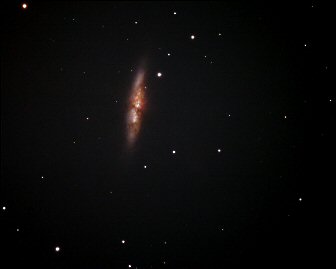
Here is M82, an edge – on galaxy in the constellation of Ursa Major. It is also known as the “cigar” galaxy, and is a starburst galaxy; activity thought to be caused by interaction with its neighbour M81. At about 12 million light years from the Earth it is the closest starburst galaxy to us. A year ago a type 1a supernova was discovered in M82 during an observing session at the University of London Observatory.
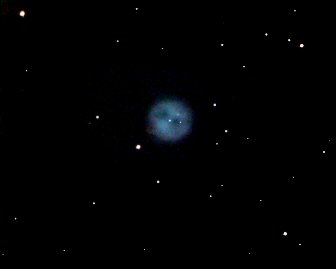
Next is M97, a planetary nebula also in the constellation of Ursa Major. This object lies about 2000 light years from the Earth, and is known as the “owl” nebula. It is just under 3.5 arc minutes in diameter, and has an apparent magnitude of 9.9. M97 is reckoned to be about 8,000 years old, with a magnitude 14 white dwarf stellar remnant at its centre.
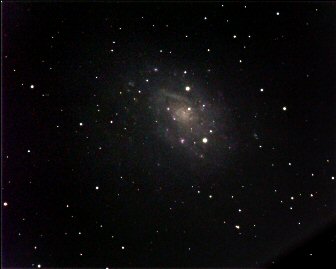
NGC 2403 can be found at magnitude 8.9 in the constellation of Camelopardalis. It is a member of the M81 group of galaxies, and is about 8 million light years from the Earth.
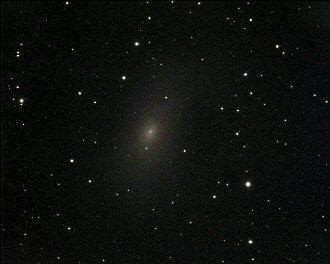
M110, also known as NGC 205, is a magnitude 8.9 dwarf elliptical galaxy and satellite of M31, the Andromeda galaxy. M110 has been shown to contain some dust and signs of recent, in astronomical terms, star formation which is unusual for this type of galaxy. It was assigned a Messier number as recently as the 1960’s.
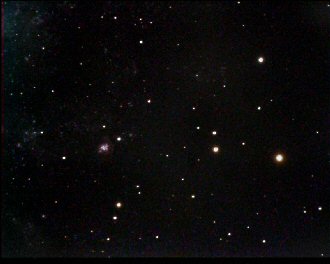
Emission nebula, NGC 604, which is in the Triangulum galaxy M33, appears small because it is about 2.7 million light years from us, but in fact it is one of the biggest HII regions in the local group of galaxies which includes our own Milky Way. It is believed to be over 40 times the size of the visible part of the Orion nebula and over 6,000 times more luminous – if it were as close as M42 it would appear brighter than Venus.

This planetary nebula is NGC 7662, the “blue snowball”, which is in the constellation of Andromeda. It is magnitude 8.3, and about 37 arcseconds in diameter. In small telescopes only the brighter, central, 12 arcsecond diameter part may be seen. The central dwarf star varies in magnitude between 12 and 16.
The next seven of Mark’s images were taken with the same camera and filter arrangement, but with a 100mm F9 Orion Skywatcher refractor. M101 is the “pinwheel” galaxy in the constellation of Ursa Major. It is face – on to us, and is about 27 million lght years from the Earth. It is much bigger than our Milky Way Galaxy at about 170, 000 light years in diameter, 28 x 26 arc seconds in angular size, and apparent magnitude 7.9. Its low surface brightness however means that in the eyepiece of all but the biggest amateur telescopes only the brighter central parts may be seen.
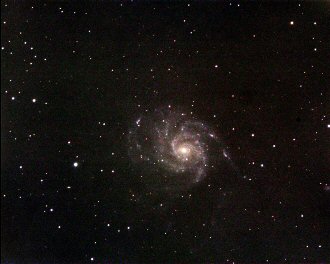

NGC 1491 is an emission nebula in the constellation of Perseus. The central star is producing strong ultra violet radiation which is ionising the hydrogen gas in the nebula and creating a void in the nebula around itself.
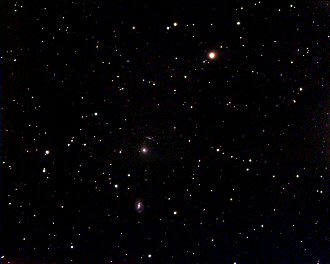
This image shows NGC 2633 and together with NGC 2634 and NGC 2634A, galaxies in the constellation of Camelopardalis. (also in a second image further down the page) The first two are of magnitude 12 and 11.8, and are only 2 minutes of arc in angular diameter. All three are of the order of 100 million light years from the Earth, but they are not thought to be interacting with each other.

NGC 4236 is a barred spiral galaxy in the constellation of Draco. A part of the M81 group of galaxies, this edge – on spiral is about 11.7 light years from Earth and is magnitude 10.5. Its angular dimensions are 22 x 7 arcminutes.

This is an image of dark nebulae B12 and B13; clouds of cold dust and molecular gas that block out the visible light of more distant stars.

This is a cluster of galaxies in the constellation of Camelopardalis, the most prominent being NGC 2633 and NGC 2634 (see the other image, the third above)

NGC 7822 is an emission nebula in the constellation of Cepheus. At the core of this star forming region is a young cluster of stars known as Berkeley 59. Within the cluster is a very hot young star, part of an eclipsing binary system, which is about 100,000 times as luminous as the sun. This star is one of the sources of powerful ultra violet radiation that sculpt and illuminate the nebula.
The last three images that Mark sent in this month were taken using the 140mm OMC Maksutov telescope.
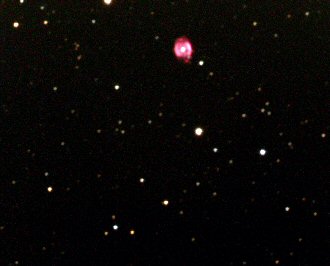
Here is NGC40, a planetary nebula in the constellation of Cepheus. Also known as the “bow tie” nebula, it is about a light year across, and the central white dwarf star has a surface temperature of about 50.000 degrees K. It appears small in the telescope at 38 x 35 arcseconds, and has an apparent magnitude of 11.3.
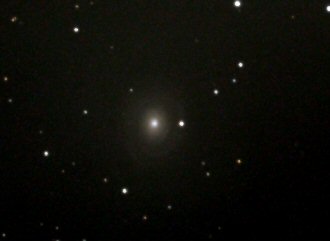
NGC 2985 is a spiral galaxy in the constellation of Ursa Major. It is magnitude 10.4, and 4.6 x 3.4 arcminutes in angular size.
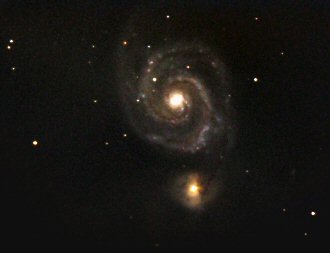
Mark’s sixteenth and final image this month is of M51, the “whirlpool” galaxy in the constellation of Canes Venatici. The first spiral galaxy to be classified as such, its smaller companion is NGC 5195. M51 is one of the best known sights in the night sky.
Michael Kinns, observing from Eastry, sent in two drawings: these are of adjacent open clusters, in the constellation of Taurus near the border with Orion: NGC 1807 and NGC 1817. Michael used a 200mm f6 Newtonian telescope, working at a magnification of 200x for each sketch.


Mike Wood sent in three sketches, using his 180mm Takahashi Mewlon Dall Kirkham reflector from Debenham.
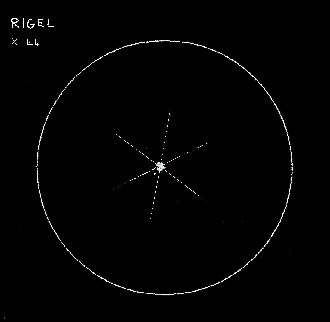
Here is Rigel, Beta Orionis, actually the brightest star in the constellation of Orion at apparent magnitude 0.13. Rigel has an absolute magnitude of -7.84, and is about 120,000 times more luminous than our sun. Rigel has a companion, Rigel B, seen in this sketch in the 7 o’clock position. It is a spectroscopic binary comprising two type B stars, making Rigel a triple star system.
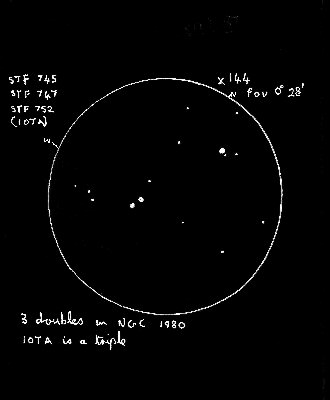
Mike’s sketch of NGC 1980 shows in three pairs of double stars within it. This open cluster is interesting because it was once thought to be part of the Orion nebula. It has recently been shown to be between the Earth and M42. Research suggests the massive stars in this cluster around iota Orionis are slightly older than the Trapezium stars.

Here is M42, the Orion nebula; a massive star forming region visible to the naked eye below Orion’s belt.
Dale Holt observing from Chippingdale, sent in eight drawings. For the first three observations Dale used a 153mm f9 refractor, coupled to an uncooled Watec 120N video camera, sketching what could be seen on the monitor screen.

GC 2024 is the “Flame” nebula in the constellation of Orion: the bright star depicted at the bottom right is Alnitak, Zeta Orionis. This emision nebula, created by fierce ultra violet radiation from Alnitak ionising the surrounding hydrogen gas, is part of the Orion Molecular cloud complex.

NGC 2374 is an open cluster to be found in the constellation of Canis Major

NGC 2903 is a magnitude 9.7 barred spiral galaxy about 30 million light years from the Earth in the constellation of Leo.

The next four observations were made using a 505mm f3.7 Newtonian reflector, plus video camera as before. Dale’s drawing of NGC 1055 shows an edge on galaxy in the constellation of Cetus. It is part of a group of galaxies that includes M77. This galaxy has a prominent central bulge, and a wide band of dust and gas.
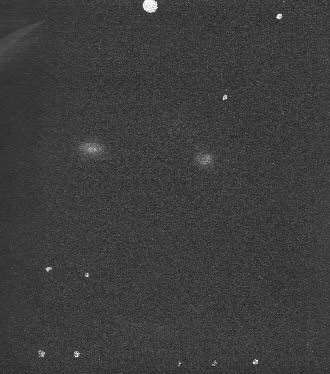
Here is a drawing of two galaxies in the constellation of Orion. NGC 1604 is a magnitude 13 eliptical, NGC 1602 to its right is also an eliptical and a magnitude fainter.
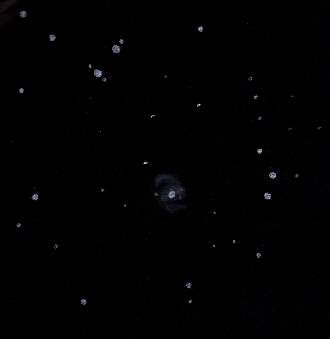
This sketch is of NGC 1924, a barred spiral galaxy in the constellation of Orion. It is estimated to be about 133 million light years from the Earth, is magnitude 13.3, and has an angular size of 1.6 x 1.2 arcminutes.
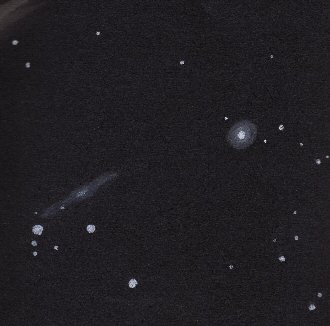
Here is a drawing of two galaxies, NGC 2749 and NGC 2752 which are in the constellation of Cancer. NGC 2752 is magnitude 13.7 barred spiral and is 1.8 x 0.4 arcminutes in angular size. NGC 2749 is a magnitude 11.8 elliptical galaxy and 1.8 x 1.7 arcminutes in size.

Dale’s final sketch this month was made using the 153mm refractor, and shows the NGC 2749 group of galaxies, a wide view including those in the above sketch and many more.
Dave Finnigan