
The return of shorter days has given a boost to section activity: six members sent in twenty digital images and one drawing.
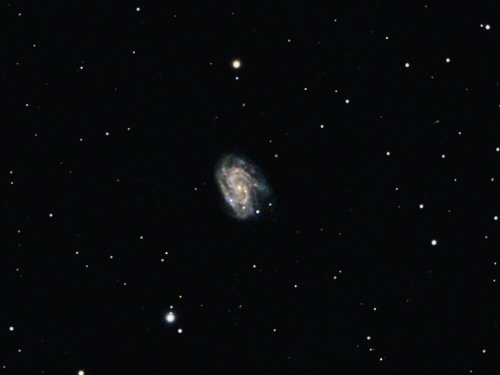
Mark Beveridge imaged galaxy NGC 157 and the Skull planetary nebula NGC 246 which are both in the constellation of Cetus, also galaxy NGC 7640 in Andromeda:
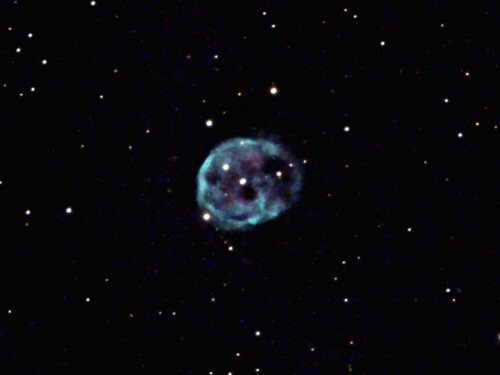
NGC 246 has an irregular outer blue ring, which we think is a result of shock waves as the outer shell of expanding gas expelled by the dying star interacts with the interstellar medium, becoming hot and unstable. The central white dwarf is currently magnitude 12, just under a magnitude fainter than fifty years ago.

Mark used a Celestron C11 SCT with a 0.63 focal reducer and a ZWO ASI294 MC Pro colour camera.
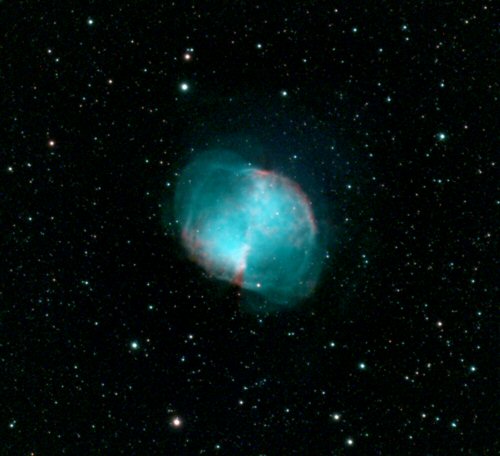
Richard Lewis used a Takahshi FSQ 106mm refractor and ZWO ASI294 MC Pro colour camera to capture M27 the Dumbbell planetary nebula in the constellation of Lyra and M16 the Eagle emission nebula in Serpens Cauda:

M16 is a region of active star formation, with emission nebulosity surrounding a cluster of over 8,000 young stars. The brightest star is HD 168076, a binary star comprising two class O components, one of which is 80 solar masses and a million times more luminous than the sun.
John Fathers sent in two sets of images. The first five were taken at the Kelling Heath Star Party, to which John took a Celestron 8″ Rowe-Ackerman f2 Asrograph (RASA 8) together with ZWO ASI533 MC and ASI071 MC colour cameras. Below are NGC 6888 the Crescent emission nebula in the constellation of Cygnus (taken through a narrow band filter, cropped version). Changing to an Optolong L-eNhance filter, the other four images are Barnard 142 & 143 the Big E dark nebula in Aquila, Barnard 150 the Seahorse dark nebula in Cepheus, NGC 7293 the Helix planetary nebula in Aquarius and LDN 1235 the Shark Head dark nebula also in Cepheus:


Barnard 142 & 143 is roughly the same angular size as the full moon, 30 arcminutes. Dark nebulae such as this and B 150 and LDN 1235 below are clouds of cold molecular gas and dust which are dense enough to block the light in the visible part of the electromagnetic spectrum emanating from the stars beyongd them.


Upon returning home, John took three more images, of emission nebulae in Cassiopeia. Below are NGC 7625 the Bubble nebula (cropped version), IC 1805 the Heart nebula and Westerhaut 5 the Soul nebula, all with the telescope and camera above plus a ZWO Duo-Band narrow band filter:


Steve Norrie sent in two sets of images, the first taken with Celestron Edge C8 SCT and Starlight Xpress Trius 694 mono camera plus narrow band filters to give the Hubble palette. Below are emission nebulae Melotte 15 and NGC 281 the Pacman nebula both in the constellation of Cassiopeia and NGC 7380 the Wizard nebula in Cepheus:

Melotte 15 lies at the centre of the Heart nebula (see John Father’s image above), where powerful stellar winds and UV radiation from young, hot, massive stars ionise and sculpt the surrounding clouds of gas and dust.


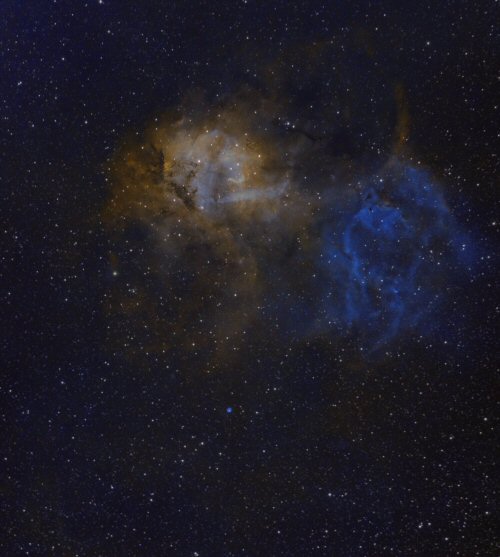
Steve’s next three images were taken with an EDR 72mm refractor and ZWO ASI294 MC colour camera plus Optolong L-eXtreme filter, IC 1396 the Elephant’s Trunk and Sh-2 132 the Lion nebula both emission nebulae in Cepheus and NGC 6992 the Eastern Veil (part of the Veil supernova remnant) in Cygnus:


Michael Kinns observed open cluster NGC 654 in the Constellation of Cassiopeia with an Orion 200mm SPX Newtonian reflector at a magnification of 67x and sketched what he saw at the eyepiece:

NGC 654 is magnitude 6.5, with an angular size of 5 arc minutes, so may be observed with binoculars. It is estimared to be around 14 million years old, and about 7,800 light years from the Earth, which places it in the Cassiopeia OB8 association in the Perseus arm of our galaxy along with open clusters M103, NGC 659 and NGC 663.
David Davies imaged open cluster M39 in the constellation of Cygnus:

M39 is magnitude 5, around the apparent size of the full moon in the sky so readily observed with binoculars. Six of the brightest components of the cluster are known to be double stars. In contrast with NGC 654 above, M39 is esrtimated to be much older, (around 280 million years old), but considerably closer to us at about 1000 light years.
David used an APM 107mm refractor and QSI 683 mono camera plus red, green and blue filters.
Dave Finnigan