
Autumn always brings a welcome increase in deep sky section activity, and seven section members contributed towards this month’s total of twenty-six digital images.
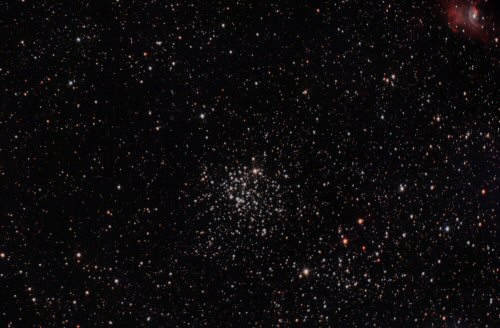
Ian Papworth captured two open clusters, M52 and NGC 659 and the Pacman emission nebula NGC 281, all in the constellation of Cassiopeia:


NGC 281, also known as Sh2-184, contains open cluster IC 1590 and Bok globules, dense gas and dust dark nebulae where star birth is considered to take place. One very luminous star in NGC 281 is a class O6; it is the brightest in a quintuple star system called B1 discovered by American astronomer S.W.Burnham. (See also Steve Norrie’s image below)
Ian also imaged the Wizard emission nebula NGC 7380 in Cepheus:

Ian uses a Skywatcher 150p Newtonian telescope and an Altair Hypercam 183c Pro colour camera.
Paul Brierley used a Williams Optics Zenithstar 61mm f5.9 refractor and an astro-modified Canon EOS 600D DSLR to image two emission nebulae, IC 1396 the Elephant’s Trunk in the constellation of Cepheus (see also Alan Clitherow’s image below) and NGC 7000 the North America nebula in Cygnus:

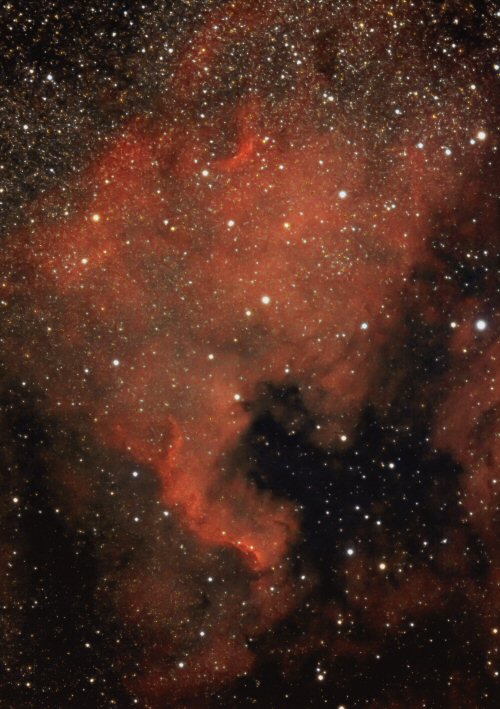
NGC 7000 covers an area on the sky of about 120 x 100 arcminutes. The Gaia astrometry satellite has given a distance for this and the associated Pelican nebula of 2,590 light years from the Earth, so NGC 7000 is 90 light years from top to bottom, and the combined HII region (Sh2-117) is 140 light years across.
It was once thought that Deneb was the star ionising the nebula. The latest information I have names the star responsible as the Bajamar Star, (J20551.3+435225) a double with two type O components, (an O3.5 and an O8) positioned in the nebulosity near ”Florida”, partly obscured by the central dark nebula (it is magnitude 13.2, but would appear to be magnitude 3.6 if it was clear of the dust cloud)
(See also Steve Norrie’s image below.)
Richard Lewis imaged spiral galaxy M31 in the constellation of Andromeda with a Takahashi FSQ 106mm refractor plus ZWO ASI294 colour camera:
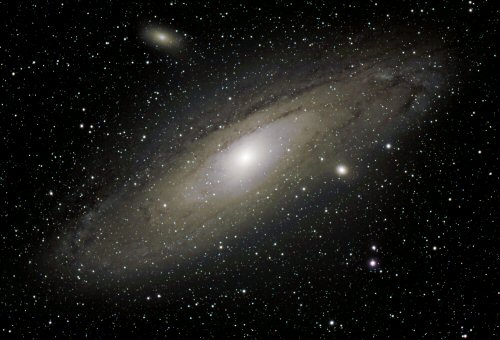
M31 has an apparent magnitude of 3.4 so is a naked eye object and well worth observing with binoculars and small telescopes. Research in 2018 and 2019 indicated that M31 is bigger in size than the our Milky Way galaxy, but lower in mass. M31’s spectrum is blueshifted and it is approaching us at an estimated 110 km/sec, and will take roughly 4.5 billion years to cross the 2.5 million light years between us.
David Davies used an APM 107mm refractor and 0.7x focal reducer with a QSI 683 mono camera plus narrow band filters to produce this Hubble palette depiction of IC 5067/5070 the Pelican nebula in the constellation of Cygnus:

The Pelican nebula is separated from the nearby North America nebula by a region of dark dust and molecular gas. It is a region of new star formation, sculpted by the intense radiation and powerful stellar winds of massive young stars. (See also Steve Norrie’s image of the Pelican nebula, below)
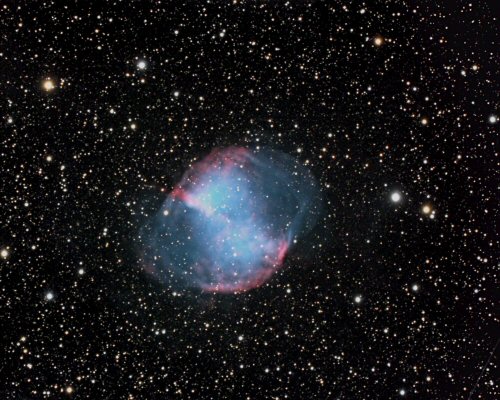
Mark Beveridge used a Celestron 200mm Edge HD SCT at f10.4 and a SXR-H14 mono camera plus red green and blue filters to image globular cluster M2 in the constellation of Aquarius, M27 the Dumbbell planetary nebula in Vulpecula and galaxy NGC 7479 in Pegasus:

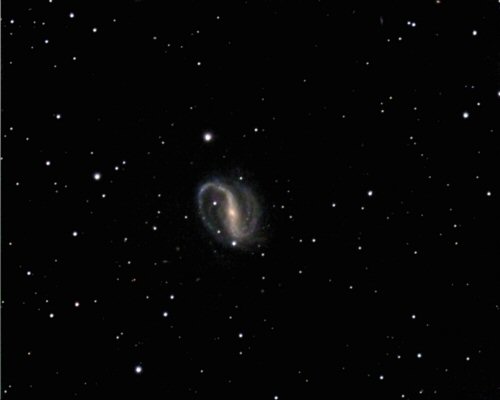
NGC 7479 is also known as Caldwell 44, and is readily identified as a barred spiral. It is also a Seyfert galaxy, with widespread new star formation occurring in the nucleus, bar and spiral arms; it is thought that it probably merged with a small galaxy relatively recently.
With the same telescope (at f7.4) and the same camera Mark imaged these objects in Triangulum; M33 the pinwheel galaxy and interacting galaxies NGC 672 and IC 1727:


Alan Clitherow, SPA planetary section director, imaged IC 1396 the Elephant’s Trunk emission nebula in the constellation of Cepheus, combining a colour image from a QHY 10APS-C colour camera with luminance data from an astro modified Canon 600D DSLR:

The name Elephant’s Trunk actually refers to IC 1396A, a small part of this ionised gas nebula where star formation is thought to be happening (Top centre). The whole nebula is being ionised by the massive, triple star system HD 206267A, and the colossal stellar wind from the three stars is compressing dust and gas in regions such as IC 1396A, but stripping away protoplanetary discs from their neighbours.
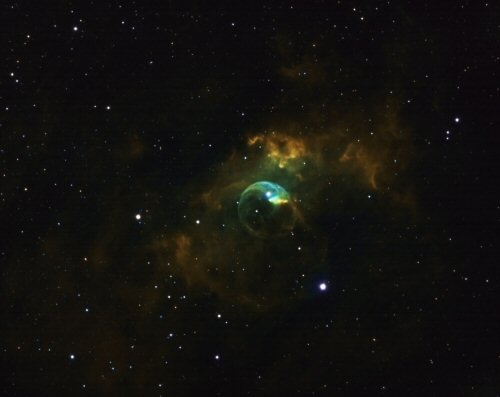
Steve Norrie sent in twelve images, the first six taken with a Celestron Edge C8 SCT and a Starlight Xpress Trius 694 and narrow band filters. Below are three emission nebulae images; a close up of part of the Elephant’s Trunk nebula IC 1306 in the constellation of Cepheus, then in Cassiopeia a part of the Heart nebula IC 1805 and NGC 7635 the Bubble nebula:


Steve also imaged IC 5146 the Cocoon reflection/emission nebula in Cygnus, Melotte 15 an open cluster within the Heart nebula in Cassiopeia and M27 the Dumbbell planetary nebula in Vulpecula:


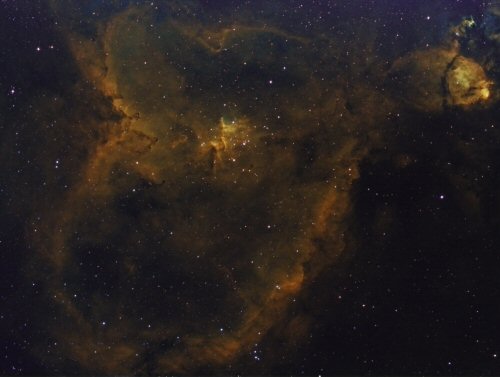
At the centre of the Heart nebula (IC 1805, see below) is Melotte 15, a cluster containing some young (about 1.5 million years old), massive (a few 50 x the mass of the sun), hot stars whose radiation and powerful stellar winds are sculpting the gas and dust clouds and ionising the gases.

Steve took the remaining images with an EDR 72mm refractor and the same camera and filters as above. All six are emission nebulae. The first three are in Cassiopeia; IC 1805, the Heart nebula, (Melotte 15, pictured above, is just above centre) NGC 281 the Pacman nebula and IC 1848 the Soul nebula:


The remaining three images are NGC 7000 the North America nebula and IC 5067/5070 the Pelican nebula (both in Cygnus) and NGC 7822 in Cepheus:


Dave Finnigan