
October brings longer nights and the end of British Summer Time, so generally there is an increase in deep sky section activity, but clear nights have been scarce lately. Three section members sent in a total of ten digital images.
Mark Beveridge used a Celestron C11 SCT with a 0.63x focal reducer and ZWO ASI294 MC colour camera to image NGC 7008, the Foetus Planetary nebula, in the constellation of Cygnus:
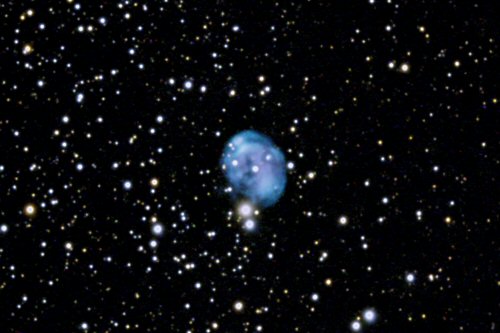
NGC 7008 is about one light year in diameter and 2,800 light years from the Earth, with an apparent magnitude of 12.0.
David Davies captured M32, a dwarf satellite galaxy of M31, classified as a compact elliptical:

The above image was cropped from a larger original, which also revealed some globular clusters associated with M31, which David has labelled in the image below:

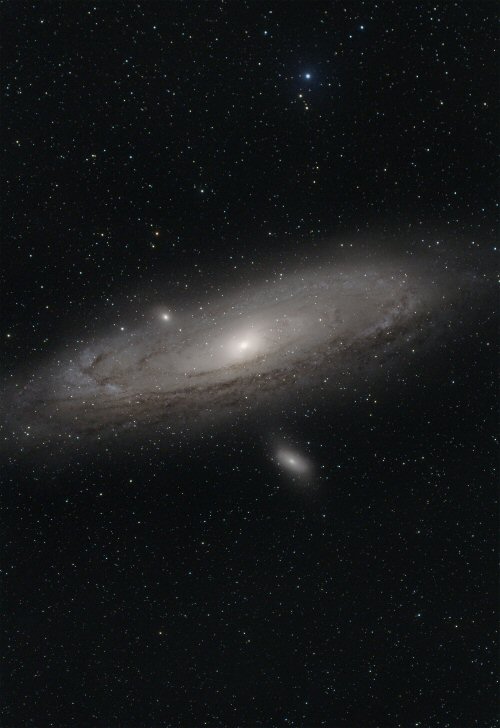
Steve Norrie sent in seven images The first four are of M31 galaxy in the constllation of Andromeda, plus IC 1805 and IC 1848 the Heart and Soul emission nebulae in Cassiopeia and Sh2-108 an emission nebula in Cygnus, which were taken using a Williams Optics Redcat 71 refractor and Altair Astro Hypercam 26 C colour camera, (plus an Optolong L-eXtreme filter for the nebulae)


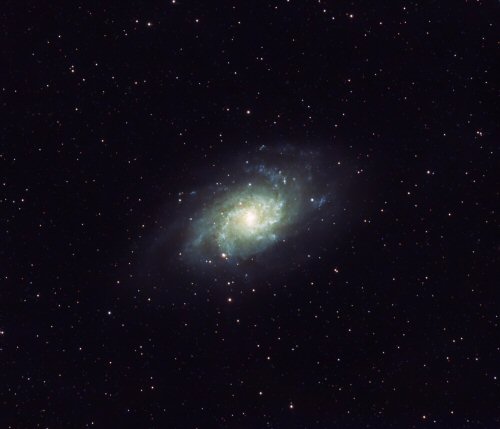
With a smaller Redcat 51 refractor and an Atik 490 MC colour camera, (again , with the eXtreme filter for the nebula) Steve imaged M33 the Pinwheel spiral galaxy in Triangulum and The Lobster Claw emission nebula Sh2-157 in Cassiopeia:

Sh2-157 is about 11,000 light years from the Earth. The nebulosity at the left of the image is NGC 7635, the Bubble nebula.
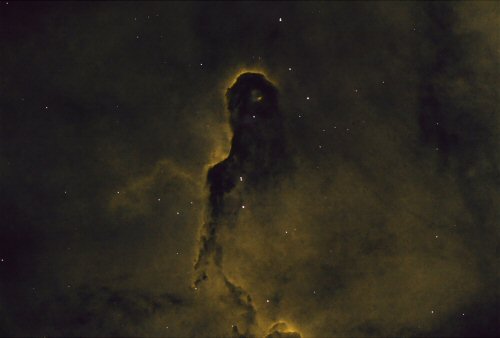
Changing telescope once more to a Celestron C8 SCT, with a ZWO ASI 294 MC colour camera plus an Optolong L-eNhance Tiri-band filter, Steve zoomed in on the Elephant’s Trunk star forming region of emission nebula IC 1396 in Cepheus:
Dave Finnigan