
A relatively quiet month for the section as bad weather inevitably took its toll; despite the dearth of clear skies four section members were able to send in a total of twelve digital images of deep sky objects:
Ian Papworth used a Skywatcher 150P Newtonian reflector and Altair Hypercam 183c colour camera to capture this image of spiral galaxy M31 in the constellation of Andromeda:
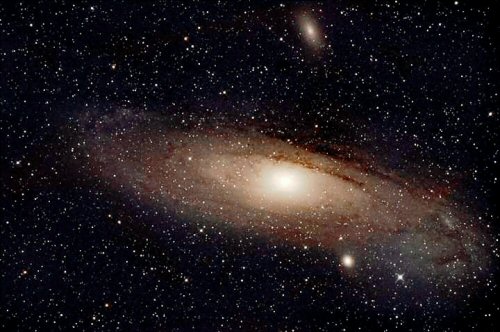
M31, also imaged by Steve Norrie (see below) is about 2.5 million light years from the Earth and is the closest major galaxy to us.
Richard Lewis imaged NGC 281 the Pacman emission nebula in the constellation of Cassiopeia, M64 the Black Eye galaxy in Coma Berenices and NGC 6960 the Western Veil (aka the Witches Broom), a part of the Veil supernova (see also below) remnant in Cygnus:

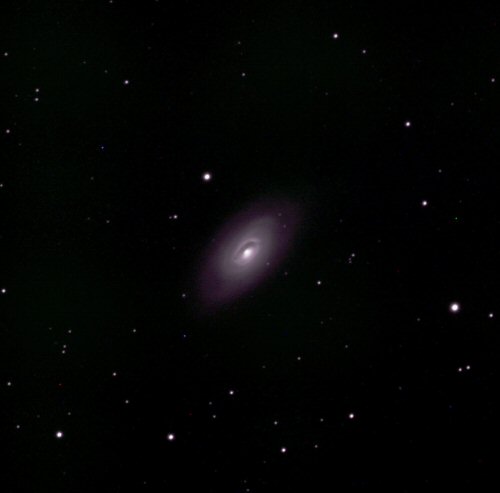
M64 is a type 2 Seyfert galaxy, around 17 million light years from the Earth.

Richard used a Takahashi 106N refractor and a ZWO ASI 294 colour camera.
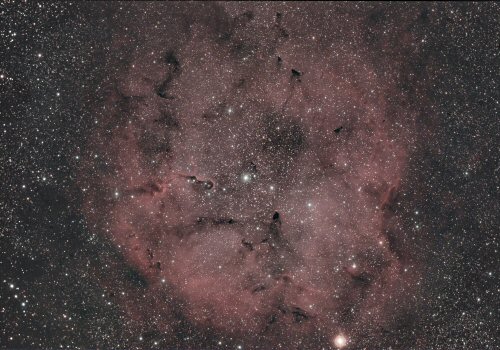
John Fathers sent in his first images to the section, using a 70mm APO refractor and ZWO ASI 071 MC Pro colour camera plus a TriBand light pollution filter at his location in Oxfordshire. IC 1396 is the Elephant’s Trunk emission nebula in the constellation of Cepheus, NGC 7000 the North America nebula in Cygnus and NGC 6960 the Veil supernova remnant also in Cygnus:
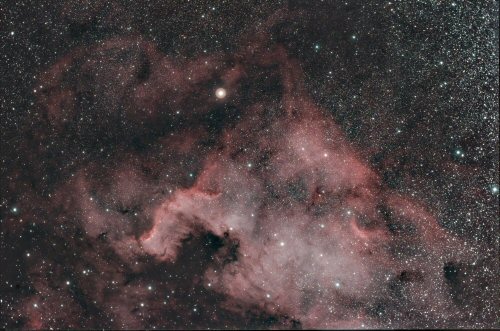
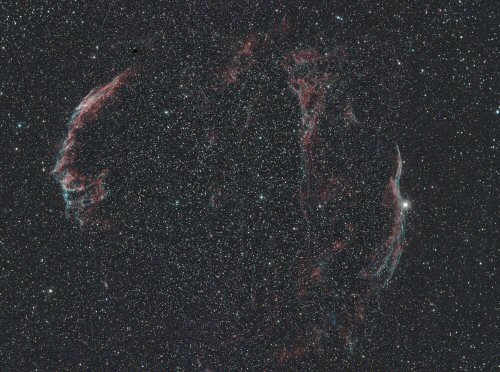
The Veil nebula is the remnant of a massive star, perhaps twenty times the mass of the sun, which ended its life as a supernova 10,000 to 20,000 years ago. It spans about three degrees and is reckoned to be 2,400 light years from the Earth. On the right of the above image can be seen the Western Veil or Witches Broom, imaged in detail by two other members this month.
Steve Norrie imaged a detail of IC 1396 the Elephant’s trunk nebula (see above) with a Celestron C8 SCT and Starlight Xpress Trius 694 mono camera plus narrow band filters:

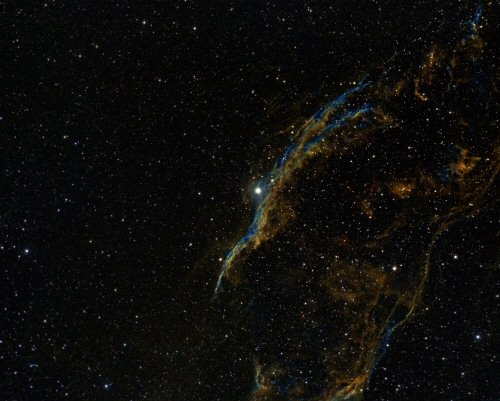
With the same camera but now with an EDR 72mm refractor Steve imaged NGC 6960 (see above) in Cygnus and NGC 7380 the Wizard open cluster/emission nebula in Cepheus:
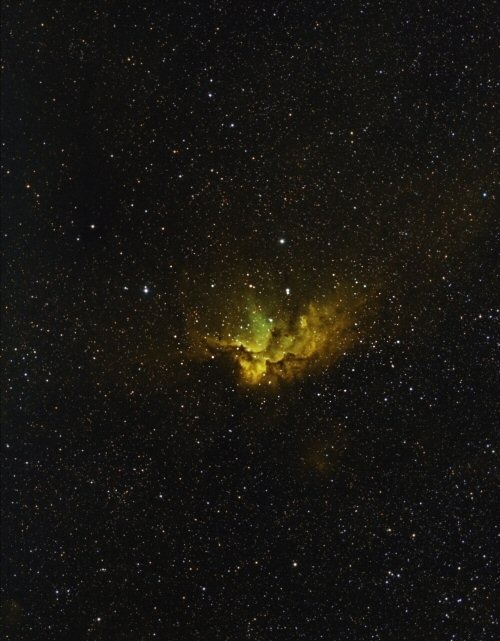
NGC 7380 is an open cluster of young stars, around 4 – 12 million years old. One in particular is a spectroscopic binary with two O type star components called DH Cephei which is ionising the surrounding gas and causing further new star formation.
With the same telescope and a ZWO ASI 294 MC camera, Steve imaged M31 (see also above):

For this image of M33 the Pinwheel galaxy in Triangulum Steve used an ES 127mm refractor and an Atik 490 colour camera:

Dave Finnigan