
A total of forty – two digital deep sky images were submitted to this section by six section members this month.
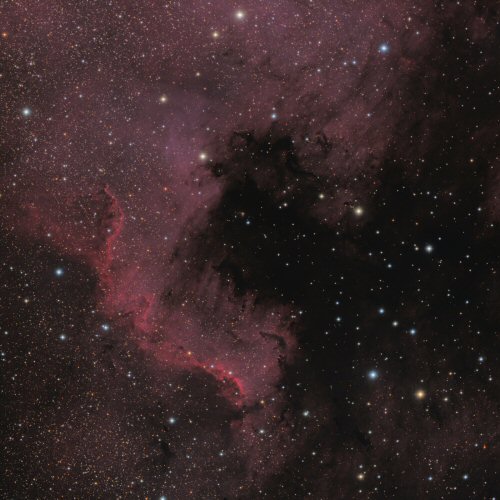
David Davies imaged NGC 7000, the North America emission nebula in the constellation of Cygnus and NGC 7789, an open cluster in Cassiopeia known as Caroline’s Rose, after William Herschel’s sister Caroline, who discovered it in 1783. David used an APM 107mm refractor and QSI 583 mono camera plus red green and blue filters:

The age of NGC 7789, also known as the White Rose cluster, is around 1.6 billion years. The most massive stars have already evolved into red giants which moved away from the main sequence as their core hydrogen became depleted. It is about 8,000 light years from the Earth, and some 50 light years in diameter, appearing as big as the full moon (half a degree), on the sky.
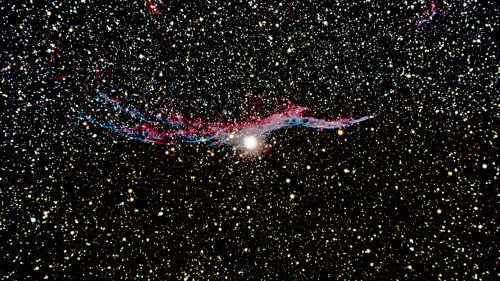
Richard Lewis used a Skywatcher 80ED Pro refractor and ZWO ASI294 colour camera to capture M31 spiral galaxy in the constellation of Andromeda, NGC 6960, the Witches Broom, a part of the Veil Nebula supernova remnant in Cygnus, IC 5146, the Cocoon emission nebula in Cygnus and M27, the Dumbbell planetary nebula in Vulpecula:

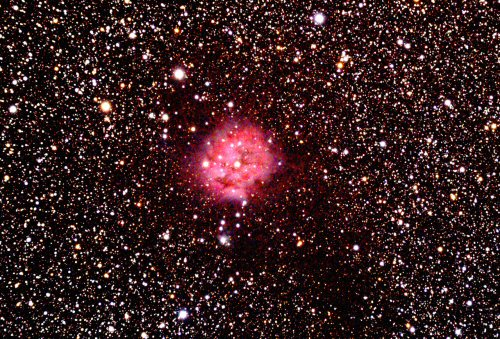
IC 5146, also known as Caldwell 19, is around 4,000 light years from the Earth and 15 light years across. There are emission, reflection and dark nebula components present – the latter, which surrounds the bright components and extends toward the bottom right in this image, is named Barnard 168. The open cluster associated with the nebula is called Collinder 470, and the central star whose powerful UV radiation is ionising the gas around it is a mere 100,000 years old.

Paul Brierley imaged NGC 281, the Pacman emission nebula and part of IC 1871, the Soul emission nebula, both in the constellation of Cassiopeia plus edge – on galaxy NGC 891 in Andromeda. Paul used an Altair Astro 115 EDT APO refractor and and Atik 428 ex camera plus a H alpha filter for the nebulae:

NGC 281 is about 9,200 light years from the Earth in the Perseus arm of our galaxy. It is associated with open cluster IC 1590, and contains several Bok globules, small dark patches in this image. Bok globules are concentrations of gas and cosmic dust where star formation may eventually happen; especially double or multiple star systems, according to current thinking.


Mark Beveridge sent in eighteen digital images, all but two of galaxies or groups of galaxies. The first four galaxies are M33, the Pinwheel galaxy in the constellation of Triangulum, NGC 266 in Pisces, NGC’s 2276 and 2300 in Cepheus and NGC 6685 in Lyra:


Mark’s next four galaxy images are NGC 6962 in Aquarius, NGC 7250 in Lacerta, NGC’s 7541 and 7537 in Pisces plus NGC’s 7619 and 7626 in Pegasus:


Below are galaxies IC 1613 in Cetus, IC 5090 in Aquarius (a monochrome image), M74 in Pisces and NGC’s 470 and 474 also in Pisces:
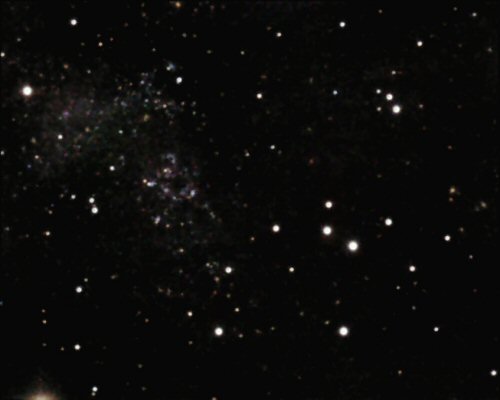


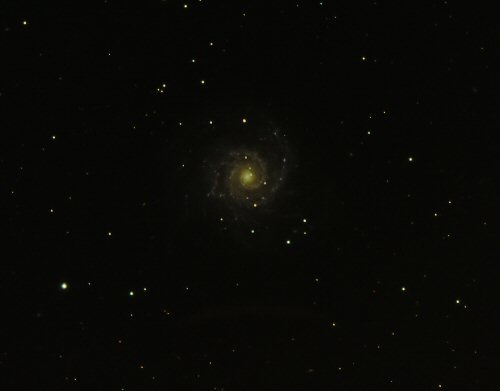
M74 is face on to us with a low surface brightness, so, for a Messier catalogue object, is particularly hard to see visually. Professional astronomers use this galaxy to examine how density waves might produce the spiral structure we observe, of which M74 is a fine example.

Mark’s final four galaxies are:
NGC 7606 in Aquarius, NGC 7721 also in Aquarius, NGC 7741 in Pegasus and NGC 1272, a galaxy group in Perseus:


Mark’s final two images are NGC 1624, an open cluster embedded in an emission nebula in Perseus and planetary nebula NGC 6905 aka the Blue Flash, in Delphinus:


Mark used a Celestron Edge HD 200mm f10.4 SCT and an SXR – H814 mono camera plus red green and blue filters.
Ian Papworth imaged the Bubble emission nebula, NGC 7635, in the constellation of Cassiopeia with a Skywatcher 80ED pro refractor and a ZWO ASI294 camera:

Also known as Caldwell 11, a young, massive (45 times the mass of the sun), energetic star (SAO 20575) is creating the bubble with a powerful outflow of stellar wind. Differences in the density of the surrounding medium has resulted in the bubble appearing very much off – centre with respect to this star, which in this image is to the inside left edge of the bubble. Energetic UV radiation from this star is ionising the surrounding gas making it visible to us. It is about 7 light years across and 7,000light years from the Earth.
Steve Norrie sent in fourteen digital images, some with a Celestron C8 SCT, some with an EDR72 refractor, all with a Starlight Xpress Trius mono 694 mono camera. Steve uses narrow band filters for the Hubble palette images, red green and blue filters for the remainder.
The first four are galaxy NGC 6643 in the constellation of Draco, NGC 6888 the Crescent nebula in Cygnus, NGC 6992, the Eastern Veil, a part of the Veil supernova remnant and NGC 7000, the North America emission nebula which are both in Cygnus too:
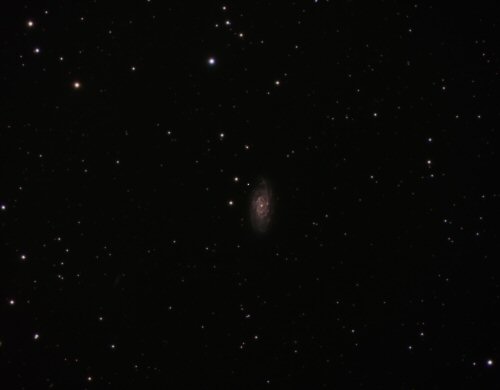
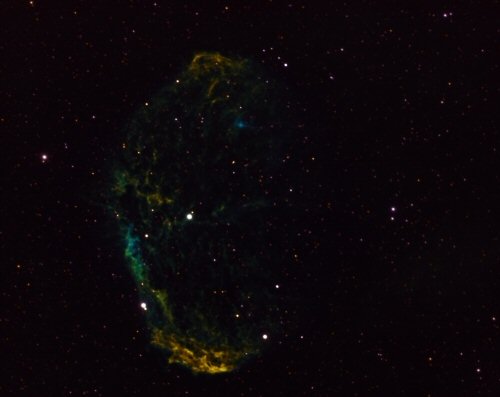

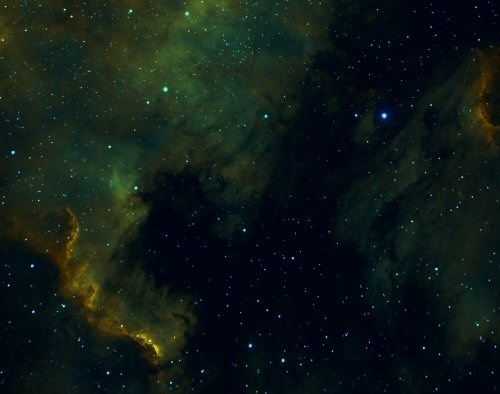
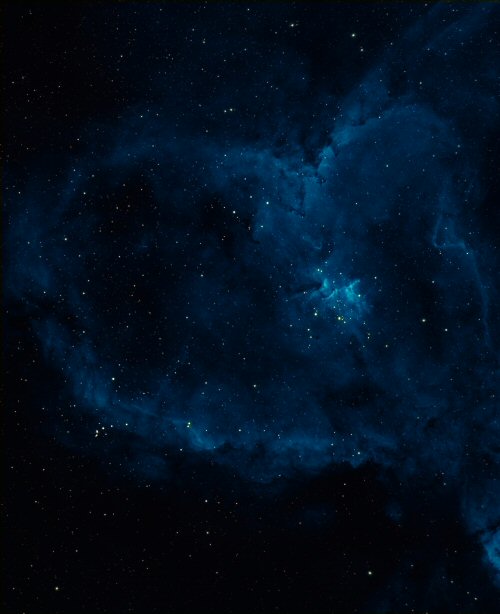
Steve’s next four images are NGC 7023 the Iris reflection nebula in Cepheus, emission nebula NGC 7822 also in Cepheus, IC 1805 the Heart emission nebula in Cassiopeia and spiral galaxy M74 in Pisces:
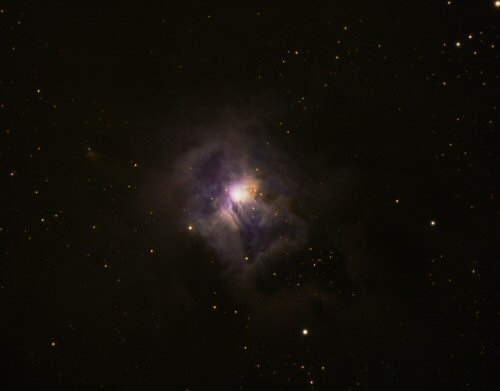

NGC 7822 is of the order of 3,000 light years from the Earth, and is a stellar nursery with some stars only one or two million years old. The open cluster associated with the nebula is called Berkeley 59, which contains double star BD+66 1673, one of the components being an extremely hot and luminous class O star. This star and similar stars sculpt and illuminate the nebula.
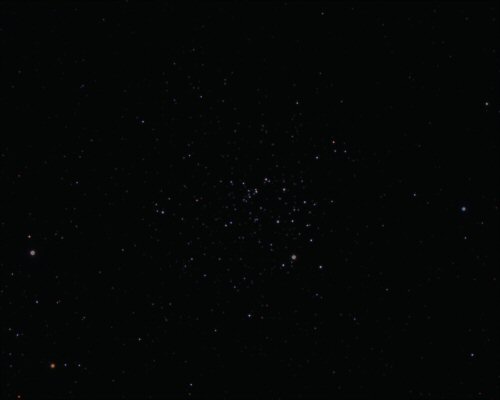
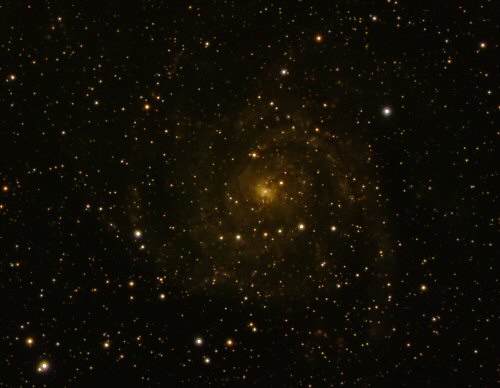
Below are M52, an open cluster in Cassiopeia, galaxy IC 342 in Camelopardalis, IC 1396 the Elephants Trunk nebula in Cepheus and NGC 7635 the Bubble emission nebula in Cassiopeia:


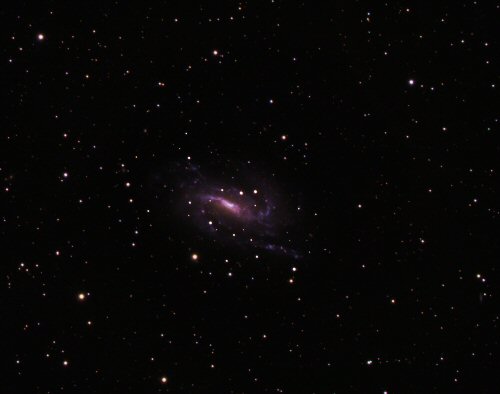
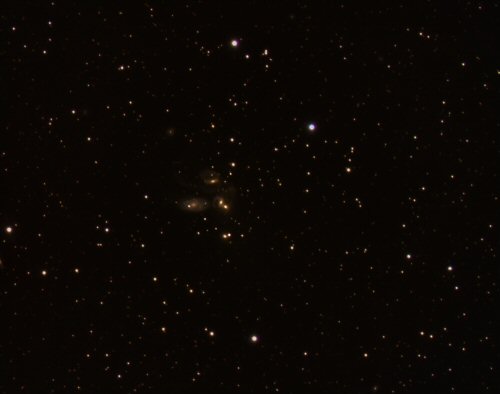
Sreve’s final two images are galaxy NGC 925 in Triangulum and Stephan’s Quintet, a group of five galaxies in Pegasus:
Dave Finnigan