
An unexpectedly quiet month, considering the time of year; it is certain that continued bad weather has reduced the opportunities for deep sky observation and imaging considerably.
Steve Norrie was the only section member to submit images this month, taken with a variety of telescopes, camera and filters:
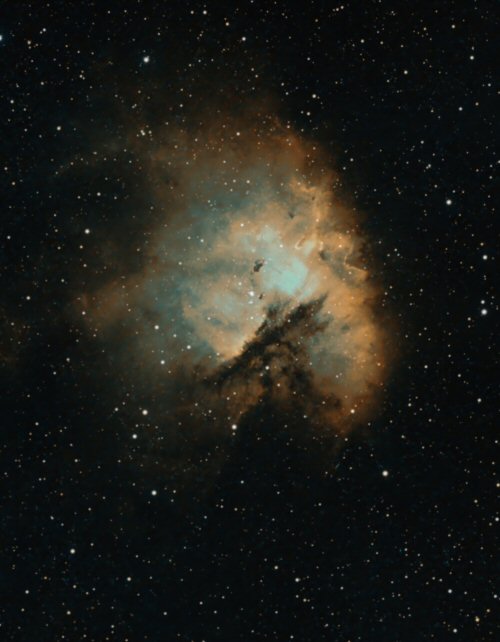
With an Explore Scientific 127mm f7.5 refractor and Atik 490 camera plus narrow band filters Steve imaged Melotte 15, the open cluster at the centre of IC 1805, the Heart emission nebula in the constellation of Cassiopeia (consequently often referred to as the Heart of the Heart) and NGC 281 the Pacman emission nebula also in Cassiopeia:
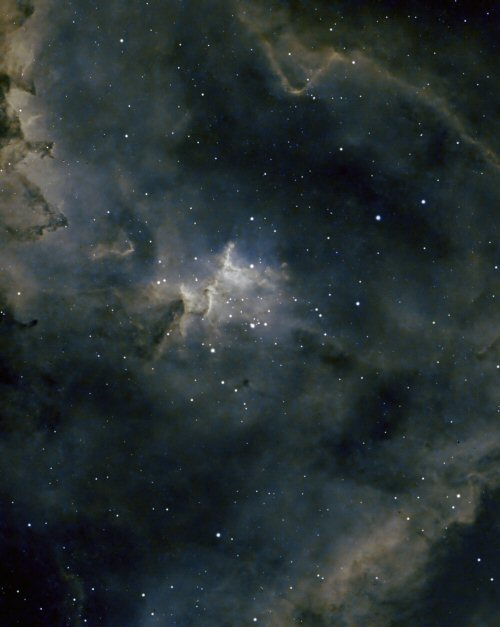
The clouds of dust and gas at the centre of the Heart nebula are being shaped by the powerful stellar winds and ionised by strong ultra violet radiation from the young, massive stars within Melotte 15. One O type star, HD 15558 is particularly massive and luminous, a spectroscopic binary estimated to be of 152 and 46 solar masses. It is likely that the 152 mass star will, in time, also prove to be a double. Located around 7,500 light years from the Earth, the cluster is estimated to be around 1.5 million years old.
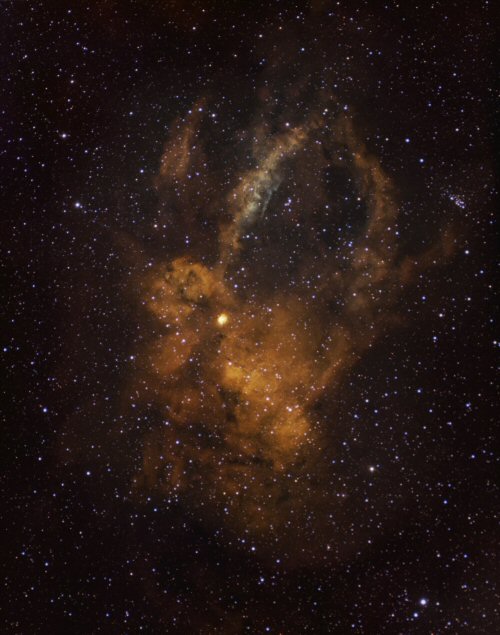
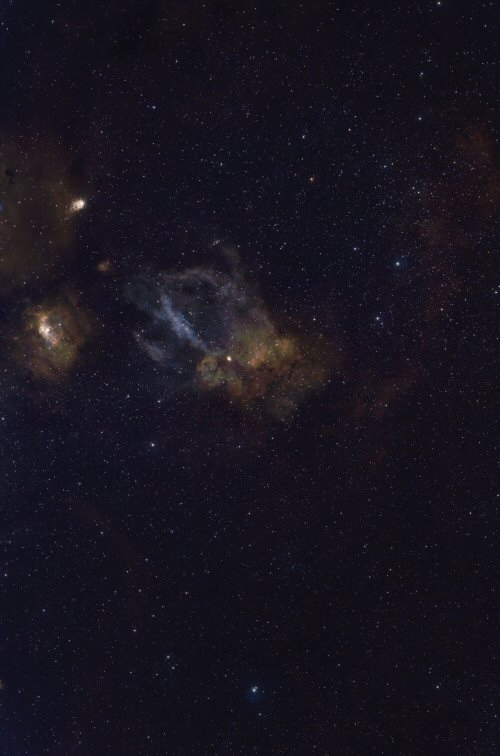
Steve imaged Sh1-109 the Lobster Claw emission nebula in Cassiopeia twice, the first image below with a Williams Optics Redcat 71mm f4.9 refractor and Starlight Xpress Trius 694 mono camera plus narrow band filters, the second with a Williams Optics Redcat 51mm f4.9 refractor and Altair Astro 26C TEC colour camera plus Optolong L-eXtreme filter:
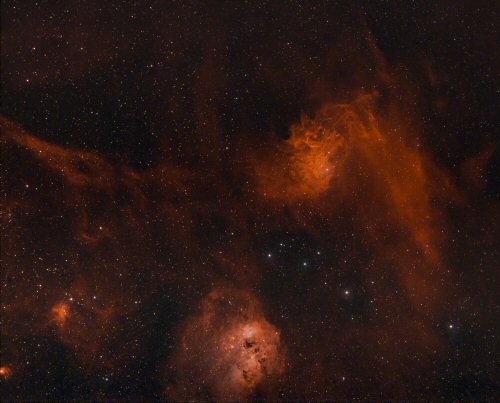
With the Recat 51mm set up described above Steve also imaged IC 405, the Flaming Star emission nebula in Auriga:
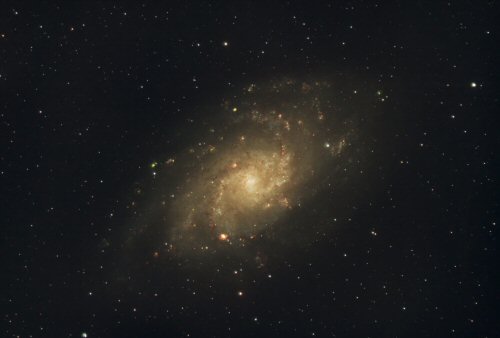
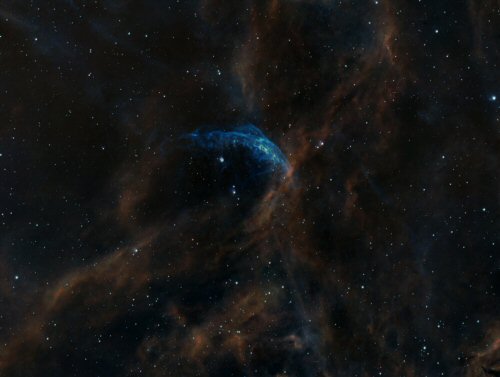
Below are images of M33 the Pinwheel spiral galaxy in Triangulum, and WR 134 Wolf Rayert star in Cygnus, both taken with an Explore Scientific 127mm f7.7 refractor and a ZWO ASI 294 MC colour camera (the latter with the addition if an Svbony dual band (HII, OIII) filter:
Dave Finnigan