
This month, five section members sent in a total of twenty digital images and two sketches.
Steve Norrie used a Celestron C9.25 SCT and StarlightXpress Trius 694 camera plus red, green and blue filters (and narrow band filters for the Hubble palette) to produce twelve deep sky images.
In the constellation of Perseus Steve imaged parts of the the Heart emission nebula: the first image is a close up of Melotte 15, the open cluster at the core of the nebulosity.

It is the young, massive stars in Melotte 15, some of almost 50 solar masses, which provide the intense ultra violet radiation responsible for ionising the nebula.

NGC 896 lies at the western edge of the heart nebula. It is the brightest part and was the first to be discovered.
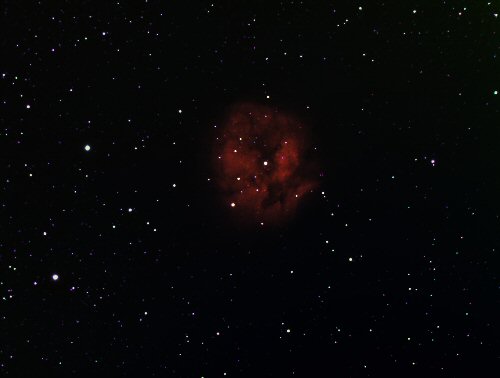
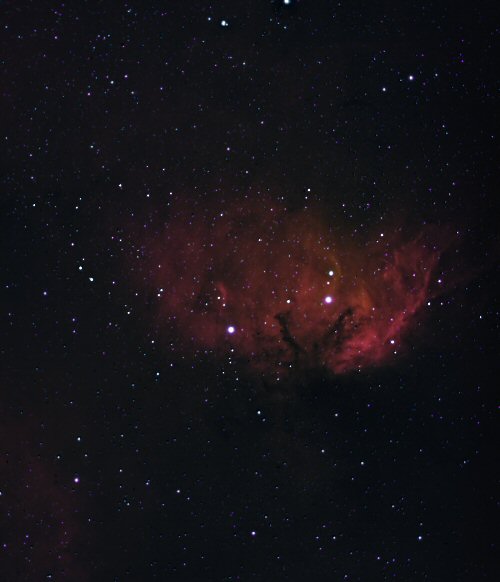
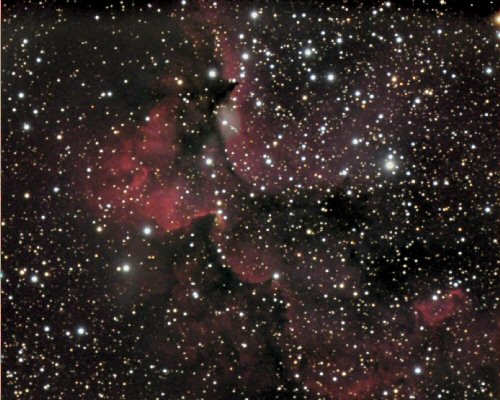
Steve also imaged emission nebulae IC 5146 the Cocoon nebula, Sh2 – 101 the Tulip nebula and Sh2 – 112; all in Cygnus:

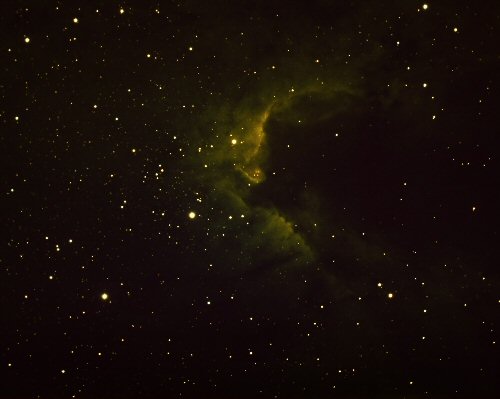
Below are another two emission nebulae: a part of NGC 2244 the Rosette nebula in Monoceros and Sh2 – 155 the Cave nebula in Cepheus.

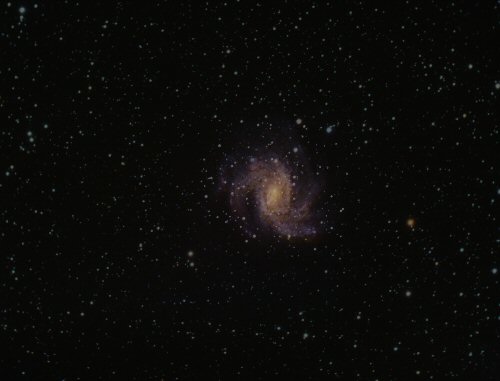
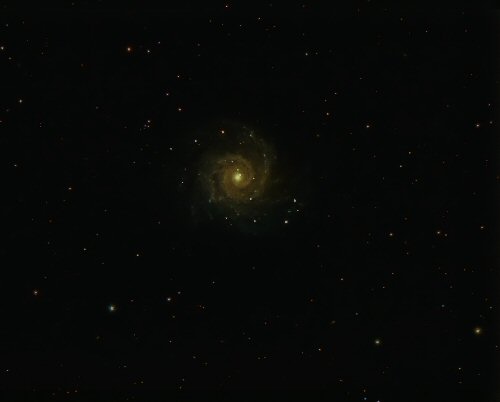
The remaining five images are all galaxies: NGC 7331 in Pegasus, NGC 891 in Andromeda, NGC 6946 on the Cepheus/Cygnus border, NGC 925 in Triangulum and M74 in Pisces:



Michael Kinns used a 200mm Orion Optics f6 Newtonian reflector to sketch two open clusters, NGC 752 in the constellation of Andromeda and M34 in Perseus:
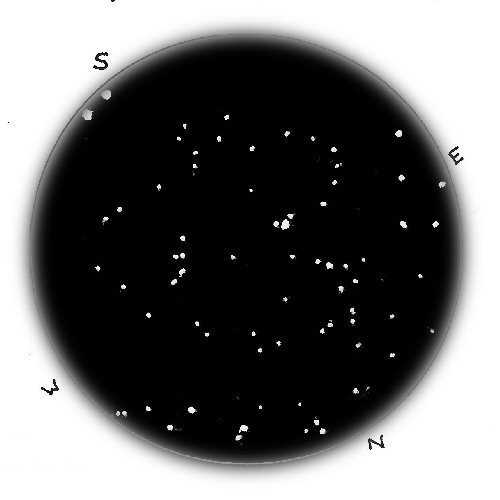

M34 has an apparent magnitude of 5.5, so should be a binocular target under reasonable conditions and even a naked eye object from a dark sky site. It is reckoned to be around 200 million years old, about 7.5 light years across and 1,500 light years from the Earth.
Paul Brierley imaged emission nebula IC 5146, the Cocoon nebula, in the constellation of Cygnus with an Altair Wave 115 EDT refractor and an Atik 428 Ex mono camera:
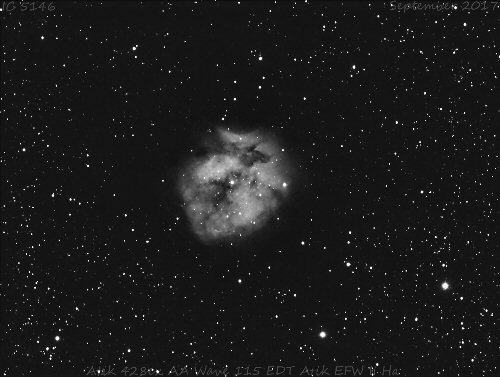
IC 5146 is around 4,000 light years from the Earth, so the 12 arcminute diameter equates to about 15 light years. The dark nebula associated with the emission nebulosity is designated Barnard 168.
David Davies imaged open cluster NGC 188, also known as Caldwell 1, in the constellation of Cepheus, using an APM 107mm refractor and QSI 583 mono camera plus red, green and blue filters.
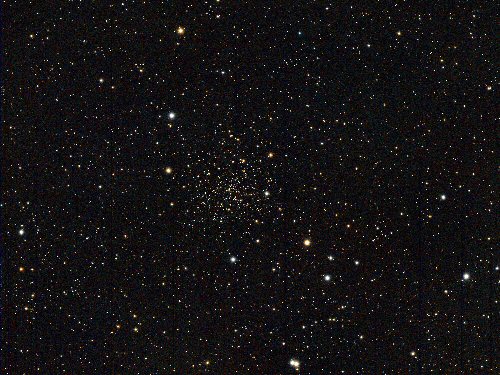
NGC 188 lies well above the the milky way galactic plane, away from its greatest gravitational influence; which explains why, at about 7 billion years old, it hasn’t dispersed. It is about 5,000 light years from the Earth.
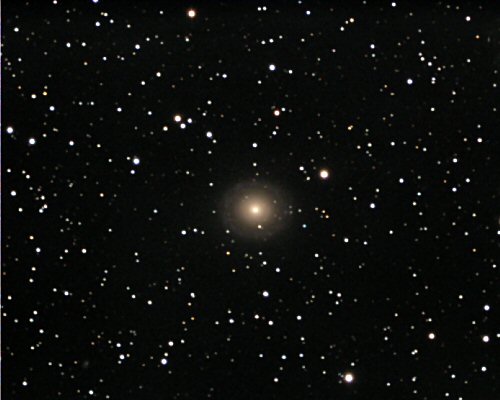
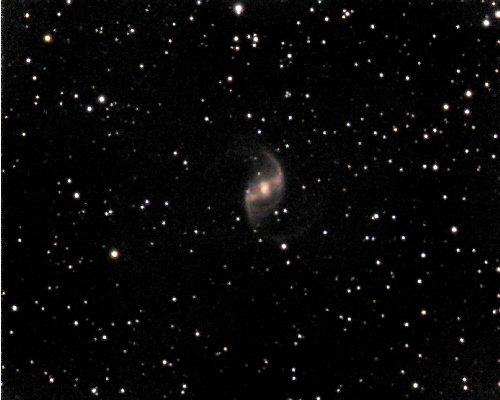
Mark Beveridge sent in six digital images. The first three are galaxies which lie in the constellation of Pegasus: NGC 7217, NGC 1530 and NGC 7318 (Stephan’s Quintet).

Stephan’s Quintet is made up of NGC 7318A and B (a pair of colliding galaxies), NGC 7319, NGC 7320, and NGC7317. Four of the five (aka Hickson Compact group 92) are physically associated and considered likely to merge over time.
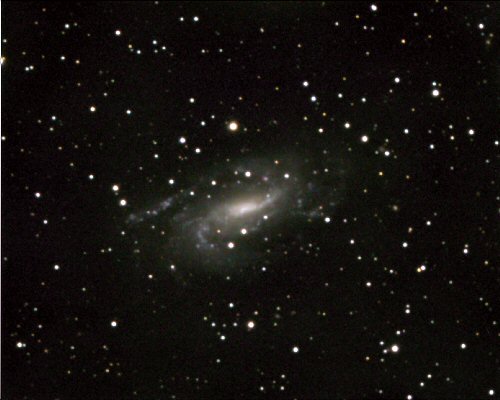
The next two galaxy images are NGC 7242 in Lacerta and NGC 925 in Triangulum:
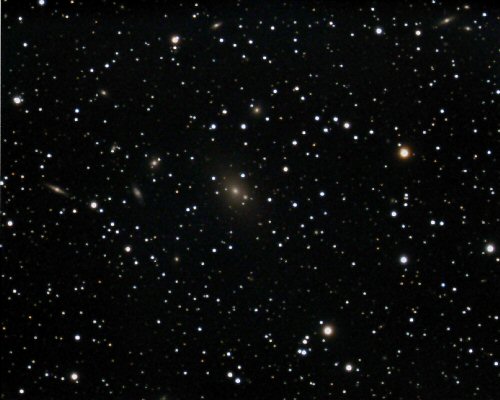
NGC 7242 is a member of a group of galaxies designated WBL 679. A number of the fainter galaxies have been captured in this image.
Mark’s sixth image is 0f emission nebula NGC 7380, the Wizard nebula, in Cepheus:
Dave Finnigan