
This month, three section members submitted a total of seven images.
Paul Brierley sent in four images, the first two taken using a ZWO SeeStar S50 smart telescope. They are NGC 4631 the Whale galaxy in the constellation of Canes Venatici and globular cluster M13 in Hercules (compare with Roger Howes’ M13 image below):


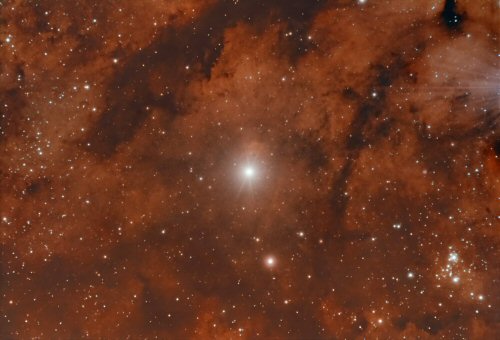
Paul used a Takahashi TSA-120 f7.5 refractor and ZWO ASI 294 MC Pro colour camera to capture images of IC 1318 the Butterfly emission nebula in Cygnus (an Optolong L-Pro filter was employed here) and galaxy cluster Abell 2151 in Hercules (an inverted i.e. “negatve” image):

Abell 2151, also known as the Hercules Cluster, containing hundreds of galaxies roughly 500 million light years from the Earth. Just seven of these galaxies are brighter than 14th magnitude.
Roger Howes, new to astrophotography, sent in the first two images taken with his ZWO SeeStar S30 smart telescope. Roger imaged globular cluster M13 in Hercules, and M51 the Whirlpool galaxy in Canes Venatici:

M13 has an apparent magnitude of 5.8 and considered to be a naked eye object with favourable condtions and good eyesight. It is about 25,000 light years from the Earth.

Steve Norrie imaged NGC 6503, a galaxy in the constellation of Draco, with a Celestron 200mm Edge HD f10.4 SCT and ZWO ASI 585 MC Pro colour camera:

NGC 6503 is classified as a field dwarf spiral galaxy. A field galaxy exists beyond the gravitational influence of any other galaxy. A dwarf spiral galaxy is characterised by a relatively small diameter (under 5 kiloparsecs) and low surface brightness.
Dave Finnigan