
May delivered a bounty of clear, pollution free skies but of course the hours of astronomical darkness dwindled rapidly as the month progressed. Six section members did well to produce twenty-five digital images and a drawing.
David Davies imaged two galaxies, NGC 2841 in the constellation of Ursa Major and M91 in Coma Berenices:


M91 is a barred spiral galaxy which is within the Virgo galaxy cluster and has been measured to be around 63 million light years from the Earth and about 100,000 light years in diameter. It has an apparent magnitude of 11.0, the faintest of the Messier catalogue objects and one of the toughest to see through the eyepiece.
David used an 8″ Richey Chretien telescope and QSI 683 camera plus red, green and blue filters from his observatory in Cambridge.
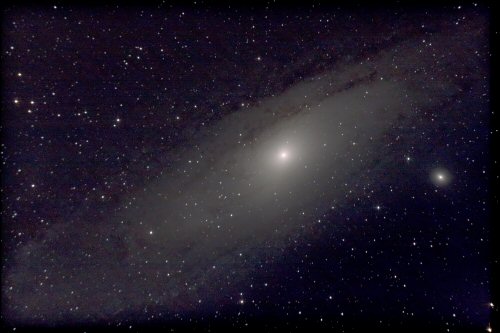
Steve Cooke, observing fron Devon, sent in seven images. The first four are galaxies – M51 (two images) the Whirlpool galaxy in the constellation of Canes Venatici, M31 in Andromeda, and M101 the Pinwheel galaxy in Ursa Major:



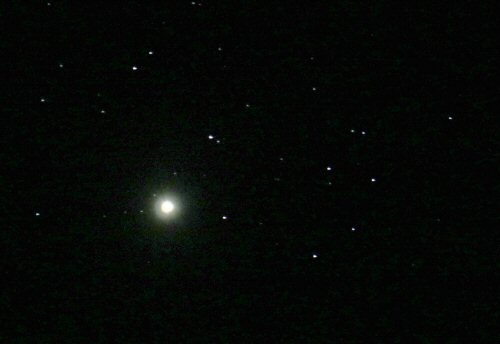
Steve also sent in images of globular cluster M3 in Canes Venatici and open clusters M45, the Pleiades (with Venus), in Taurus and M41 in Canis Major:

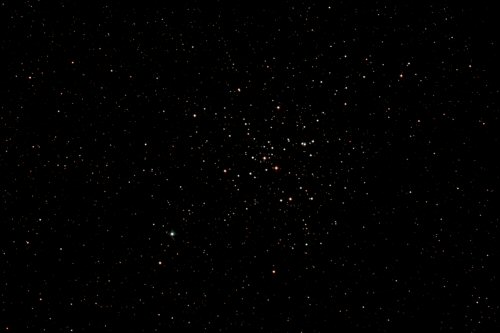
M41 is about 25 light years in diameter; at a distance of around 2,300 light years from the Earth it appears to be about the same angular diameter as the full moon, and is about four degrees south of Sirius. At an estimated age of 190 million years it contains several red giants and some white dwarfs.
Steve used a Skywatcher 200P Newtonian reflector and Canon 1000D astro modified DSLR for all but one of the images. For M45 and Venus he used a Canon EOS 80D DSLR with a 500mm f5.6 telephoto lens.
Richard Lewis imaged three galaxies. Two of them, NGC 4631 the Whale galaxy and NGC 4656/57 the Hockey Stick galaxy are in the constellation of Canes Venatici. The third, M104, is the Sombreo galaxy in Virgo:

NGC 4631 is included in Arp’s catalogue of peculiar galaxies as Arp 281, having had interactions with the dwarf elliptical galaxy NGC 4627, which is clearly visible in this image. NGC 4631 is reckoned to have also interacted with NGC 4656/57 (below) and there is a stream of hydrogen linking these two galaxies.


Richard observes from Suckley with a Takahashi FSQ 106N refractor and ZWO ASI294 colour camera (also a 1.6 x Extender Q to give f8 focal ratio).
Michael Kinns used an Orion Optics 200mm f6 Newtonian reflector at 100x from his location at Eastry to produce this drawing of galaxy NGC 4449 in the constellation of Canes Venatici. Michael reports that this galaxy looked very comet-like initially but as his eyes became more dark-adapted the rectangular shape it presents became apparent:
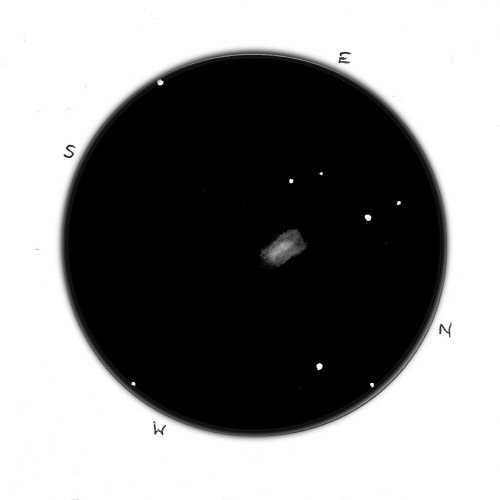
NGC 4449 is also known as Caldwell 21, and is an irregular galaxy, which might be compared to the Large Magellanic Cloud because of its general appearance. NGC 4449 is a starburst galaxy however, with twice the rate of star formation of the LMC due to interactions with neighbouring galaxies in the M94 group of galaxies to which it belongs, at about 12 million light years from the Earth.
Ian Papworth imaged seven deep sky objects. In the constellation of Cygnus open clusters NGC 6819, NGC 6866 and NGC 6834 plus NGC 6960, the Eastern Veil supernova remnant:


Ian also imaged globular clusters M56 in Lyra, M13 in Hercules and the Dumbbell planetary nebula M27 in Vulpecula:

M56 is reckoned to be 13.7 billion years old, and has a retrograde orbit around the milky way suggesting that it was captured when our galaxy consumed a dwarf galaxy in the distant past. The metallicity of the stars within M56, that is, the abundance of elements other than hydrogen and helium, is very low, about 1% of the metallicity of the Sun; these stars were formed early in the history of the universe therefore, when heavier elements had not been synthesised in appreciable amounts.


Ian uses a Skywatcher 150P Newtonian reflector and an Altair Hypercam 183C pro colour camera from his location in Bedfordshire.
Steve Norrie, observing from Fife, employed a Celestron C8 SCT and an ASI 294 colour camera to image five galaxies; M51 the Whirlpool galaxy, M106 and NGC 5033 all in the constellation of Canes Venatici, NGC 5985 in Draco and M101 the Pinwheel galaxy in Ursa Major:


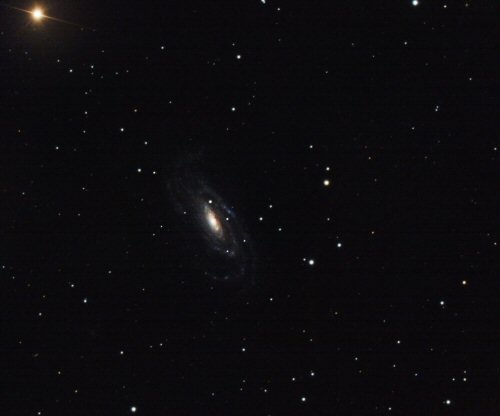
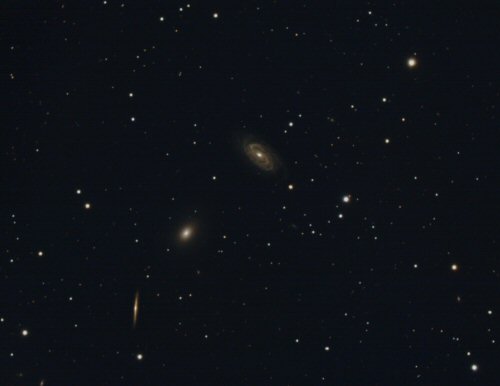
There are three galaxies in the above image, NGC 5985 is the almost face on spiral at the top, NGC 5982 is the elliptical galaxy in the middle and NGC 5981 is the edge-on spiral at the bottom. They are about 100 million light years from the Earth. NGC 5985 is a Seyfert galaxy with an active nucleus.

For the next image, galaxy NGC 4244 in Canes Venatici, Steve used an ES 127mm refractor and Atik 490 colour camera:

Dave Finnigan