
This month, five members submitted thirteen observations of deep sky objects to this section; more than in April, despite the lengthening daylight hours.
David Davies imaged two Messier catalogue galaxies, M108 in the constellation of Ursa Major and M98 in Coma Berenices (for which David also supplied an inverted version). David used an 8″ Richey Chretien telescope and a QSI 583 mono camera, plus red, green and blue filters.
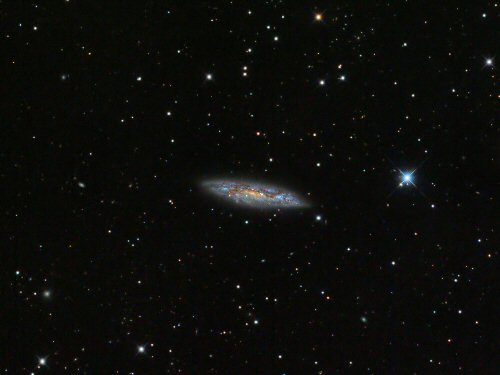

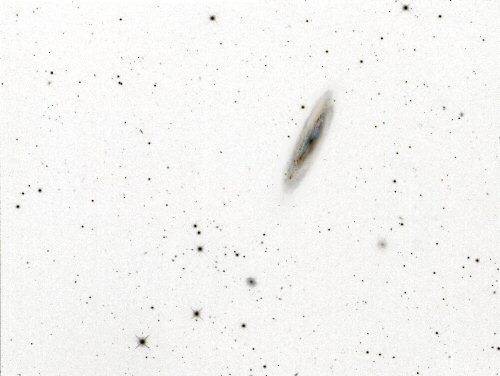
M98 is about 44 million light years from the Earth, has an active nucleus and is a member of the Virgo Cluster of galaxies. David noted that many more galaxies have been captured in this image: NGC 4186 is to the South of M98 and UGC 7223 to the SW, with three faint galaxies in the VCC catalogue also.
Geoff Elston, SPA solar section director, used an 80mm Vixen refractor and a Canon 550 DSLR to image galaxies M81 and M82 (actually a two – image composite) which lie in the constellation of Ursa Major. M81 is known as Bode’s Galaxy after the astronomer who discovered the pair in 1774, Johan Elert Bode. M82 is often called the Cigar Galaxy, and is experiencing high rates of new star formation, probably triggered by interaction with M81; it is much more luminous than our own Milky Way galaxy.

M81 is on the left in this image.
Ian Papworth sent in two images, using a Sky Watcher 150p Newtonian reflector and an Altair Hypercam 183c pro camera.
NGC 6888, known as the Crescent Nebula, is an emission nebula in the constellation of Cygnus. NGC 6960 is known as the Witches Broom, and is the Western part part of the Veil Nebula, a supernova remnant also in Cygnus. The bright star in the image is 52 Cygni which makes this object more difficult to see for visual observers.


The Veil or Cygnus Loop had a progenitor star possibly 20 times more massive than the sun. It went supernova some 8,000 years ago and now has an angular diameter of around three degrees on the night sky; about six times the width of the full moon.
Mark Beveridge submitted five images to the section, all galaxies to be found in the constellation of Coma Berenices: M63 the Sunflower Galaxy, NGC 4490 the Cocoon Galaxy, NGC 4631 the Whale Galaxy, the NGC 5350 group of galaxies and NGC 5371.

M63 has a lack of large scale spiral structure in visible light, a form described as flocculent. It has a two – arm structure when viewed in near infra red, however.
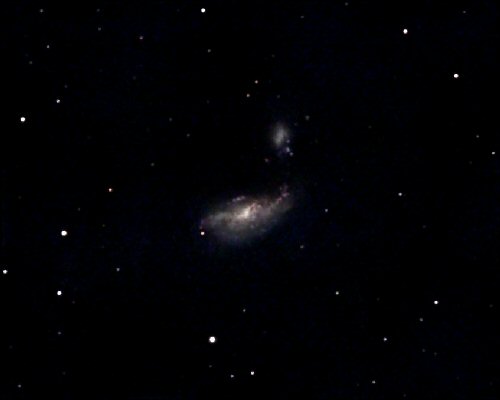
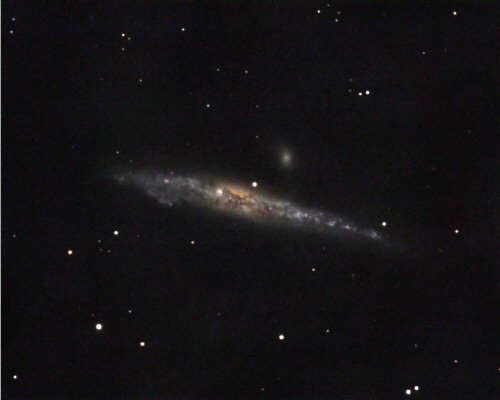
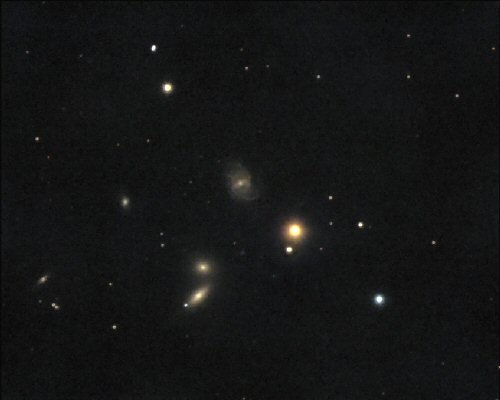
NGC 5350 is the uppermost galaxy in the above image with noticeable spiral arms; below and slightly to the left is NGC 5354, below that is NGC 5353. Off to the left of NGC 5350 is NGC 5355. The bright yellowish object to the right is a magnitude 6 foreground star, HD 121197.
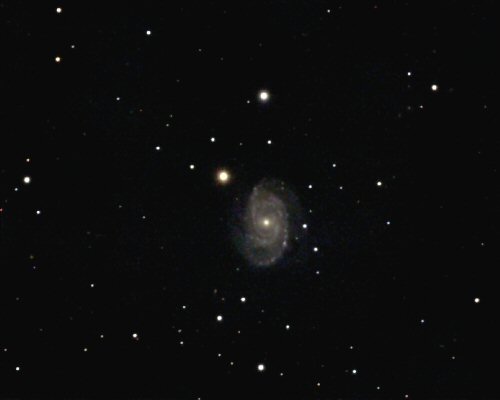
Mark used a Celestron 200mm f10.4 Edge SCT and an SXR – H814 mono camera plus red, green and blue filters.
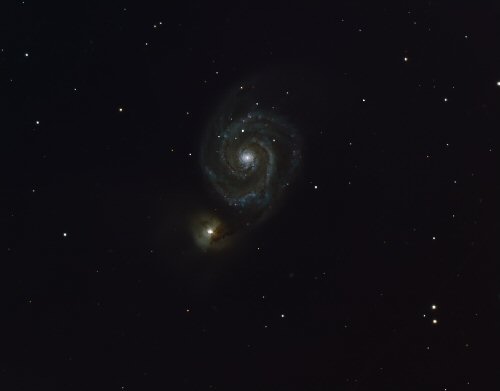
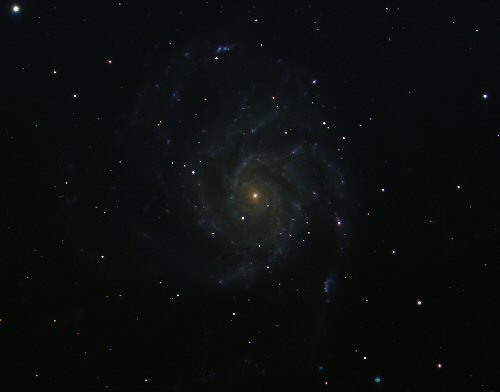
Steve Norrie imaged emission nebula Sh2 – 155, the Cave nebula in the constellation of Cepheus, and two galaxies: M51, the Whirlpool galaxy in Canes Venatici and M101, the Pinwheel galaxy in Ursa Major. Steve employed a Celestron 200mm Edge SCT with a 0.75 focal reducer and a Starlight Xpress Trius 694 mono camera plus narrow band filters for the emission nebula, red green and blue filters for the galaxies.

Sh2 – 155 was included in the Sharpless Catalogue, second edition, in 1959. It is on the edge of the Cepheus molecular cloud, and is energised by the hot, young stars in the Cepheus OB3 association; one type O star in particular (HD 217086) is thought to be triggering new star formation by compressing nebula material in its vicinity.
Dave Finnigan